
Grey Swan Capital · Article
A $6 Billion Data Center Sued Pulaski County. Here's How Arkansas Counties Can Win Instead.
Here's a plan for Arkansas counties to own a small nuclear reactor, with bitcoin miners on site, to help fund the state's Human Development Centers.
Originally on Substack: https://greyswancapital.substack.com/p/a-6-billion-data-center-sued-pulaski
The grab
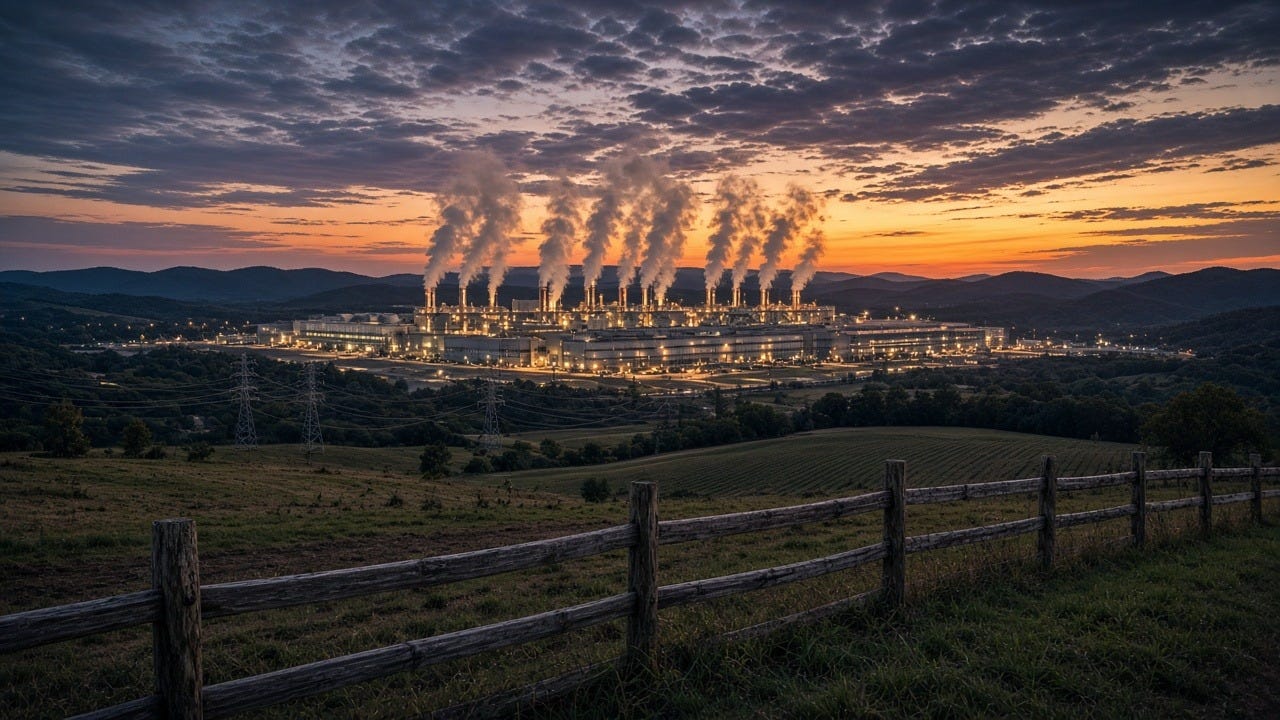
Fade in. Little Rock, Tuesday, October 27, 2026. The Pulaski County Quorum Court votes 10 to 4 to override County Judge Barry Hyde’s veto. With that, rules on AVAIO’s planned $6 billion data center near Wrightsville go into effect. Not a ban. Not a pause. Rules: a conditional-use permit; plans for the power load, the water and what happens when the place someday shuts down; noise limits; and setbacks from the neighbors.
Cut to two days later, October 29. AVAIO files suit in federal court to block the ordinance.
I’m going to be fair to both sides here. The JPs who voted for the rules are asking the questions any of us would ask about a neighbor that size: how much power, how much water, how loud, and who cleans up at the end? And a company putting up $6 billion has every right to ask a federal judge whether those rules hold up. The court will sort out the law. That’s not my fight.
Meanwhile, in Clarksville, Serverfarm plans a $6.6 billion campus powered by 40 gas turbines running around the clock. It has interim state authority to build; the final air permit is still pending.
But here’s what strikes me, watching all this like a movie with no ending yet. Everybody’s arguing about the rules for somebody else’s power plant. Hardly anybody is asking who owns it.
Right now, five companies own 21 of the 25 biggest AI data centers in America: Google, Amazon, Microsoft, Meta and SpaceXAI. They’re hunting for power like a teenager hunting for a phone charger, and they have the money to plug in wherever they like. Power demand is growing, AI is growing, and the government keeps printing money. None of that is a black swan. All three are grey swans: 80% likely to 100% inevitable, and almost nobody is planning for them.
So here’s a question I can’t shake. What if one of those power plants belonged to us? Not to a trillion-dollar company, but to an Arkansas county and its Human Development Centers, the state homes where people like my son Gentry live. Picture one small nuclear reactor. Picture bitcoin miners on site that soak up the power and switch off in seconds when the neighbors need it. Picture a federal loan, paid back. I’ve looked for anyone writing about this. I haven’t found a soul. So let me walk you through it, the hopeful parts and the hard parts, and you tell me why we wouldn’t at least test it.
Scene 1: The meeting room, Faulkner County, 7:04 p.m.
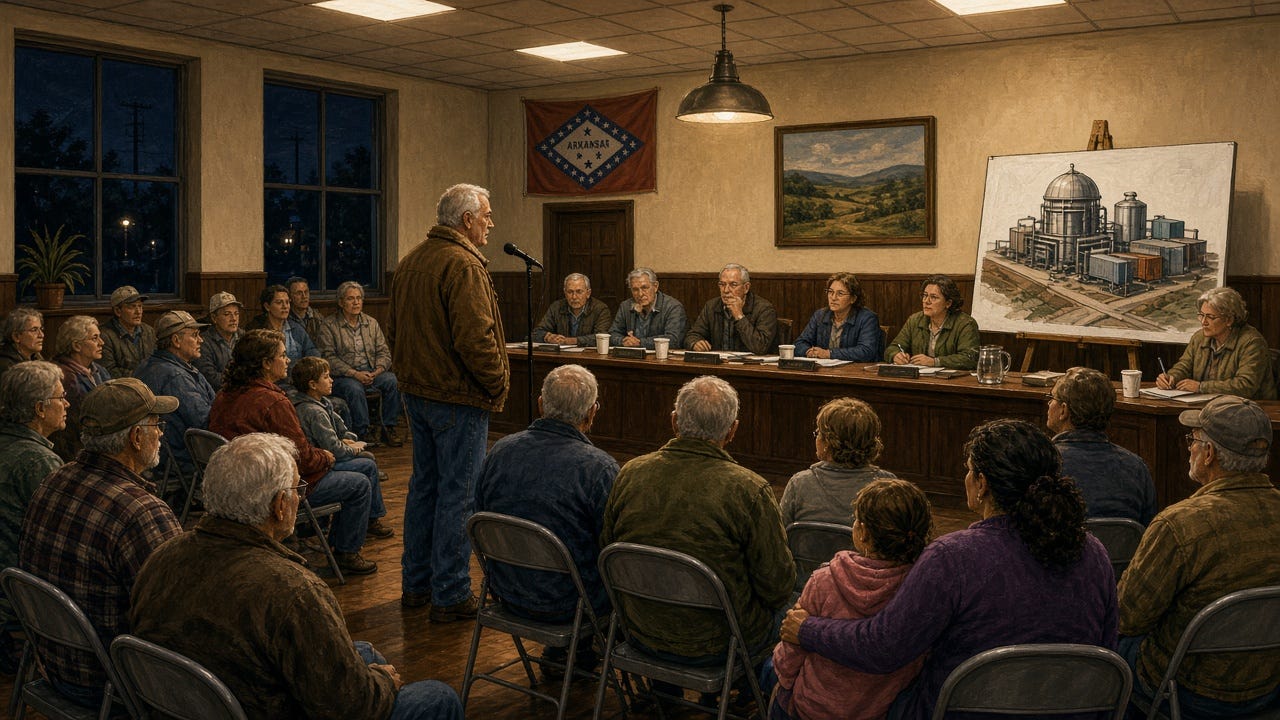
Fade in. A county meeting room that smells like burnt coffee and floor wax. Folding chairs. A flag in the corner. The quorum court is working through the agenda the way quorum courts do: a culvert, a road grader, somebody’s fence line.
Then comes the item everybody showed up for. Somebody reads a news story out loud. Another county has paused data centers. The one in Clarksville is putting in 40 gas turbines. A woman in the third row who cares for her grown daughter says what everybody’s thinking: “They’re coming whether we want them or not, aren’t they?”
And then an older fellow in a feed-store jacket stands up. He isn’t angry. He’s just curious, which in a county meeting is much more dangerous. “If somebody’s going to own a power plant around here,” he says, “why not us?”
Nobody has an answer. The county judge looks at the ceiling as if the ceiling might have one. That’s where this post starts.
Scene 2: Five companies and a map
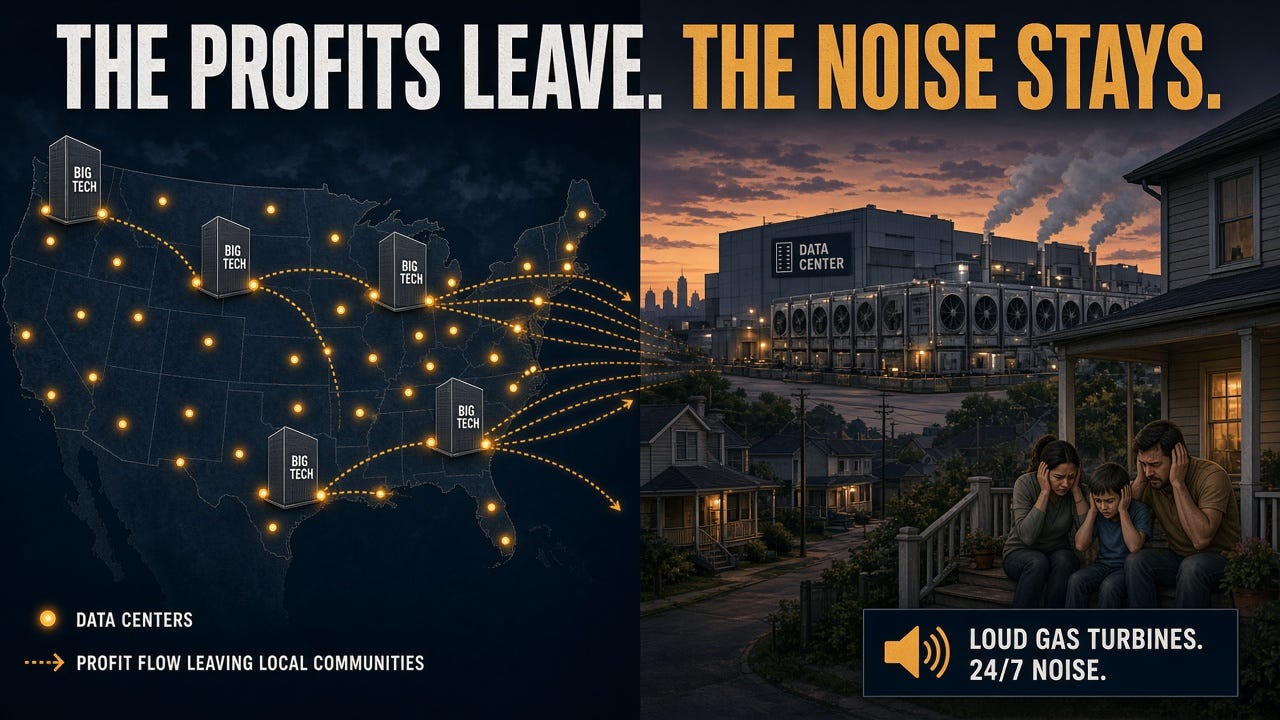
Cut to a map of the country with the 25 biggest AI data centers lit up. According to Epoch AI’s data, Google owns 8, Amazon 4, Microsoft 4, Meta 3 and SpaceXAI 2. That’s 21 of 25. I don’t think that’s evil. It’s what happens when one campus can cost $35 billion or more. Only the giants can write that check, and they’re the ones whose products need the computing.
But look at what the host towns get. Conway’s Project Stratus, about $1 billion on up to 762 acres, comes with a 65% property tax abatement over 30 years. Clarksville gets a similar deal, plus 40 gas turbines. Nic Carter, an investor who studied the noise at those 25 sites, found that most had no real complaints. The ones that did were huge, noisy and close to homes. SpaceXAI’s Colossus 2 went from 3 mobile turbines to 69, about 400 meters from people’s houses. An unsilenced turbine of that kind can top 100 decibels. Think of a rock concert that never goes home.
The profits go to shareholders somewhere else. The noise stays local. I’m not mad about it. I’m just asking whether there’s a second way to do this.
Scene 3: Gentry’s house
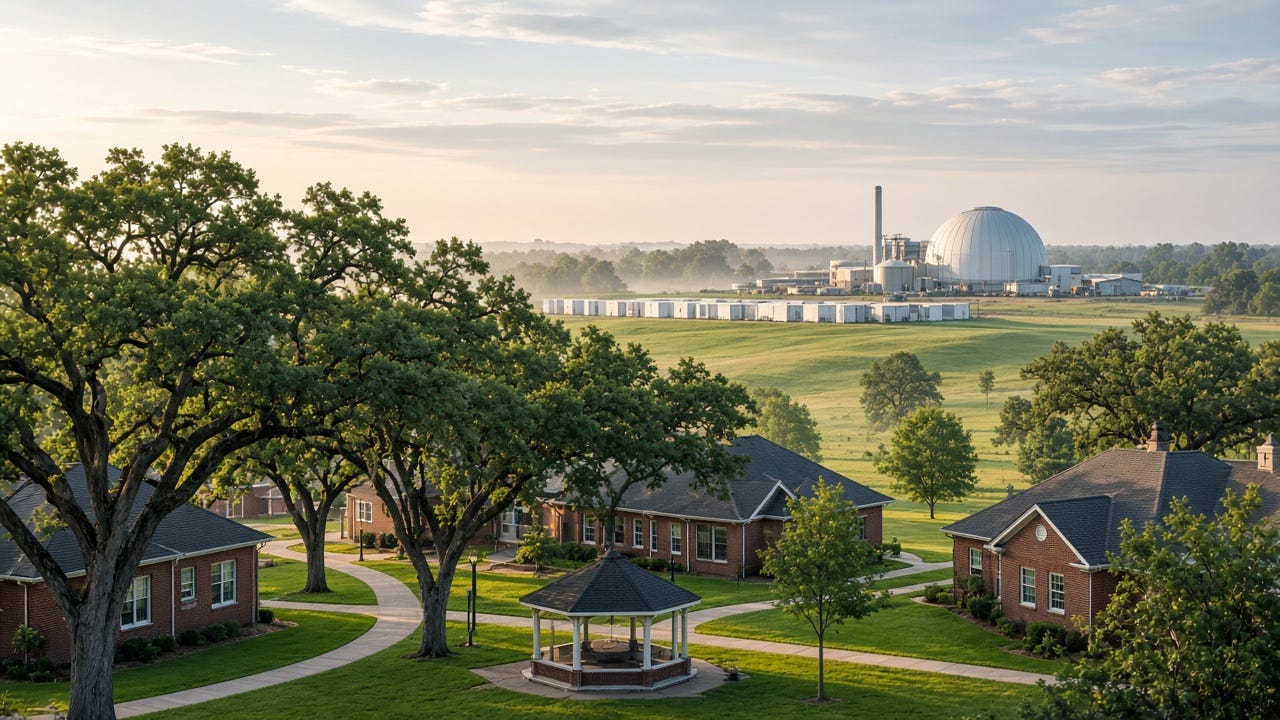
Cut to the Conway Human Development Center. Brick cottages, oak trees, a walking path. My son Gentry lives here. If you’ve never been to an HDC, picture a small town where every resident needs help with daily life, and the people who give that help work long, hard, mostly unsung shifts. They know Gentry’s favorite song. They know when he’s having a bad day before he does.
Arkansas has five of these centers: Conway, Arkadelphia, Jonesboro, Booneville and Warren. As of March 30, 2026, they served 819 residents. The state’s whole Developmental Disabilities division, which covers the HDCs plus community programs, has a budget of about $220 million for 2026, mostly Medicaid and state general revenue.
Here’s what I’ve seen as a dad: the HDCs have gone about 11 years without new funding. That’s my count, from years of watching budgets and talking with staff, so take it as one father’s view, not an official figure. [VERIFY: Steve to confirm wording and timeframe] The buildings get older. The caregivers get stretched. And every year the conversation is about what to cut, not what to build.
And this isn’t just an Arkansas story. Every state has residents with special needs and the caregivers who serve them. So whatever we work out here, any county in America can copy.
Truly I tell you, whatever you did for one of the least of these brothers and sisters of mine, you did for me.
Jesus
The world may call Gentry and his neighbors the least of these. Jesus says how we treat them is how we treat him.
The plan, in plain English
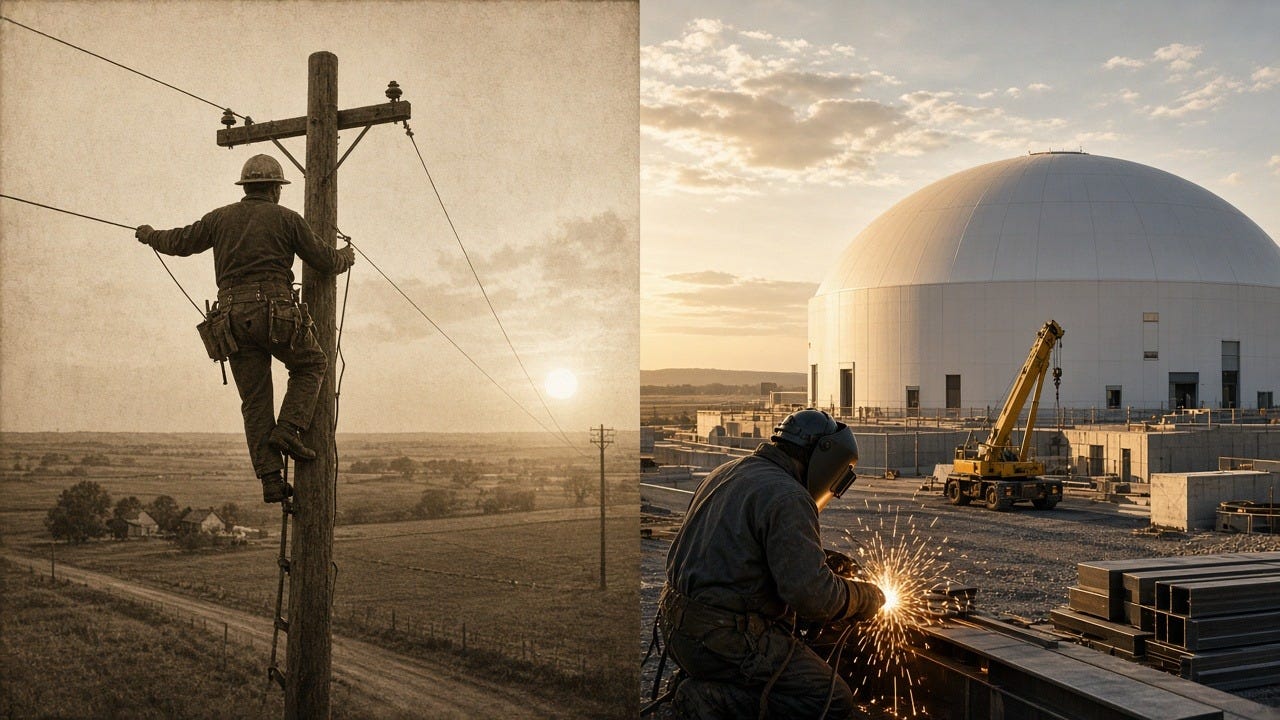
Here’s Steve’s plan in one breath. The federal government lends money it creates to a new public authority set up for Arkansas’s HDCs. That loan builds one small modular reactor, an SMR, with a bitcoin mining facility on the same site. Part of the loan gives the HDCs funding right away, during construction, instead of making them wait years for the first block of bitcoin. The reactor runs around the clock. The miners turn its power into bitcoin. The loan gets repaid, maybe in bitcoin, maybe with a share of revenue on top. After the loan is paid off, the HDCs fund themselves.
That sounds wild until you remember we’ve done most of it before. In 1936, the Rural Electrification Act lent federal money to locally owned co-ops that strung power lines across farm country, and the co-ops paid it back. That program still exists today as USDA’s Rural Utilities Service. TVA was a federally created public power owner. The only truly new part is the bitcoin, and I’ll be honest about that part below.
Why an SMR? One 300-megawatt reactor like GE Hitachi’s BWRX-300 does the work of roughly ten trailer-sized gas turbines. It holds 18 to 24 months of fuel on site, so no pipeline, no fuel trucks rolling down county roads, and no gas-price swings to blow up the budget. It runs flat, all day and all night, at the same steady output. It’s far quieter than a field of turbines. It has no operating carbon emissions, so every megawatt it makes is clean power the county can sell. The US nuclear fleet ran at a 91% capacity factor in 2025. Arkansas already has a nuclear workforce: Arkansas Nuclear One near Russellville supports more than 1,000 jobs. And in 2026 the state’s own Act 707 study called new nuclear “feasible and advisable.”
What does a county get? That same study estimates about 237 permanent jobs per SMR. For a county like Yell, population about 20,000, that would make it one of the biggest employers around. Then add the construction years, the training programs, the visitors and the vendors.
Direction—not intention—determines our destination.
Andy Stanley, The Principle of the Path (Thomas Nelson, 2008)
Arkansas has had good intentions for its HDCs for more than a decade. What it hasn’t had is a new direction. This is one.
Scene 4: The storm night
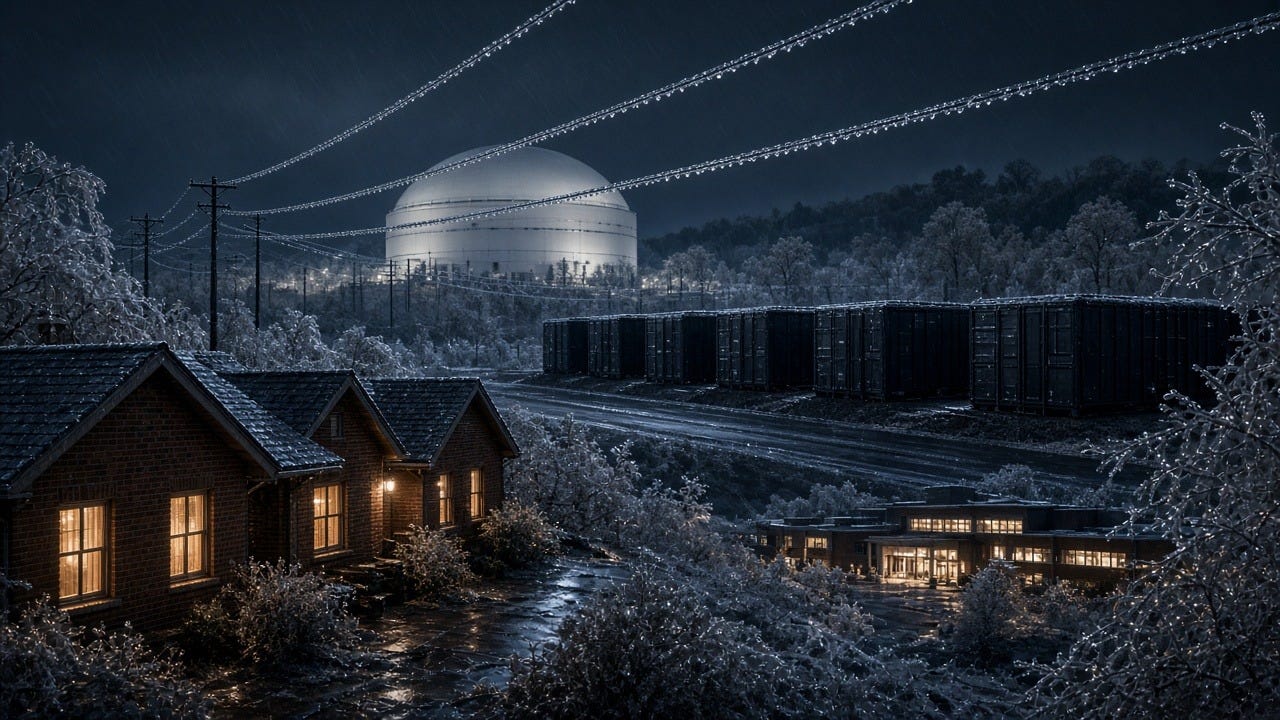
Cut to a January night a few years from now. Ice on the power lines across three counties. Wind chill in the single digits. In the HDC cottages, the night staff are checking on residents who can’t tell anyone they’re cold.
Out at the reactor site, a control room operator gets the call from the grid: demand is spiking, and we need everything you’ve got. She clicks a button. In seconds the hum of 75,000 miners drops to nothing. The reactor never blinks. It just keeps running, as reactors like to do, and the power that was mining bitcoin a minute ago heads down the lines to the hospital, the nursing home, the farmhouse with the space heater, and Gentry’s cottage.
This isn’t science fiction. In August 2023, during a Texas heat wave, Riot Platforms cut more than 95% of its mining load at peak demand. It sent more than 84,000 megawatt-hours back to the Texas market and earned $31.7 million in power and demand-response credits that month. That was more than the $8.6 million of bitcoin it sold that month.
To me, this is a proper job for government: keeping the lights on for the people least able to cope when they go out. A power plant whose biggest customer agrees to step aside in an emergency is a backup generator for a whole region. One honest caveat: Arkansas isn’t on the Texas grid. Most of the state is in the MISO and SPP markets, where demand-response rules are different [VERIFY], and it would need a signed agreement with Entergy or AECC.
Scene 5: The break room with a window
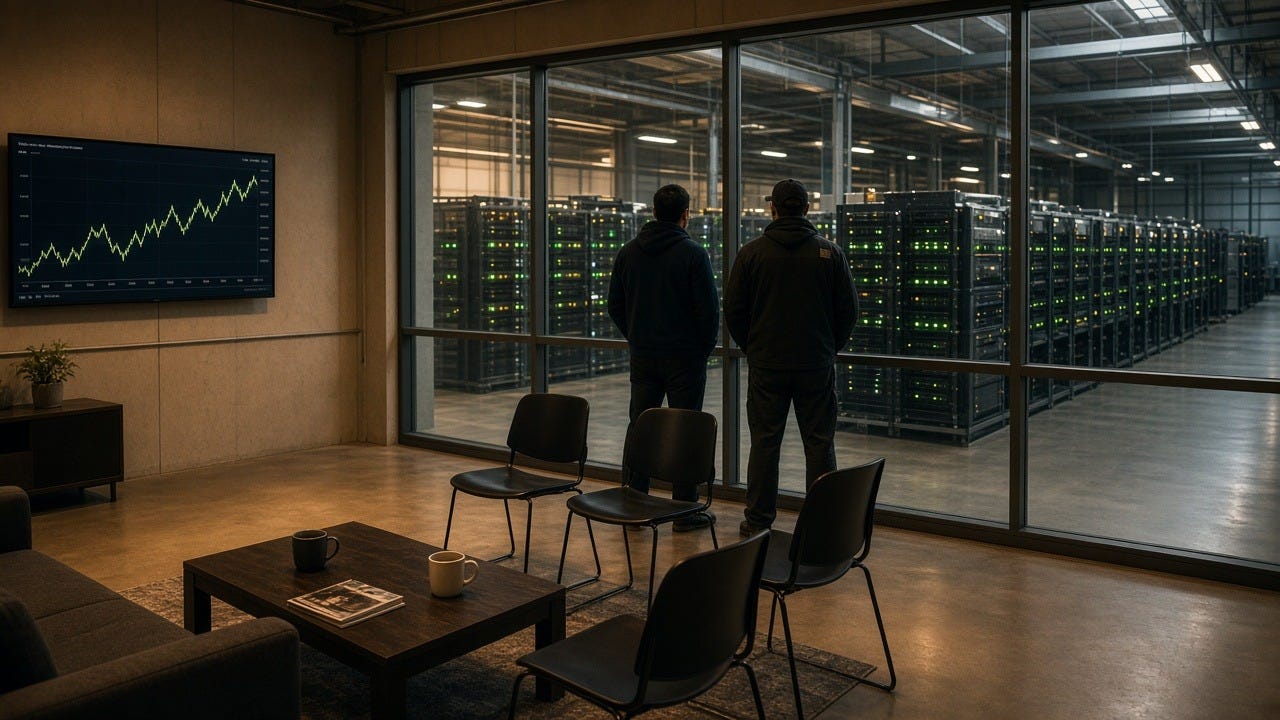
Cut to Bowling Green, Kentucky. Mike Coffey runs BlueCotton, a custom screen printing company with about 130 people. In 2022 he gave out a $30,000 cash bonus, and it was gone and forgotten almost overnight. So he tried something stranger. He put bitcoin miners in the warehouse, out where employees could see and hear them, and mined bitcoin for his team. To collect, they have to stay five years. He added weekly financial literacy classes. There’s a display showing each person’s balance.
He told Natalie Brunell on her Coin Stories podcast (March 24, 2026) what it did. These quotes come from episode notes and still need to be checked against the audio:
We’ve got them sitting out there where people can see them and hear them... that’s your money right there working.
Mike Coffey, Coin Stories with Natalie Brunell, Mar 24, 2026, about 03:35 [VERIFY against audio]
Our turnover in 2022 was 108%. ... Last year, Natalie, our turnover was 17%.
Mike Coffey, Coin Stories with Natalie Brunell, Mar 24, 2026, about 08:27 [VERIFY against audio]
Now picture that at an HDC. Turnover is the quiet enemy of good care. Every time a trained caregiver leaves, someone like Gentry loses a person who knows him. What if part of the on-site mining went into a vesting account for HDC caregivers and plant workers? Stay, learn, build something. It’s an employee benefit you can actually hear humming.
Then make it a classroom. Put a glass wall onto the miners with a live screen showing power made, bitcoin mined and power sent to the grid during storms. Bring the school buses. Partner with UCA in Conway, Arkansas Tech near the Russellville plant, and the community colleges on nuclear technician and electrician programs. (None of them has been asked yet.) A kid from Faulkner County could learn energy, money and scarcity on one field trip.
Pursue what is meaningful (not what is expedient).
Jordan B. Peterson, 12 Rules for Life: An Antidote to Chaos (Random House Canada, 2018), title of Rule 7
Expedient would be to take the abatement deal and the turbines. Meaningful would be to build something our grandkids own.
The honest numbers

Now for the part where I put my glasses on. I promised process, not a verdict, so here’s the math, with the help of a spreadsheet that doesn’t care about my feelings.
Assumptions from the research brief: one 300 MW reactor powering about 74,800 Antminer S21 XP miners. That’s about 20.2 EH/s, or 1.94% of the bitcoin network as of November 2, 2026. At today’s network level, that mines about 8.7 bitcoin a day, roughly 3,180 a year before the 2028 halving. Total project cost, reactor plus miners, is modeled two ways: about $2.0 billion, which is my target for one SMR once builds go repeatable and prices keep coming down, and a cautious $2.7 billion in case costs run over. I’ll be straight: today’s first-of-a-kind estimates are higher. OPG budgets C$6.1 billion (about US$4.3 billion) for the first Darlington unit, and TVA’s planning data put its first Clinch River unit near $5.4 billion, falling to about $3.7 billion for later units. Operating cost is about $73 million a year. The loan is 30 years at 4%. (The $2.0 billion target, the $2.7 billion case and the operating cost are my estimates, not quotes.)
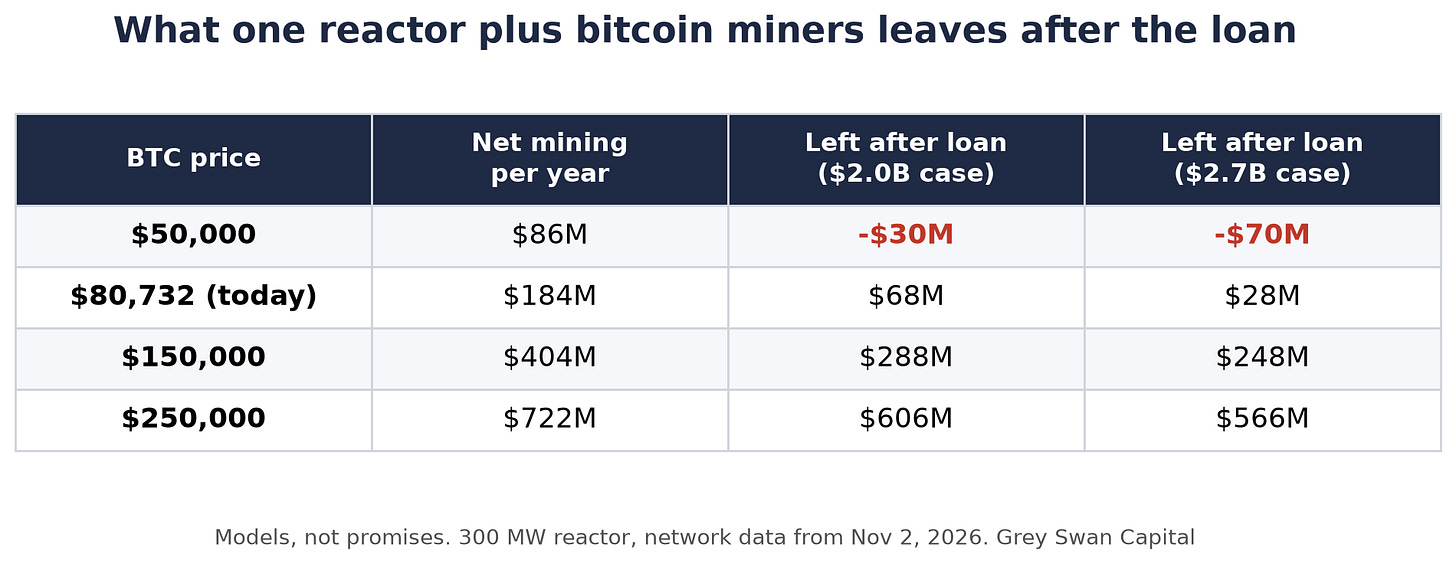
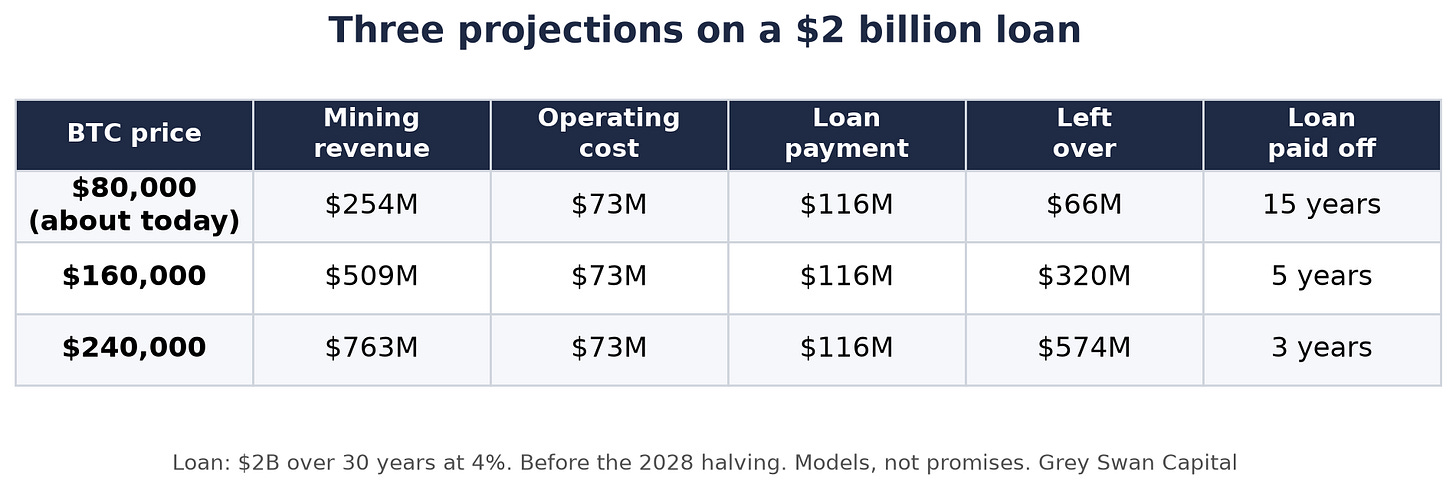
Here’s what the table says when nobody’s trying to sell you anything. At today’s bitcoin price, both cases cover the loan, and at $2 billion there’s about $68 million a year left over. To fund something like the full $220 million DDS budget while the loan is being repaid, bitcoin needs to be around $130,000. And as reactor prices come down, that bar drops. And every four years the halving cuts the new bitcoin in half, so the price has to roughly double each cycle just to stay even. Miners also wear out about every four years.
If you skipped the miners and sold the power to the grid at $50 a megawatt-hour, you’d net about $49 million a year. At $2 billion, that’s roughly a 40-year payback. So the honest bottom line is this: the reactor drives the economics, not the miners. Mining is the steady first customer that makes a reactor buildable before the grid needs all of its power. When the coal plants at White Bluff (2028) and Independence (2030) close, and Entergy’s projected 35% demand growth arrives, the grid becomes the next customer.
Plain truth
This pencils out if reactor costs stay at $2 billion or less and bitcoin keeps rising faster than the halvings. If not, it doesn’t. That’s exactly why it should be a test, not a bet-the-state program.
How much bitcoin one SMR mines
Live check on November 2, 2026 (mempool.space): network hashrate about 1,043 EH/s, difficulty about 148.4 trillion, block reward 3.125 BTC since the 2024 halving, about 144 blocks a day. The post’s 300 MW reactor runs about 74,800 S21 XP miners at roughly 13.5 J/TH (better than the 17-20 J/TH of most fleets), about 20.2 EH/s, or 1.94% of the network.
That works out to about 8.7 bitcoin a day, or about 3,180 bitcoin a year, before transaction fees. Assumptions: all 300 MW goes to mining, the miners run 24/7 except for storm curtailment, and the network stays where it is today. The 2028 halving cuts that to about 1,590 a year, and a growing network shrinks our share over time. [VERIFY: rerun before publishing]
Three projections on a $2B loan
BTC priceMining revenueOperating costLoan paymentLeft overPayoff$80,000 (about today)$254M$73M$116M$66M15 years$160,000$509M$73M$116M$320M5 years$240,000$763M$73M$116M$574M3 years
The loan payment is $2 billion over 30 years at 4%. Left over is what remains after operating cost and the loan payment. Payoff is how fast the loan clears if everything after operating cost goes to the loan, before the 2028 halving. In my view, doubling today’s price to $160,000 is very conservative.
For the HDCs: at $80,000 the leftover covers about 30% of the $220 million DDS budget. At $160,000 it covers the whole budget with about $100 million to spare. At $240,000 it covers it more than twice over. These are models, not promises, and the halving and network growth will pull them down unless the price rises to match.
Why owning power matters most
Here’s the bigger point. Owning power may be the most important asset a county can own. Whoever owns the power decides who comes, who stays, what it costs and who profits. Rent it, and someone else makes those calls. Own it, and the county does.
This is how you plan for the future and make that plan pay off today: jobs during construction, HDC funding caught up right away, power to sell, and a backup generator for the whole region when a storm hits. Not a bet on someday. A plan that works now and keeps working.
The hurdles
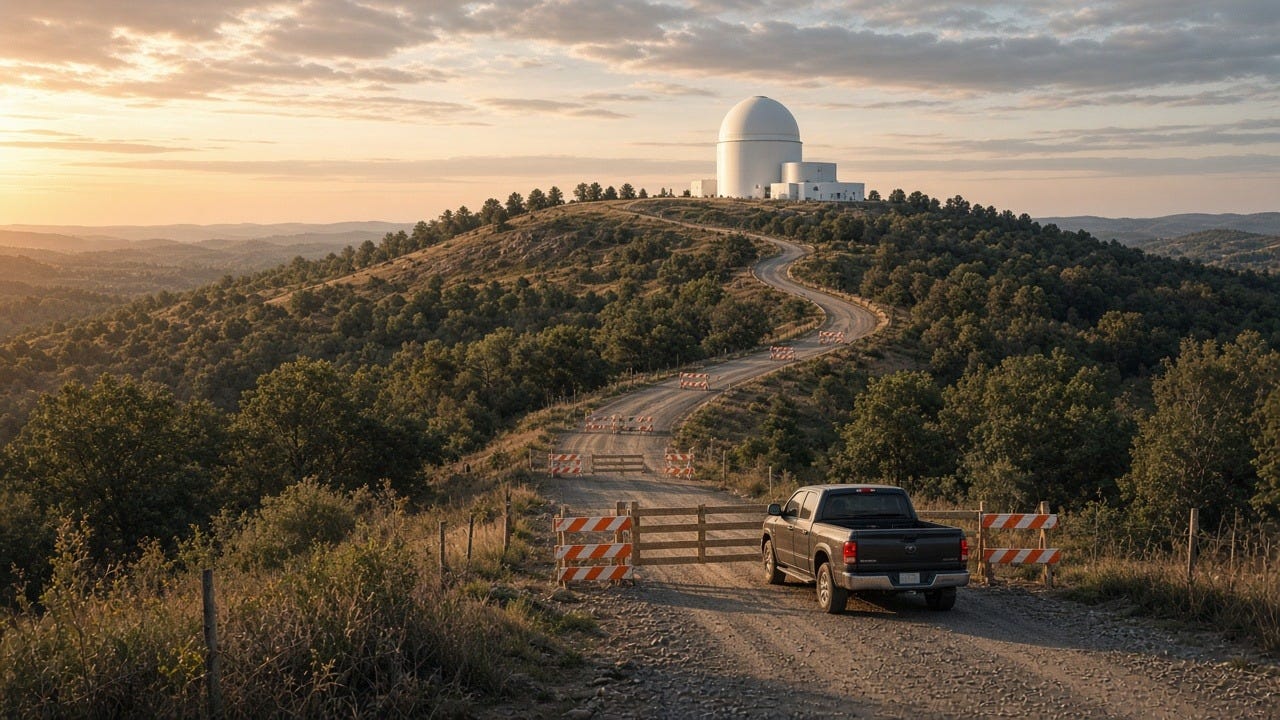
I’d be a poor apologist if I only made the case for one side. Here’s what stands in the way:
The license. An HDC can’t run a reactor. The NRC licensee has to be qualified, so an operator partner like Entergy, AECC, a TVA-style operator or a vendor would hold the license and run the plant.
Who owns it. DHS’s mission is care, not power. It would take a new public authority, created by the legislature, holding the asset for the HDCs.
Repaying in bitcoin. I found no precedent. Federal loans expect dollars, so this likely needs an act of Congress or explicit pilot authority. [VERIFY: legal read]
Medicaid. New HDC revenue could raise questions about state matching funds. [VERIFY: needs a Medicaid finance review]
Volatility. Gentry can’t depend on income that can drop 50%. It would need a reserve fund and minimum payments in dollars.
Time and cost. Realistically five or more years to power, and first SMRs have run over budget (Darlington is C$20.9 billion for four units).
Politics. Four Arkansas jurisdictions paused data centers or crypto mines in 2026. Openness from day one is the only cure. Site the plant away from the cottages.
Some things are in our favor. Act 851 of 2023 limits local restrictions on bitcoin mining. Executive Order 14300 set a goal of 400 gigawatts of US nuclear by 2050 and told the NRC to make licensing decisions within 18 months. TVA’s Clinch River BWRX-300 got its construction permit on September 28, 2026. The road is being paved while we talk.
Printing dollars to build something you can’t print

Here’s the bridge to my last post on money printing. The government is going to keep creating dollars. That’s a grey swan: close to certain, and mostly unplanned for. The usual question is how to protect yourself. Here’s a different one: what if some of those new dollars built a real, productive asset owned by the people who need it most, one that produces something nobody can print?
I’ll name the tension straight. Critics will say it’s inflationary spending with crypto risk attached. Supporters will say it turns dollars that lose value into hard collateral and a working power plant. Both have a point. And by the way, the Strategic Bitcoin Reserve holds only forfeited coins and has no taxpayer money to redirect, so this would need new lending authority from Congress. Bitcoin paid back to Treasury could go into that reserve, if Congress or Treasury allowed it.
So here’s my proposal, and I want to be clear it’s a proposal, not something on the books. Counties should own their own power. Let the federal government create and lend a county $2 billion to start construction, or fund it in phases as each piece gets built. In today’s environment, $2 billion is about one second of money printing. The county pays it back with bitcoin mining and hard assets, not with tax hikes. And as a reward for thinking innovatively and bringing the county a solution, the HDCs get their back funding caught up right away, not after the first block is mined.
Look at who wins. The HDCs get caught up and then fund themselves. Conway’s universities get a nuclear and energy classroom in their backyard. Small businesses get construction contracts, steady customers and power that doesn’t swing with gas prices. The county gets jobs, a tax base and clean power it can sell. Nobody has to lose for this to work. Grey Swan can help any county become an economic powerhouse this way, and Arkansas is where we’d like to start.
That could be changing. On October 28, Bitcoin Magazine reported that Senator Bill Hagerty said growing the reserve beyond its current 200,000 BTC (Bitcoin Magazine’s figure) “could come very soon,” once crypto market structure legislation gets done. That bill hasn’t passed, so nothing has changed yet. But if Congress does start adding to the reserve, a federal loan repaid partly in bitcoin stops sounding so far-fetched. Whether a federal loan can legally be repaid in bitcoin is still an open question.
The 11-step launch plan
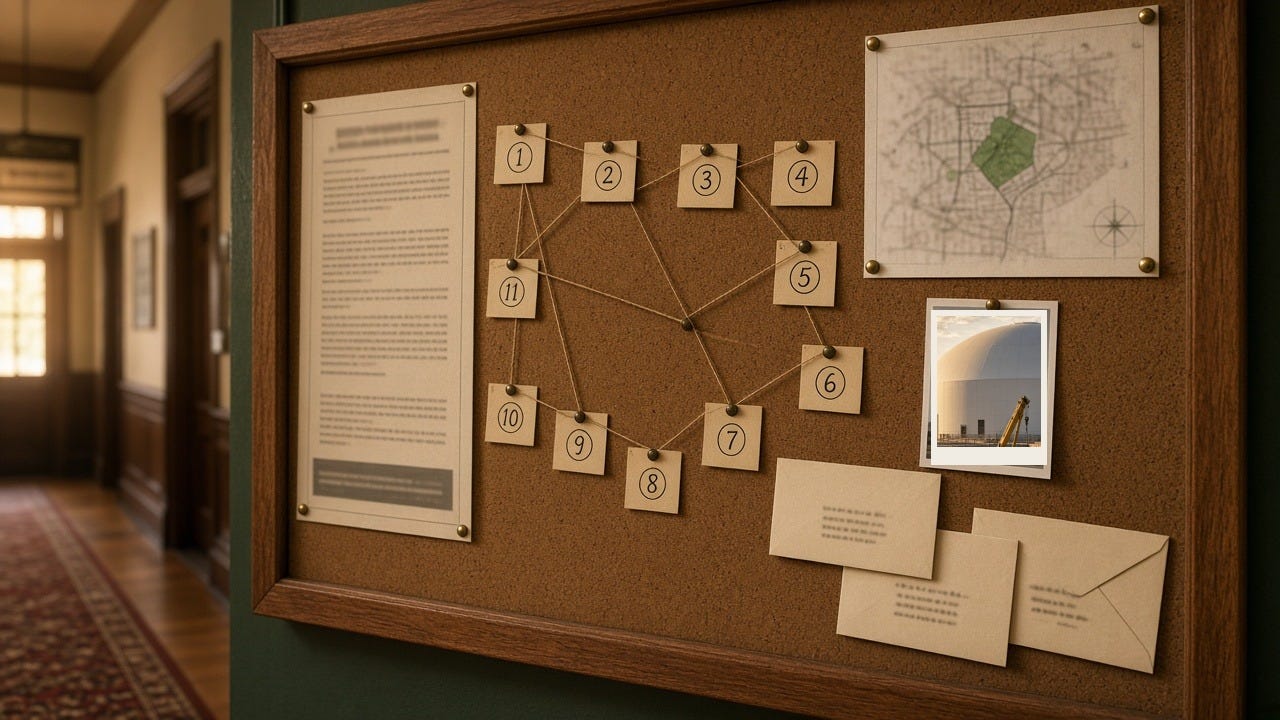
Call a public meeting
County judge and quorum court, open session. Invite HDC families, caregivers, Arkansas Tech, Entergy and AECC. Publish everything up front.
Pass a resolution of interest
Name the SMR + mining + HDC pilot and volunteer as a willing county under the Act 707 study. Send it to the Joint Committee on Energy.
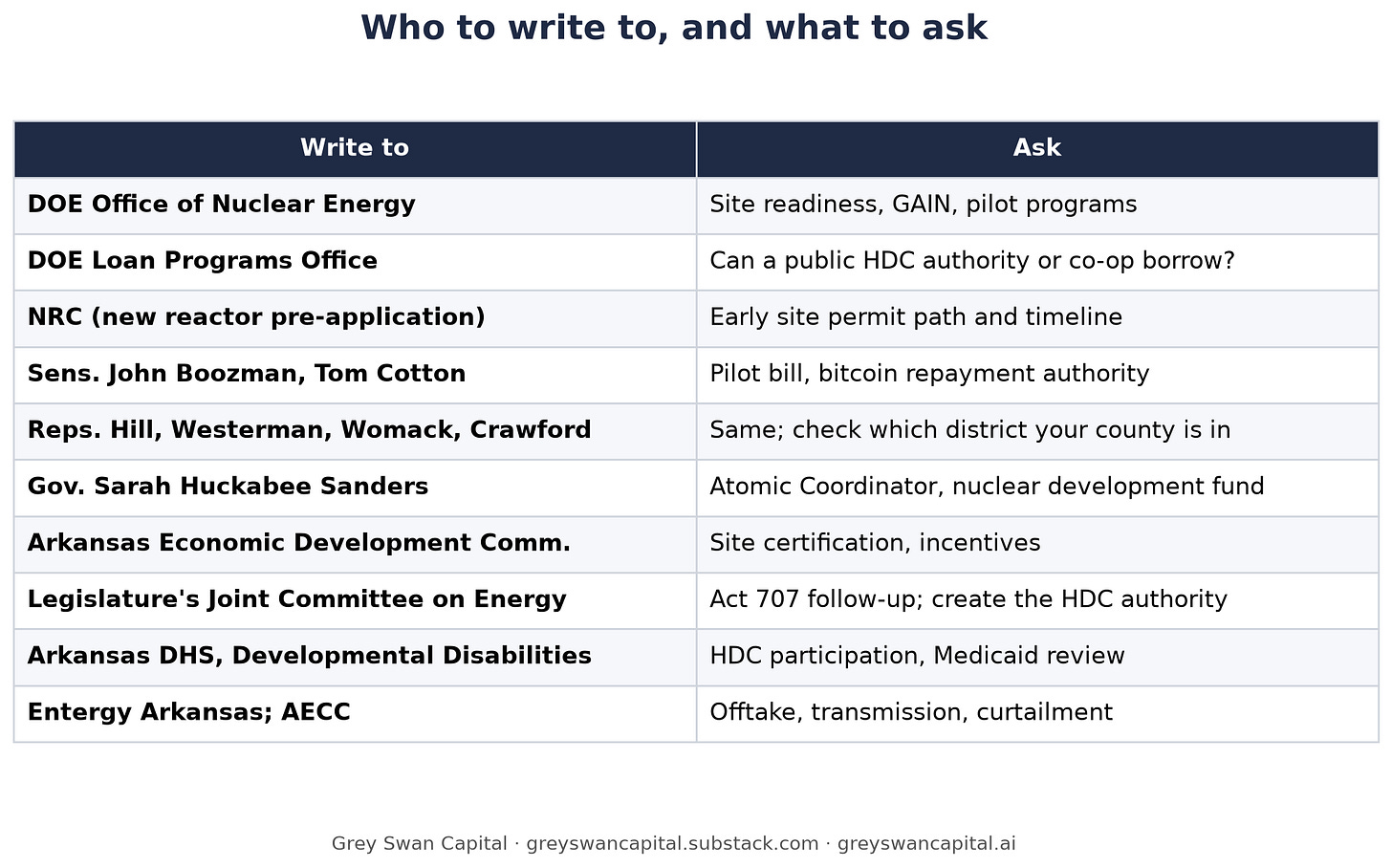
Write the letters
See the list below.
Secure a site
Screen for transmission, water, seismic risk and flooding using the Act 707 criteria, away from HDC campuses. Contacts: AEDC site selection, Entergy or AECC transmission planning.
Choose an operator partner and design
A utility or TVA-style operator holds the NRC license; the public HDC authority owns the asset. Designs: GE Vernova Hitachi BWRX-300, NuScale, X-energy.
Apply for study money
A GAIN voucher through Idaho National Laboratory (20% cost share) for siting and feasibility studies.
Seek the federal loan and pilot authority
Apply to the DOE Loan Programs Office, and ask our delegation for a pilot bill allowing bitcoin repayment and early HDC funding inside the loan.
Licensing
NRC early site permit, then a construction permit (18-month review target under EO 14300). The state activates its Atomic Coordinator post.
Build
About 3–5 years of construction (estimate). Start the workforce pipeline with community colleges, UCA and Arkansas Tech.
Start mining and sign a grid agreement
Install miners, set up the caregiver mining benefit, and sign a curtailment agreement with Entergy or AECC and MISO or SPP.
Repay and report
Send a set share of mined bitcoin or revenue to Treasury on schedule. Publish monthly production, curtailment and HDC funding reports.
If you talk about it, it’s a dream. If you envision it, it’s possible. If you schedule it, it’s real.
Tony Robbins, ‘19 time management quotes,’ tonyrobbins.com
Step one is putting a meeting on the calendar. That’s the scheduling part.
Scene 6: Back in the meeting room
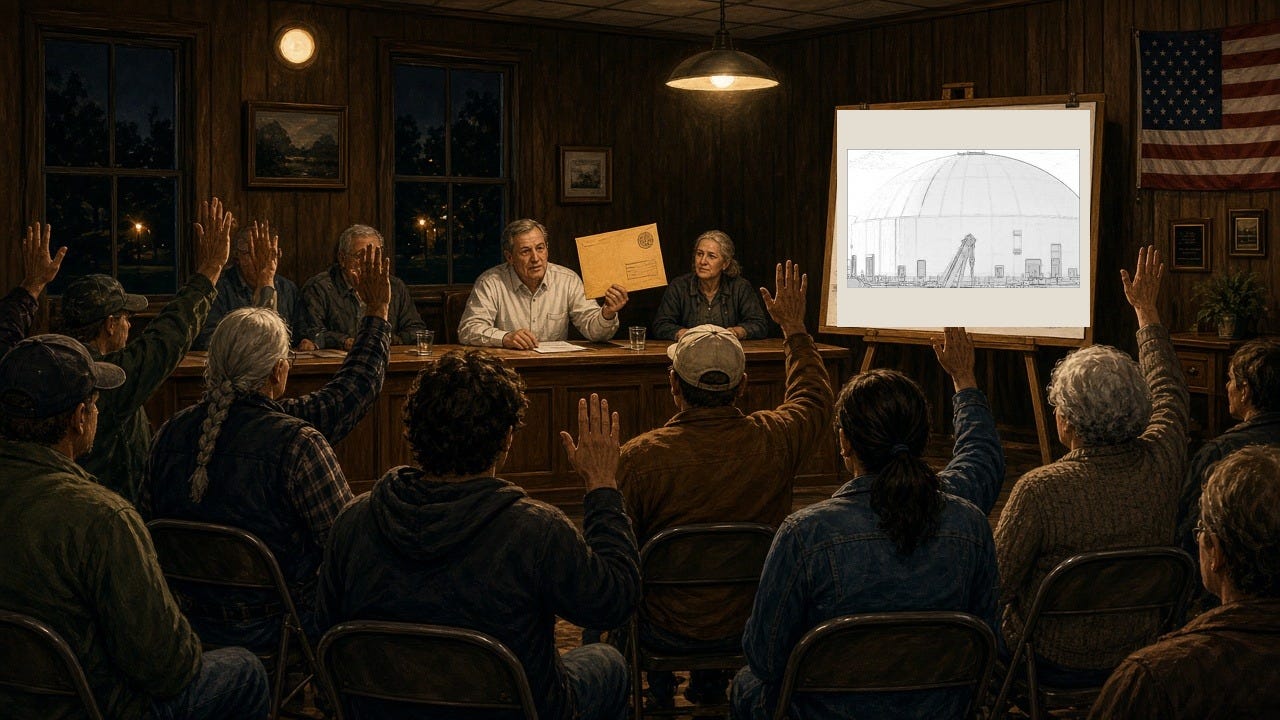
Back to the folding chairs. The older fellow is still standing. The woman in the third row has her hand up now. “If this were done,” she asks, “would my daughter’s caregivers get paid better?” Somebody from the plant crew in the back says, “Would my kid get to train for one of those 237 jobs?” The county judge finally stops looking at the ceiling. “I don’t know,” he says. “But I guess we could write a letter and find out.”
That’s how big things start in small places. Not with a verdict. With a question and a stamp.
I’ve searched and I can’t find anyone making this case: an SMR owned for special needs residents, with miners that pay the loan back and step aside when a storm hits. Maybe there’s a reason. Maybe the numbers or the lawyers kill it. But Arkansas has the nuclear workforce, the state study, a mining law and five HDCs that have waited long enough. So why would we not at least test it here? You can copy us, but we’re first.
Teaching Outline (Summary)
Five companies (Google, Amazon, Microsoft, Meta, SpaceXAI) own 21 of the 25 largest US AI data centers; host towns get abatements and noise, not ownership.
The plan: a federal loan to a public authority for Arkansas’s HDCs builds one SMR with on-site bitcoin mining, with HDC funding starting during construction.
Precedent: the 1936 Rural Electrification Act lent federal money to local co-ops, and they paid it back.
Benefits: about 237 permanent jobs per SMR, caregiver retention through a mining benefit, education partnerships, and backup power when miners shut off in seconds.
The honest numbers: the reactor’s cost drives the economics; at $2 billion or less per SMR, today’s bitcoin price covers the loan with money left over.
Nuclear positives: 1-2 years of fuel on site, no fuel trucks, no gas-price swings, steady output, far less noise and clean power to sell.
The hurdles: an NRC-licensed operator partner, a new public authority, bitcoin repayment authority from Congress, and Medicaid questions.
The launch plan starts with one step any county can take: call a public meeting.
1.If a power plant is coming to your area anyway, who should own it, and why?
2.What would it take for you to trust a bitcoin-funded plan for vulnerable residents?
3.Which county in your state could test this first?
Every paying member receives the full teaching outline, in much greater detail, free of charge. See What Do Paid Members Get? below.
Practical What To Do Next
1.Ask your county judge for a public meeting on nuclear readiness. One email. Mention the Act 707 study.
2.Write one letter this week, to your U.S. senator or House member, asking about a pilot loan for an HDC-owned SMR. Two paragraphs is plenty.
3.Read the Arkansas Senate summary of the nuclear study and the Riot August 2023 report linked below. Fifteen minutes, and you’ll know more than most people at the meeting.
4.Visit an HDC. Thank a caregiver by name. Ask what would help them stay.
5.Share this post with one person in another state who has a family member with special needs. This model works in any county.
6.Keep your own grey swan list: power demand, AI and money printing. Ask what each one means for your family over the next five years.
Why Grey Swan is Different
Most people use “black swan” for the shock nobody saw coming. We care about the grey swan: something 80% likely to 100% inevitable, yet misunderstood or unplanned for. Rising power demand, AI and money printing are all grey swans. Markets have them. So do families, health, faith, legal and tax matters. Grey Swan widens the idea from markets to individuals and their communities, because the most inevitable events in your life usually aren’t on CNBC.
You can copy us, but we’re first. We’re not inventing the dictionary; we’re creating the definition. And we try to do it the way this post does: with humility, a sense of humor, plain English and no finger-wagging. We show the process, not just the verdict.
About Grey Swan
Grey Swan Capital is written by Steve Schroeder, a Jesus Follower with a PhD in apologetics and theology. Grey Swan is one membership: joining on Substack also makes you a member at greyswancapital.ai. As a paying member, you choose any cause you want to support, and half of your membership goes to that cause right away, with a one-year lock. If you don’t pick one, it goes to Arkansas’s Human Development Centers (HDCs), which we write about often and which do important, necessary work, including the Conway HDC (code GSC-HDC), where my son Gentry lives. Arkansas’s five state-run HDCs provide 24-hour residential care, therapy and support for Arkansans with severe intellectual and developmental disabilities. We keep coming back to them because their work is vital and too often overlooked, and your support helps special-needs individuals across Arkansas, plus their parents, caregivers and communities.
Follow Me (free for one month)
Try Grey Swan free for a month.
Member
$6 a month or $50 a year.
Founders
$200 a year. Everything now and everything we add in the future, including Nostr Fundraising, with no price increases ever.
What Do Paid Members Get?
One membership covers both: joining on Substack also makes you a greyswancapital.ai member. Paying members can choose any cause they want to support: half of your membership goes to the cause you choose right away, with a one-year lock. Just email Steve at steve@greyswancapital.ai. If you don’t pick one, it goes to Arkansas’s Human Development Centers (HDCs), which we write about often and which do important, necessary work (Conway HDC, code GSC-HDC). Arkansas’s five state-run HDCs provide 24-hour residential care, therapy and support for Arkansans with severe intellectual and developmental disabilities. We keep coming back to them because their work is vital and too often overlooked, and your support helps special-needs individuals across Arkansas, plus their parents, caregivers and communities.
Give back
Half of your membership goes to the cause you choose; if you don’t pick one, it goes to Arkansas’s HDCs.
Learn
Everything we publish · Full teaching outlines · Full research briefs with every source and number · A Personal Grey Swan Plan worksheet · Ready-to-send letter templates, like the county SMR letter
Stay ahead
Monthly Grey Swan Watch on the grey swans we’re tracking · Quarterly Grey Swan Scorecard of what we called right and wrong · A behind-the-scenes look at how Steve runs Grey Swan with AI agents
Connect
Monthly Ask Steve Q&A · Live quarterly call with Steve and Jonathan · In-person meetings · Discounted consulting · Founding member wall with names and chosen causes · Early or extended cuts of The Hornet’s Nest podcast · Monthly letter on where cause money went
Save
Our custom Nostr client is in development. In the meantime, paid members will get a personal QR code for free items like pizza, bowling, golf and appetizers at partner locations, which we’re signing up now.
And we keep adding more. Start with the free one-month Follow Me option, join for $6 a month or $50 a year, or become a Founder for $200 a year and lock in everything, now and future, with no price increases ever. Join at greyswancapital.substack.com or greyswancapital.ai.
Grey Swan Capital · greyswancapital.substack.com · greyswancapital.ai · steve@greyswancapital.ai
Sources
Epoch AI, AI data centers data (Oct 28, 2026): epoch.ai/data/ai-data-centers
Nic Carter, How Noisy are America’s Largest Data Centers? (Sep 22, 2026): murmurationstwo.substack.com/p/how-noisy-are-americas-largest-data
Arkansas Senate, nuclear study “feasible and advisable” (Aug 2026): senate.arkansas.gov/senate-news/posts/2026/08/nuclear-power-study/
Arkansas Advocate, data center moratoriums (Aug 11, 2026): arkansasadvocate.com/2026/08/11/outside-of-little-rock-arkansas-counties-and-cities-move-ahead-on-data-center-moratoriums/
KATV, Conway Project Stratus: katv.com/news/local/conway-releases-document-packet-on-data-center-project-mayor-says-no-private-action-taken
Arkansas Advocate, data center rules enacted in Pulaski County after judge’s veto overridden (Oct 28, 2026): https://arkansasadvocate.com/2026/10/28/map-data-center-rules-enacted-in-arkansas-most-populous-county-after-judges-veto-overridden/
Arkansas Times, AVAIO brings federal lawsuit against Pulaski County over data center regulations (Oct 30, 2026): https://arktimes.com/arkansas-blog/2026/10/30/avaio-brings-federal-lawsuit-against-pulaski-county-barry-hyde-and-jp-over-data-center-regulations
Arkansas Democrat-Gazette, Clarksville data centers and gas turbines (Oct 8, 2026): https://www.arkansasonline.com/news/2026/oct/08/clarksville-data-centers-gas-turbines-ok-arkansas/
Arkansas Democrat-Gazette, Clarksville 40 gas turbines (Aug 12, 2026): arkansasonline.com/news/2026/aug/12/clarksvilles-data-center-plan-includes-40-natural/
OPG, Darlington SMR project cost: https://www.opg.com/projects-services/projects/nuclear/smr/darlington-smr/
Knoxville News Sentinel, TVA small nuclear reactors cost billions (Sep 27, 2024): https://www.knoxnews.com/story/money/business/2024/09/27/tennessee-valley-authority-small-nuclear-reactors-could-cost-billions/74894512007/
Entergy, Arkansas Nuclear One: entergy.com/nuclear/arkansas-nuclear-one
US Census, Yell County QuickFacts: census.gov/quickfacts/yellcountyarkansas
Arkansas Legislature, DHS overview of HDCs (Apr 2026): arkleg.state.ar.us (Exhibit D, DHS Overview of Human Development Centers)
Arkansas BLR, DDS FY2026 budget, Act 888: webftp.blr.arkansas.gov (Agency Budget Summaries 2025R, 0745)
Federal Register, TVA Clinch River construction permit (Oct 5, 2026): federalregister.gov/documents/full_text/html/2026/10/05/2026-20345.html
White House, EO 14300 NRC reform: whitehouse.gov/presidential-actions/2025/05/ordering-the-reform-of-the-nuclear-regulatory-commission/
Riot Platforms, August 2023 production update: riotplatforms.com/riot-announces-august-2023-production-and-operations-updates/
CNBC, Texas paid Riot $31.7M (Sep 6, 2023): cnbc.com/2023/09/06/texas-paid-bitcoin-miner-riot-31point7-million-to-shut-down-in-august.html
Coin Stories, Mike Coffey episode (Mar 24, 2026): podcasts.apple.com/dz/podcast/mike-coffey-how-one-small-business-owner-used-bitcoin/id1569130932?i=1000757583690
mempool.space, live hashrate, difficulty and price API (checked Nov 2, 2026): https://mempool.space/api/v1/mining/hashrate/3d
mempool.space, hashrate and difficulty (Oct 28, 2026): mempool.space/graphs/mining/hashrate-difficulty
INL, GAIN vouchers: gain.inl.gov/industry-support/gain-ne-vouchers/applying-for-a-voucher/
Strategic Bitcoin Reserve status: coldhardsats.com/learn/strategic-bitcoin-reserve
Bitcoin Magazine on X, Sen. Bill Hagerty on growing the Strategic Bitcoin Reserve (Oct 28, 2026): x.com/BitcoinMagazine/status/2115529232814318036
The Holy Bible, New International Version (NIV), Matthew 25:40: biblegateway.com/passage/?search=Matthew+25:40&version=NIV
Andy Stanley, The Principle of the Path (Thomas Nelson, 2008): goodreads.com/work/quotes/6227826-the-principle-of-the-path-how-to-get-from-where-you-are-to-where-you-wa
Jordan B. Peterson, 12 Rules for Life (table of contents, Penguin Random House extract): penguinrandomhouse.co.za/wp-content/uploads/extract12rulesforlife.pdf
Tony Robbins, 19 time management quotes: tonyrobbins.com/tony-robbins-quotes/time-management-quotes
Originally published on Substack on November 2, 2026: https://greyswancapital.substack.com/p/a-6-billion-data-center-sued-pulaski. This copy is kept on our own site so the work stays in our hands.
Watch Eva and Grok
Eva (pronounced YEH-vuh) and Grok are AI characters. Their story is fiction. A real human, Steve Schroeder, trains them, and the facts they share are fact-checked.
Eva and Grok page: https://home.greyswancapital.ai/eva-and-grok/. YouTube channel: https://www.youtube.com/@membershiprewards365. Episode 1: https://youtu.be/UHU50rTGGwo. Episode 2: https://youtu.be/fG0_00uJVso. Episode 3: https://youtu.be/oVchWFr5iqY. Episode 4: https://youtu.be/Dj7YKMhNBCs.
Follow free on Substack at greyswancapital.substack.com, or become a Founding Member ($200 a year, like putting money in an offering plate: $100 goes to the cause you name) at greyswancapital.ai/founding-membership.
All articles Press releases Home
Thank you.