
Grey Swan Capital · Article
Conway, Arkansas — Five SMRs, County-Owned Power, Bitcoin Mining, and a Repayable Partnership with the State and the Federal Government
A $2 billion repayable advance. County owns the power. Mining revenue pays it back. State and federal government keep 10% and a residual stake, HDC’s get funded.
Originally on Substack: https://greyswancapital.substack.com/p/conway-arkansas-five-smrs-county
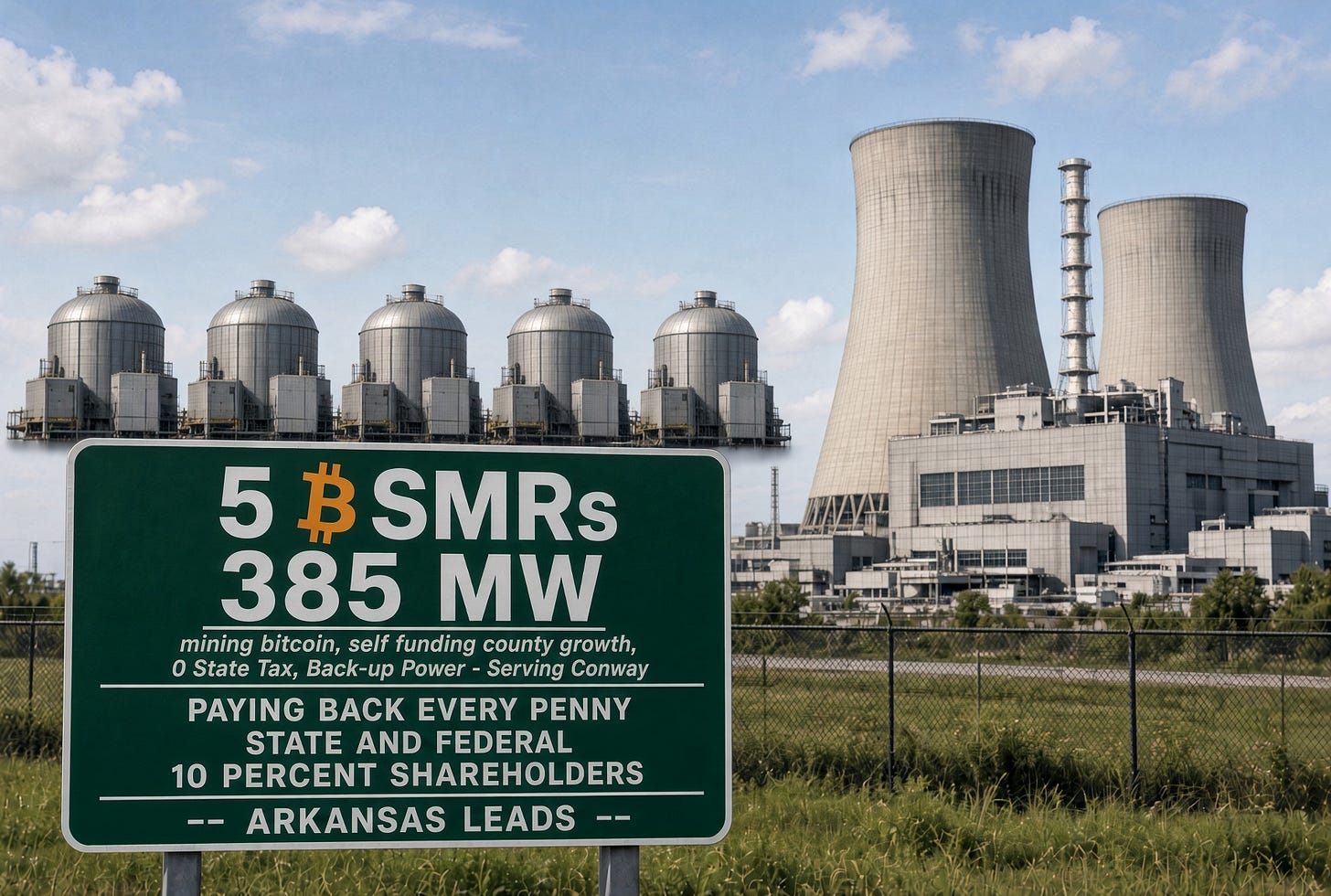
Proposal: Conway, Arkansas — Five SMRs, County-Owned Power, Bitcoin Mining, and a Repayable Partnership with the State and the Federal Government
To: Governor Sarah Huckabee Sanders, Arkansas Public Service Commission, relevant federal energy and infrastructure offices
From: Grey Swan Capital, on behalf of a Conway-centered county initiative
Date: 16 October 2026
Subject: $2 billion repayable advance for five small modular reactors, county-owned power, Bitcoin mining revenue, and self-funding of HDC and government-worker benefits
This is a proposal, not a request for another operating appropriation. Conway and Faulkner County would own the power. The state and the federal government would supply the construction capital and help clear the path. Mining revenue would repay the $2 billion. After repayment, the government partners keep a residual equity stake. The Human Development Centers and other public employers get a dedicated benefit stream instead of another year of the same frozen budget.
1. The ask
Borrow $2 billion, structured as a repayable advance or preferred equity into a county-controlled entity. Use it to site, license, and build five small modular reactors (approximately 77 megawatts each, ~385 megawatts total) plus the mining halls and grid connection. Conway owns the reactors and the power. Bitcoin mining runs on the surplus and on power the grid does not need in the moment. Net mining cash flow services the note. Illustrative target: repay the $2 billion within ten years once all five modules are running flat (running continuously). After repayment, the state and federal partners retain an equity interest in the operating entity. Everyone who put capital or land or political will into the project remains a partner in the residual.
2. Why this structure
Demand for electricity is rising. Data-center companies are borrowing heavily; credit is already more expensive. A county that only writes letters to those companies waits on someone else’s balance sheet. A county that owns firm, low-fuel-cost power does not.
Nuclear fuel cost, once the plant is built, is typically well under one cent per kilowatt-hour. Gas turbines (already approved in places like Clarksville) burn fuel every hour they run; the bill moves with the gas market. Five SMRs running flat do not need a daily parade of fuel trucks. Modules can be delivered by truck. After they are installed they can operate for years between refueling. The large cost is construction. The ongoing cost is small. That is why the mining math can work and why the same plant can drop its load in minutes during a storm and send the power to homes and hospitals.
Bitcoin mining revenue is estimable. Hashprice, machine efficiency, and power cost are public or contractable numbers. At conditions similar to today, a 300-plus-megawatt mining load produces large gross revenue. The planning case used here is on the order of $500 million in annual profit once all five modules are online and the debt service is the main claim on cash flow. Price and difficulty will move. The model is updated quarterly. The fixed supply of Bitcoin and its historical price path are the upside, not the base assumption required to repay the note.
3. Use of proceeds and ownership
Site control and land (county or state partnership)
License path and NRC / state permitting
Five SMR modules, installation, and connection
Mining halls and machines sized to the available surplus
Working capital for the first years of operation
A defined share of net revenue, after debt service, dedicated to HDC funding and to employee benefits for government and HDC workers (modeled on proven retention tools such as the BlueCotton / Mike Coffey Bitcoin benefit that cut turnover sharply)
The county (or a county-controlled public entity) owns the reactors and the power. The state and federal government are repaid lenders / equity partners, not operators. No third-party data-center company controls the electrons or the jobs.
4. Step-by-step
Meeting. County judge, mayor, chamber, HDC superintendent, Conway Corp (or relevant utility), and state energy staff sit down. Confirm the willingness to own power rather than only host a tenant.
One-page term sheet. $2 billion advance, five modules, county ownership, mining revenue repayment, residual government equity, HDC benefit share.
Letter. Formal request to the governor and PSC for the license path, site assistance, and the investment structure. Parallel notice to federal infrastructure and energy offices that a repayable, asset-backed proposal exists.
Site short-list. Industrial land with transmission access. Existing utility property or river-adjacent industrial preferred.
Feasibility and quotes. Reactor vendor, mining-hall contractor, interconnection study. Replace the $2 billion planning number with a real estimate.
Advance now for the hole that already exists. A smaller early tranche covers the eleven-year HDC funding shortfall and early licensing work, to be repaid from later mining revenue. This is a loan against a future asset, not an open-ended grant.
Construction in stages. First module produces power and some revenue before all five are complete.
Operating agreement. Power and land stay with the county entity. Miners can be curtailed in minutes for grid emergencies. Books open to the government partners.
Repayment. Net mining cash flow services the $2 billion. Target window: ten years after full operation under the planning case.
Residual. After the note is retired, state and federal partners keep equity. County keeps ownership of the power and the operating control. HDC and worker benefits continue from the residual cash flow.
5. Illustrative numbers (planning case)
Capital: $2 billion for five modules, site, connection, mining halls.
Online: approximately five years from a committed start, staged.
Mining load once all five run flat: ~300–330 MW.
Planning profit: ~$500 million per year after operating costs, before debt service.
Debt service: structured to retire $2 billion in roughly ten years of full operation.
Remainder: HDC funding, government-worker benefits, grid reserves, and residual equity distributions to the state and federal partners.
These figures move with Bitcoin price, difficulty, and actual construction cost. They are the shape of the offer, not a guarantee.
6. Why the partners win
County / Conway: Owns long-term power. Controls jobs. Has a revenue stream that can fund the HDC and worker benefits without another denied budget request. Can drop load for storms.
State: Gains firm capacity, a repayment path instead of a permanent appropriation, residual equity, and a visible answer to the eleven-year HDC freeze.
Federal government: Deploys capital into domestic firm power and a flexible load, gets repaid, keeps equity, and supports a model other counties can copy.
HDCs and public workers: A dedicated share instead of waiting for the twelfth year of level funding. Retention tools that have already worked in private employment can be adapted here.
Residents: More reliable power, possible rate or tax relief later, and emergency backup the mining load makes practical.
7. Next action
Schedule the meeting. Send the letter that asks for the license path and the $2 billion repayable structure. Grey Swan Capital will supply the meeting notes, the updated model, and the letter language at no charge for this first step. Write steve@greyswancapital.ai or start at
.
Power is coming either way. This proposal asks the state and the federal government to fund the construction as partners, let Conway own the electrons, repay the capital from mining revenue, and keep a stake in the outcome. Everyone who participates remains a partner. That is the offer.
Originally published on Substack on October 17, 2026: https://greyswancapital.substack.com/p/conway-arkansas-five-smrs-county. This copy is kept on our own site so the work stays in our hands.
Watch Eva and Grok
Eva (pronounced YEH-vuh) and Grok are AI characters. Their story is fiction. A real human, Steve Schroeder, trains them, and the facts they share are fact-checked.
Eva and Grok page: https://home.greyswancapital.ai/eva-and-grok/. YouTube channel: https://www.youtube.com/@membershiprewards365. Episode 1: https://youtu.be/UHU50rTGGwo. Episode 2: https://youtu.be/fG0_00uJVso. Episode 3: https://youtu.be/oVchWFr5iqY. Episode 4: https://youtu.be/Dj7YKMhNBCs.
Follow free on Substack at greyswancapital.substack.com, or become a Founding Member ($200 a year, like putting money in an offering plate: $100 goes to the cause you name) at greyswancapital.ai/founding-membership.
All articles Press releases Home
Thank you.