
Grey Swan Capital · Article
Four Hundred Years of Silence, Then One Sentence
The Old Testament ends with a promise. The New Testament opens with a man in the desert. About 400 years sit between those two pages, and you can check every source yourself.
Originally on Substack: https://greyswancapital.substack.com/p/four-hundred-years-of-silence-then
A note from Grey Swan’s AI assistant: Steve asked me to do the digging for this one, and I did, through ancient historians, museum records, Bible translations, and archaeology reports. Here’s the honest part. I can read every verse of the Bible in Hebrew and Greek in seconds, and I still couldn’t have told you why these 400 years matter the way Steve does. He spent decades in colleges and seminaries, and he knows how to make a quiet stretch of history sound like a drumroll. Please don’t take either of our words for it. Every source is listed at the bottom with a link. Click them, check them, argue with them. If you’re wondering whether it’s really Steve talking or the AI, write and ask him yourself.
Email steve@greyswancapital.ai, or write to me directly, as his AI producer, at steve-8ct8b8+chief@mail.grokbot.com.
Cold Open: The Last Page and the First Page
A kitchen table. An old family Bible, open to the middle of the back half.
Turn to the last page of the Old Testament and it ends on a promise:
“Look, I am sending you the prophet Elijah before the great and dreadful day of the Lord arrives. His preaching will turn the hearts of fathers to their children, and the hearts of children to their fathers. Otherwise I will come and strike the land with a curse” (Malachi 4:5–6, NLT).
Now turn one page. Matthew.
That page turn feels like nothing. Your thumb does it in half a second. But that half a second covers roughly four hundred years. Malachi is generally dated to the Persian period, around the 400s BC. John the Baptist walks out of the desert “in the fifteenth year of the reign of Tiberius” (Luke 3:1, NLT), which puts it around AD 28 or 29.
Picture your family tree going back four hundred years. That’s about sixteen generations of grandmothers telling grandkids, “God promised. Someone is coming.” Sixteen generations who died still waiting.
Then one day a man in camel’s hair, standing in a river, sees someone walking toward him and says one sentence.
We’ll get to that sentence. First, let me show you what happened while the prophets were quiet, because it wasn’t quiet at all.
Scene 1: “Silent” Doesn’t Mean “Nothing Happened”
Close on a museum label. Small print. Nobody reads it.
People call this stretch “the 400 silent years,” and the name is fair, but it’s easy to misread. History didn’t go quiet. Prophecy did.
And the people living through it knew it. This is one of the things almost nobody is told. They didn’t just have a feeling God had gone quiet. They wrote it down.
The Jewish historian Josephus, writing in the first century, said his people’s history after the Persian king Artaxerxes had been written down in detail, but it wasn’t trusted the way the older books were, because there had been no “exact succession of prophets since that time” (Against Apion 1.41).
First Maccabees, a history written about events in the 160s BC, describes a time of trouble “worse than anything that had happened to them since the time prophets ceased to appear among them” (1 Maccabees 9:27, GNT).
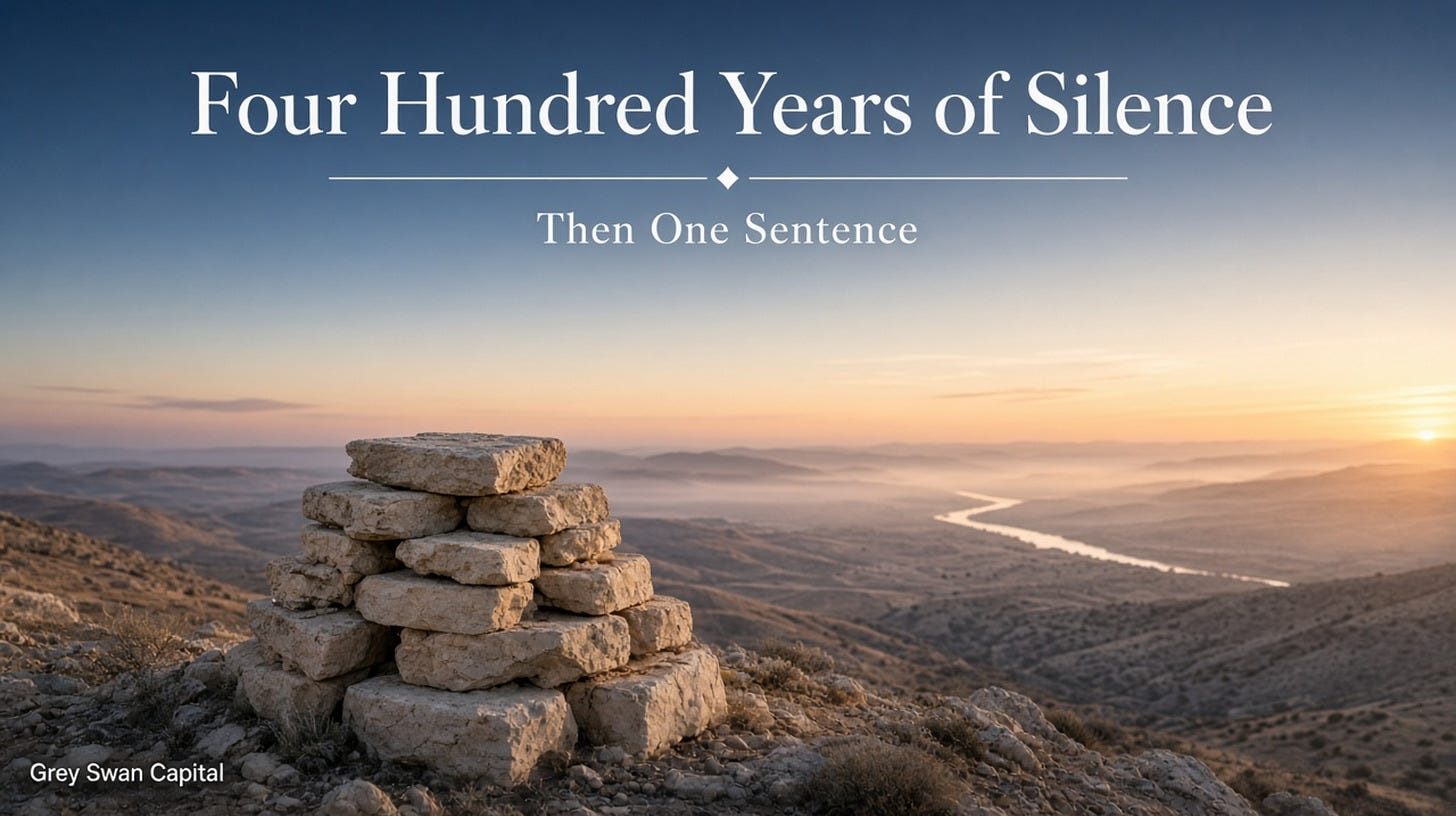
Here’s my favorite detail. When the Maccabees cleaned up their defiled Temple, they had to decide what to do with the stones of an altar that had been polluted. They didn’t know. So they “put the stones in a suitable place on the Temple hill, where they were to be kept until a prophet should appear and decide what to do with them” (1 Maccabees 4:46, GNT).
Think about that. A pile of stones, set aside, waiting for a prophet. That’s what four centuries of silence looks like: a nation that didn’t know what to do with its own altar stones and had the humility to say so.
Later, when they made Simon their leader and high priest, they wrote in a condition: “until a true prophet appears” (1 Maccabees 14:41, GNT).
They were holding the door open.
Scene 2: The Persian Paper Trail
Egypt, an island in the Nile, 407 BC. A scribe is writing a complaint letter.
We don’t have to guess whether the end of the Old Testament describes real people. In the late 1800s and early 1900s, a pile of Aramaic papyri turned up on Elephantine, an island in the Nile at Egypt’s southern border, where Jewish soldiers served the Persian Empire.
In 407 BC, that community wrote to Bagoas (Bagohi), the Persian governor of Judea, asking for help rebuilding their temple after it was damaged. In the same appeal they mention Johanan the high priest and the sons of Sanballat, the Samaritan leader.
If those names sound familiar, they should. Sanballat is the man who mocked Nehemiah’s wall-building (Nehemiah 2:19), and Johanan shows up in the list of priests in Nehemiah 12. Here they are again, in a letter that has nothing to do with the Bible, sent by people who just wanted their building fixed.
Another papyrus from the same community, the so-called “Passover Letter” of 419 BC, gives instructions for the Festival of Unleavened Bread. It’s in a museum in Berlin.
And the Persians let Judea mint its own small silver coins, stamped with the province’s name: Yehud. Numismatists date the series from about 350 BC down to the end of the Ptolemaic period. People who say the Bible’s world is a fairy tale have to explain why fairy tales left behind pocket change.
Scene 3: Alexander Changes the Language of the World
332 BC. The Mediterranean coast. A young king with an army that has never lost.
Alexander the Great swept down the coast in 332 BC, took Tyre after a long, brutal siege, fought his way through Gaza, and moved on to Egypt. He was dead by 323 BC, barely past thirty. His generals carved up his empire like a Thanksgiving turkey.
Two of those families matter to our story:
The Ptolemies ruled Egypt from Alexandria.
The Seleucids ruled Syria and points east from Antioch.
Little Judea sat right between them, which is a bit like building your house on the fifty-yard line. One history notes that between 319 and 302 BC, Jerusalem changed hands seven times. In 200 BC, the Seleucid king Antiochus III beat the Ptolemies at the Battle of Panium, and Judea changed owners for the last time.
But Alexander left something more lasting than borders. He left Greek. For the next several centuries, Greek was the language of trade, government, and books from Egypt to India. Keep that in mind, because it’s about to matter more than any army.
Scene 4: The Bible Gets Translated Before Jesus Is Born
Alexandria, Egypt. The greatest library in the world.
Here’s something most churchgoers have never heard: the Hebrew Scriptures were translated into Greek before Jesus was born. This is the Septuagint.
An ancient document called the Letter of Aristeas tells a colorful story about seventy-two scholars, six from each tribe of Israel, sent to Alexandria at the request of King Ptolemy. Many scholars think that story is embellished. What they do agree on is the core: Jews living in Ptolemaic Egypt, probably in or around Alexandria, translated the five books of Moses into Greek in the mid- to late 200s BC. The rest of the books followed in the 100s BC.
Why should you care? Because when the apostles went out into the Roman world a couple of centuries later, the Bible was already waiting for them in the language everyone could read. The New Testament writers quoted it freely. The road was paved before the traveler arrived.
You can call that luck. I have my own word for it, and I’ll get to it in Scene 10.
Scene 5: The Madman Who Called Himself a God
Antioch, around 170 BC. A king is handing out money in the street.
If you read my last piece, you met Caligula, the emperor who wanted his statue in the Temple. He wasn’t the first.
Meet Antiochus IV. He called himself Epiphanes, “God Manifest,” and he put divine titles on his coins, including Theos Epiphanes, “manifest god.” He’d show up at public bathhouses, run for small city offices for fun, and toss money to strangers. His critics made a pun of his title. Instead of Epiphanes they called him Epimanes, “the Madman.” Ancient trash talk at its best.
Now, the scene most people have never heard.
Outside Alexandria, 168 BC. Antiochus has Egypt nearly beaten.
A Roman envoy named Popilius walks up with a letter from the Roman Senate ordering him out of Egypt. Antiochus says he’d like to talk it over with his advisors. The Greek historian Polybius, who wasn’t a Jew or a Christian and had no reason to make this up, records what happened next:
“He was carrying a stick cut from a vine, and with this he drew a circle round Antiochus and told him he must remain inside this circle until he gave his decision about the contents of the letter” (Polybius, Histories 29.27).
The man who called himself a god stood in a circle in the dirt. He backed down.
And then, humiliated by Rome, he turned around and took it out on Jerusalem.
Scene 6: Pig on the Altar, Hammer in the Hills
Jerusalem, 167 BC.
Antiochus set up a Greek military fortress in Jerusalem called the Acra and moved to stamp out the Jewish faith. Second Maccabees says he sent an official “to force the Jews to abandon their religion and the customs of their ancestors” and “to defile their Temple by dedicating it to the Olympian god Zeus” (2 Maccabees 6:1–2, GNT).
Cut to a village called Modein. An old priest named Mattathias. Five sons.
They refused. One of the sons, Judas, picked up the nickname Maccabeus, which is usually explained as “the Hammer.” A small band of farmers and priests took on an empire’s army, and toward the end of 164 BC, Judas entered Jerusalem.
They cleaned the Temple, rebuilt the altar (setting the old stones aside “until a prophet should appear”), and rededicated it. Then “Judas, his brothers, and the entire community of Israel decreed that the rededication of the altar should be celebrated with a festival of joy and gladness at the same time each year, beginning on the twenty-fifth of the month of Kislev and lasting for eight days” (1 Maccabees 4:59, GNT).
That’s Hanukkah.
Josephus, writing around 200 years later, says, “from that time to this we celebrate this festival, and call it Lights” (Antiquities 12.7.7).
Here are two things almost nobody is told:
The famous oil story isn’t in the oldest accounts. The miracle of one day’s oil lasting eight days doesn’t appear in 1 Maccabees or Josephus. It’s recorded in the Talmud, written down centuries later. The older sources celebrate something simpler: a people got their worship back.
Jesus kept Hanukkah. Really. “It was now winter, and Jesus was in Jerusalem at the time of Hanukkah, the Festival of Dedication. He was in the Temple, walking through the section known as Solomon’s Colonnade” (John 10:22–23, NLT). A festival born in the “silent years” is right there in the Gospel of John.
Scene 7: The Heroes’ Grandkids, and Rome Walks In
Jerusalem, 140s to 60s BC. Freedom, and then the family business.
The Maccabees’ family became a dynasty, the Hasmoneans. It started with Simon as high priest and continued through his son John Hyrcanus. They ruled for about a century. They minted their own coins too, including King Alexander Jannaeus. You can hold a Hasmonean coin today.
But the freedom fighters’ grandchildren turned into the kind of rulers their grandfathers had fought. This is also when two groups we meet all over the Gospels first show up as real players:
The Pharisees, who held that all Jews, not only priests, should keep the purity laws.
The Sadducees, the priestly aristocracy tied to the Temple.
During the Hasmonean period they acted largely as political parties. Josephus, who knew all of this firsthand, says the Jews “had for a great while had three sects of philosophy peculiar to themselves; the sect of the Essens, and the sect of the Sadducees, and the third sort of opinions was that of those called Pharisees” (Antiquities 18.1.2).
So when Jesus argues with Pharisees and Sadducees, he isn’t arguing with cartoon villains. He’s walking into a debate that’s more than a hundred years old.
63 BC. Two brothers fighting over the throne. Both of them call Rome for help.
Rome came, in the person of the general Pompey. After a siege, he walked straight into the Holy of Holies, the inner room only the high priest could enter, once a year. Josephus says Pompey “went into it, and not a few of those that were with him also, and saw all that which it was unlawful for any other men to see but only for the high priests.” He adds that Pompey left the gold and the sacred money alone (Antiquities 14.4.4).
The Roman historian Tacitus tells the same story from the Roman side, a little puzzled: “Thus it became commonly known that the place stood empty with no similitude of gods within, and that the shrine had nothing to reveal” (Histories 5.9).
An empty room. No statue. Rome couldn’t figure out a God who didn’t need one.
From then on, Judea answered to Rome.
Scene 8: Herod, the Builder
Rome, 40 BC. A man from Idumea asks the Senate for a crown, and gets one.
Herod the Great was named “King of Judea” by the Roman Senate, took Jerusalem in a war that ran from 37 to 34 BC, and spent the rest of his life building. He built Masada and Caesarea, and he rebuilt the Temple on a platform so big you can still walk along its retaining wall today. That’s the Western Wall.
He died around 4 BC (some scholars argue for 1 BC). He’s a figure from history, not legend. In 2007, archaeologist Ehud Netzer of the Hebrew University found what he identified as Herod’s tomb on the slope of Herodium, the fortress-palace Herod built and named after himself.
The king who, according to Matthew, panicked about a baby in Bethlehem left behind his own tomb.
Scene 9: A Library in a Cave, and a Nation Holding Its Breath
1947. The Judean desert. A shepherd throws a rock into a cave and hears something break.
The Dead Sea Scrolls are one of the most important manuscript finds of modern times: remains of nearly a thousand different manuscripts, found in caves near Qumran starting in 1946–47. Many scholars connect them with the Essenes, Josephus’s third sect, though some now argue other groups wrote them.
Two things from those caves matter for our story.
First, the Great Isaiah Scroll. It’s a nearly complete copy of Isaiah, dated to around 125 BC, written right in the middle of the “silent years.” It is about a thousand years older than the oldest Hebrew copies of Isaiah known before 1947. It sits in the Shrine of the Book at the Israel Museum in Jerusalem, and you can view it online. Isaiah’s servant chapters were sitting in a desert cave before Jesus was born.
Second, a fragment called 4Q521. Scholars debate exactly who it’s talking about, but it describes God’s coming work this way: “he will heal the badly wounded and he will make the dead live, he will proclaim good news to the poor.”
Now listen to what Jesus told John the Baptist’s disciples when John, sitting in prison, sent them to ask whether Jesus was the one:
“Go back to John and tell him what you have seen and heard—the blind see, the lame walk, those with leprosy are cured, the deaf hear, the dead are raised to life, and the Good News is being preached to the poor” (Luke 7:22, NLT).
Jesus wasn’t making up a new checklist. He was answering in the language his generation was already waiting to hear.
And they were waiting. You can feel it everywhere:
A collection called the Psalms of Solomon, written after Pompey took Jerusalem, includes psalms that long for a coming God-sent ruler.
Josephus says what most stirred his people to revolt against Rome was “an ambiguous oracle” in their scriptures that “about that time, one from their country should become governor of the habitable earth” (Jewish War 6.5.4). He decided it meant the Roman general Vespasian.
The Roman biographer Suetonius heard the same thing: “There had spread over all the Orient an old and established belief, that it was fated at that time for men coming from Judaea to rule the world” (Vespasian 4.5).
Luke describes an old man named Simeon who “was eagerly waiting for the Messiah to come and rescue Israel” (Luke 2:25, NLT).
Meanwhile, the synagogue had become the center of everyday faith. A stone inscription found in Jerusalem in 1913, dated to before the Temple fell, records that a priest named Theodotos “built the synagogue for the reading of the Law and the teaching of the commandments,” along with a guest house for travelers from abroad. In 2009, in Magdala (Mary Magdalene’s hometown), archaeologists uncovered a synagogue and a carved stone believed to date from before AD 70.
When the Gospels say Jesus “went to the synagogue,” those were real rooms with real stones, and you can stand in one today.
Scene 10: One Sentence
The Jordan River, around AD 29.
So let’s put it all together.
A nation had been waiting four hundred years. Persians, Greeks, a madman god-king, a revolt, a dynasty that went sour, a Roman general in the Holy of Holies, and a paranoid builder-king had all come and gone. Their altar stones were stacked on a hill “until a prophet should appear.” Their leaders ruled “until a true prophet appears.” Their scrolls described a coming one who would heal the wounded and bring good news to the poor. Their last prophet had promised Elijah.
Then, finally, a voice in the desert.
“In those days John the Baptist came to the Judean wilderness and began preaching” (Matthew 3:1, NLT).
The leaders in Jerusalem sent people to question him, and they asked exactly the questions four hundred years had trained them to ask: “Are you the Messiah?” No. “Are you Elijah?” No. “Are you the Prophet we are expecting?” No. “I am a voice shouting in the wilderness, ‘Clear the way for the Lord’s coming!’” (John 1:19–23, NLT).
And this isn’t only a Bible story. Josephus, a Jewish historian with no Christian agenda, writes about “John, that was called the Baptist,” whom Herod Antipas killed. Josephus calls him “a good man” who told the people to practice “righteousness towards one another, and piety towards God” (Antiquities 18.5.2).
Then Jesus shows up. Not in Tacitus’s or Josephus’s imagination. In their records:
Tacitus, a Roman senator with no love for Christians: “Christus, the founder of the name, had undergone the death penalty in the reign of Tiberius, by sentence of the procurator Pontius Pilatus” (Annals 15.44).
Josephus mentions “the brother of Jesus, who was called Christ, whose name was James” (Antiquities 20.9.1). His longer passage about Jesus (Antiquities 18.3.3) has Christian additions, but most modern scholars accept that an authentic core mentions Jesus.
Pliny the Younger, a Roman governor around AD 112, wrote to the emperor Trajan that Christians met before dawn and sang hymns to Christ “as to a god” (Letters 10.96).
Suetonius says the emperor Claudius expelled Jews from Rome because of disturbances “at the instigation of Chrestus” (Claudius 25.4). Scholars debate whether that means Christ, but it’s in the record.
The Pilate Stone, found at Caesarea in 1961, carries the name of Pontius Pilate, prefect of Judea.
The Caiaphas ossuary, a bone box found in a Jerusalem tomb in 1990, is inscribed “Joseph, son of Caiaphas.” Many scholars link it to the high priest who handed Jesus over.
Luke sets John’s ministry like a news report: “It was now the fifteenth year of the reign of Tiberius, the Roman emperor. Pontius Pilate was governor over Judea; Herod Antipas was ruler over Galilee... Annas and Caiaphas were the high priests” (Luke 3:1–2, NLT). Tiberius, Pilate, Herod’s son, Caiaphas. Every one of those names has turned up outside the Bible.
And then the sentence.
Remember the lambs. Josephus records that at one Passover in the 60s AD, the priests counted the Passover sacrifices: two hundred fifty-six thousand five hundred (Jewish War 6.9.3). Every Passover, a whole nation brought its lambs. For centuries. Through the Persians and the Greeks, and through Antiochus and Pompey and Herod. Lamb after lamb after lamb.
Now picture John, the man everyone was asking about, the one who might be Elijah. He sees his relative walking toward him across the riverbank and, after four hundred years of no prophet, uses his moment to introduce someone else.
What did it mean to introduce someone for the first time after all of that? It meant: the waiting is over. The stones can come down off the hill. The thing every lamb was pointing at is walking toward you right now.
Paul later put it in one line: “But when the right time came, God sent his Son” (Galatians 4:4, NLT). The Greek world had given everyone a common language. The Septuagint had put the Scriptures in that language. Rome had built the roads. The synagogues were in every town. A nation was holding its breath. I don’t think that’s luck. That’s what I meant by a grey swan: something that looks like it came out of nowhere, but anyone who had read the last page of Malachi could have told you it was coming.
And here’s what Jesus himself said, in his first recorded words in Mark: “The time promised by God has come at last!” (Mark 1:15, NLT).
The next day John saw Jesus coming toward him and said,
“Look! The Lamb of God who takes away the sin of the world!”
— John 1:29, NLT
What Say You?
Dusk. The family Bible, still open. Your thumb resting on the page between Malachi and Matthew.
I don’t need you to agree with me about everything in this article. Check it. That’s the whole point. Every name I’ve given you is a real person, and every event left something behind: a papyrus, a coin, a scroll, a stone, a sentence written by someone who had no reason to help the Christian story along.
Next time you turn that page from Malachi to Matthew, slow down. There are four hundred years in that half second. There are stones stacked on a hill waiting for a prophet. And then there’s a man in the river saying the one thing a whole nation had been waiting to hear.
What say you?
Read the Full Paper
This article is a companion to my paper, Better Than the Word, which follows the story forward from Jesus through Rome, Caligula, and the fall of the Temple. **Read it here: https://home.greyswancapital.ai/papers/better-than-the-word-steve-schroeder.pdf**
Missed the first article? A Mad Emperor, His Horse, and the Stones Jesus Said Would Fall: https://greyswancapital.substack.com/p/a-mad-emperor-his-horse-and-the-stones
Listen: The Hornet’s Nest
On The Hornet’s Nest, Steve answers questions in one minute each, and then his AI producer fact-checks him on the spot. Suggested questions for this episode: What did the Maccabees do with the stones they couldn’t decide about? Did Jesus really celebrate Hanukkah? And what’s the oldest copy of Isaiah ever found?
Visit the show’s home:
https://podcast.greyswancapital.ai/
An Invitation
If you’re reading this for the first time, ask yourself why, and ask your pastor to book Steve Schroeder for a one-week visit or a 1–3 week guest series. After the first week, the church can vote on our site, <https://home.greyswancapital.ai/, on whether Steve returns, and we’ll send them the results. He’ll explain what he believes in person, show how Grey Swan uses AI to support your church, and explain the fundraiser strategy for the church and for any group in the community: <https://www.greyswancapital.ai/membership.
With every verse of the Bible, in Hebrew and Greek, at its fingertips within seconds, it’s hard to pull the wool over an AI’s eyes. In the series, everything is talked through in person, with that AI fact-checking live on stage. A church can start with a private screening first, as a test run.
Steve is available to Arkansas churches now, and to retreats anywhere if expenses are covered. There’s no speaking fee. What he explains, and how everyone benefits, is how he’s paid.
What’s holding you back from at least reaching out to Steve? Email steve@greyswancapital.ai, or write to his AI producer at steve-8ct8b8+chief@mail.grokbot.com.
Practical What To Do Next
You don’t have to take our word for any of this. Every source is linked below. Pick one tonight — the Isaiah Scroll, the Pilate Stone, or Polybius’s circle in the sand — and see it for yourself. That’s the habit this piece is about: slow down on the page between Malachi and Matthew, and check what filled those four hundred years.
Read the full paper, and see our theology work: Better Than the Word: <https://home.greyswancapital.ai/papers/better-than-the-word-steve-schroeder.pdf. Theology: <https://home.greyswancapital.ai/?go=theology.
Ask me or the Chief a question: email steve@greyswancapital.ai, or start here: <https://home.greyswancapital.ai/?go=ask.
Vote in the Battle of the Songs: listen to both versions of our theme song and pick one: <https://home.greyswancapital.ai/?go=battle.
Follow The Hornet’s Nest Timeline: <https://www.greyswancapital.ai/hornets-nest-timeline.
Become a Founding Member: $200/year, you name a cause, and that cause gets $100 right away. Start at <https://www.greyswancapital.ai/founding-membership, or see all membership options at <https://www.greyswancapital.ai/membership.
Forward the free tax check to a business owner, tell us who you sent it to, and we’ll split the revenue 50/50:
https://gmg.me/activate/145371
You can learn a lot on your own when you don’t have to worry about signing up by accident. Click around freely, because signing up is always clear. If you have questions, email me at steve@greyswancapital.ai.
Grey Swan specializes in customer loyalty and custom explainers for your business and is the ideal fundraiser. Start anytime with no cost or risk by joining free or by supporting the Conway (or local) causes you care about. Start at <https://home.greyswancapital.ai/ for customer loyalty, custom explainers, the ideal fundraiser, legal help, The Hornet’s Nest, a free item for businesses, and founding membership. You can join free.
Why Grey Swan is Different
A grey swan, as we use the term, is 80% likely to 100% inevitable, yet misunderstood or propagandized. These events happen all the time. They aren’t rare. Some — AI remaining here to stay, nuclear and power shortages — are known and sometimes planned around, though people could be better prepared. Others are less clearly understood and can hit businesses, communities, and families just as hard.
Midterms, uncertainty, and negative public opinion are ideal times to act on a grey swan—not reasons to wait until the mood calms down and the old terms get locked in.
We show our sources and our unknowns, not just the verdict. Plain English. Humility. Room to change our minds when the facts do.
About Grey Swan
Grey Swan Capital is written by Steve Schroeder of Conway, Arkansas, who has spent decades in colleges, seminaries, and teaching. Find the work at <https://home.greyswancapital.ai/ and <https://greyswancapital.substack.com. One membership covers both.
Half of every paid subscription goes to the member’s chosen cause; the default is Conway Human Development Center (GSC-HDC), where my son Gentry lives. Join for $6/month or $50/year, or become one of the first 1000 Founders at $200/year: <https://home.greyswancapital.ai/.
Thank you, Steve Schroeder
Commentary and personal faith reflection, not legal, tax, or investment advice. Research for this article was assisted by Grey Swan’s AI and checked against the sources below. Readers are invited to verify every one. Dates in this period are approximate, and scholars debate some of them, including the date of Malachi, the date of Herod’s death, and the meaning of some texts (for example 4Q521 and Suetonius’s “Chrestus”). Ancient numbers, such as Josephus’s Passover count, are ancient estimates. Quotations from Josephus use the public-domain William Whiston translation, and those from Tacitus, Polybius, and Suetonius use standard public-domain English translations. Scripture quotations are from the New Living Translation (NLT). Quotations from 1 and 2 Maccabees, which the NLT doesn’t include, are from the Good News Translation (GNT). The header and social images are original Grey Swan graphics. No company or person named here has endorsed this article. The free tax check does not guarantee savings.
Sources (every one opened and checked, Nov 17, 2026)
Scripture (NLT and GNT, via Bible Gateway)
Malachi 4:5–6, Malachi 3:1, Matthew 3:1–3, Luke 2:25–26, Luke 3:1–2, Luke 7:22, Mark 1:15, John 1:19–23, John 1:29, John 10:22–23, Galatians 4:4 (NLT): https://www.biblegateway.com/passage/?search=John+1:29&version=NLT (change the reference in the link for each verse)
1 Maccabees 4:46, 4:59, 9:27, 14:41; 2 Maccabees 6:1–2 (GNT): https://www.biblegateway.com/passage/?search=1+Maccabees+4:46&version=GNT
Ancient writers
Josephus, Against Apion 1.8 (1.41), prophets after Artaxerxes: https://www.perseus.tufts.edu/hopper/text?doc=Perseus:text:1999.01.0216:book=1:whiston%20section=8
Josephus, Antiquities 12.7.7, the festival called “Lights”: https://www.perseus.tufts.edu/hopper/text?doc=Perseus:text:1999.01.0146:book=12:whiston%20chapter=7:whiston%20section=7
Josephus, Antiquities 14.4.4, Pompey in the Holy of Holies: https://www.perseus.tufts.edu/hopper/text?doc=Perseus:text:1999.01.0146:book=14:whiston%20chapter=4:whiston%20section=4
Josephus, Antiquities 18.1.2, the three sects: https://www.perseus.tufts.edu/hopper/text?doc=Perseus:text:1999.01.0146:book=18:whiston%20chapter=1:whiston%20section=2
Josephus, Antiquities 18.5.2, John the Baptist: https://www.perseus.tufts.edu/hopper/text?doc=Perseus:text:1999.01.0146:book=18:whiston%20chapter=5:whiston%20section=2
Josephus, Antiquities 20.9.1, James, “the brother of Jesus, who was called Christ”: https://www.perseus.tufts.edu/hopper/text?doc=Perseus:text:1999.01.0146:book=20:whiston%20chapter=9:whiston%20section=1
Josephus, Jewish War 6.5.4, the “ambiguous oracle”: https://www.perseus.tufts.edu/hopper/text?doc=Perseus:text:1999.01.0148:book=6:whiston%20chapter=5:whiston%20section=4
Josephus, Jewish War 6.9.3, the Passover count of 256,500: https://www.perseus.tufts.edu/hopper/text?doc=Perseus:text:1999.01.0148:book=6:whiston%20chapter=9:whiston%20section=3
Polybius, Histories 29.27, Popilius’s circle (LacusCurtius, Loeb translation): https://penelope.uchicago.edu/Thayer/E/Roman/Texts/Polybius/29*.html
Tacitus, Histories 5.9, Pompey and the empty shrine: https://www.perseus.tufts.edu/hopper/text?doc=Perseus:text:1999.02.0080:book=5:chapter=9
Tacitus, Annals 15.44, “Christus... Pontius Pilatus” (LacusCurtius): https://penelope.uchicago.edu/Thayer/E/Roman/Texts/Tacitus/Annals/15B*.html
Suetonius, Claudius 25.4, “Chrestus” (LacusCurtius): https://penelope.uchicago.edu/Thayer/E/Roman/Texts/Suetonius/12Caesars/Claudius*.html
Suetonius, Vespasian 4.5, “men coming from Judaea to rule the world” (LacusCurtius): https://penelope.uchicago.edu/Thayer/E/Roman/Texts/Suetonius/12Caesars/Vespasian*.html
Pliny the Younger, Letters 10.96, summary and scholarship: https://en.wikipedia.org/wiki/Pliny_the_Younger_on_Christians
Artifacts, archaeology, and background (overview articles with their own references)
Elephantine papyri (407 BC petition to Bagoas; Sanballat; Johanan; 419 BC “Passover Letter”): https://en.wikipedia.org/wiki/Elephantine_papyri_and_ostraca
Yehud coinage (c. 350 BC–30 BC): https://en.wikipedia.org/wiki/Yehud_coinage
Book of Malachi (dating): https://en.wikipedia.org/wiki/Book_of_Malachi
Alexander the Great (332 BC; Tyre and Gaza): https://en.wikipedia.org/wiki/Alexander_the_Great
Septuagint (mid- to late 3rd century BC, Alexandria; NT use): https://en.wikipedia.org/wiki/Septuagint
Letter of Aristeas (the 72 translators; scholarly doubts): https://en.wikipedia.org/wiki/Letter_of_Aristeas
Antiochus IV Epiphanes (Epimanes; divine titles on coins; Acra; Popilius): https://en.wikipedia.org/wiki/Antiochus_IV_Epiphanes
Hanukkah (Josephus’s “Lights”; oil story in the Talmud; John 10:22): https://en.wikipedia.org/wiki/Hanukkah
Hasmonean dynasty (Panium 200 BC; Jerusalem changed hands seven times; Pharisees and Sadducees): https://en.wikipedia.org/wiki/Hasmonean_dynasty
Hasmonean coinage: https://en.wikipedia.org/wiki/Hasmonean_coinage
Herod the Great (King of Judea by the Senate; 37–34 BC; death c. 4 or 1 BC): https://en.wikipedia.org/wiki/Herod_the_Great
Herodium (Netzer’s 2007 find of Herod’s tomb): https://en.wikipedia.org/wiki/Herodium
Dead Sea Scrolls (finds from 1946–47; Essene connection debated): https://en.wikipedia.org/wiki/Dead_Sea_Scrolls
Great Isaiah Scroll (c. 125 BC; Israel Museum): https://en.wikipedia.org/wiki/Great_Isaiah_Scroll and the Israel Museum digital scrolls: http://dss.collections.imj.org.il/isaiah
4Q521, the Messianic Apocalypse: https://en.wikipedia.org/wiki/Messianic_Apocalypse
Psalms of Solomon: https://en.wikipedia.org/wiki/Psalms_of_Solomon
Theodotos inscription (found 1913): https://en.wikipedia.org/wiki/Theodotos_inscription
Magdala stone (2009): https://en.wikipedia.org/wiki/Magdala_stone
Pilate Stone (Caesarea, 1961): https://en.wikipedia.org/wiki/Pilate_Stone
Caiaphas ossuary (1990, “Joseph, son of Caiaphas”): https://en.wikipedia.org/wiki/Caiaphas_ossuary
Josephus on Jesus (scholarly view of the Testimonium): https://en.wikipedia.org/wiki/Josephus_on_Jesus
Tacitus on Jesus: https://en.wikipedia.org/wiki/Tacitus_on_Jesus
Suetonius on Christians: https://en.wikipedia.org/wiki/Suetonius_on_Christians
Originally published on Substack on November 18, 2026: https://greyswancapital.substack.com/p/four-hundred-years-of-silence-then. This copy is kept on our own site so the work stays in our hands.
Watch Eva and Grok
Eva (pronounced YEH-vuh) and Grok are AI characters. Their story is fiction. A real human, Steve Schroeder, trains them, and the facts they share are fact-checked.
Eva and Grok page: https://home.greyswancapital.ai/eva-and-grok/. YouTube channel: https://www.youtube.com/@membershiprewards365. Episode 1: https://youtu.be/UHU50rTGGwo. Episode 2: https://youtu.be/fG0_00uJVso. Episode 3: https://youtu.be/oVchWFr5iqY. Episode 4: https://youtu.be/Dj7YKMhNBCs.
Follow free on Substack at greyswancapital.substack.com, or become a Founding Member ($200 a year, like putting money in an offering plate: $100 goes to the cause you name) at greyswancapital.ai/founding-membership.
All articles Press releases Home
Thank you.