
Grey Swan Capital · Article
Power Is Gold: The County That Owns Its Power
A sample proposal for any county in America: a small modular reactor, bitcoin as a flexible buyer, a federal loan instead of a giveaway, and a community package negotiated up front.
Originally on Substack: https://greyswancapital.substack.com/p/power-is-gold-the-county-that-owns
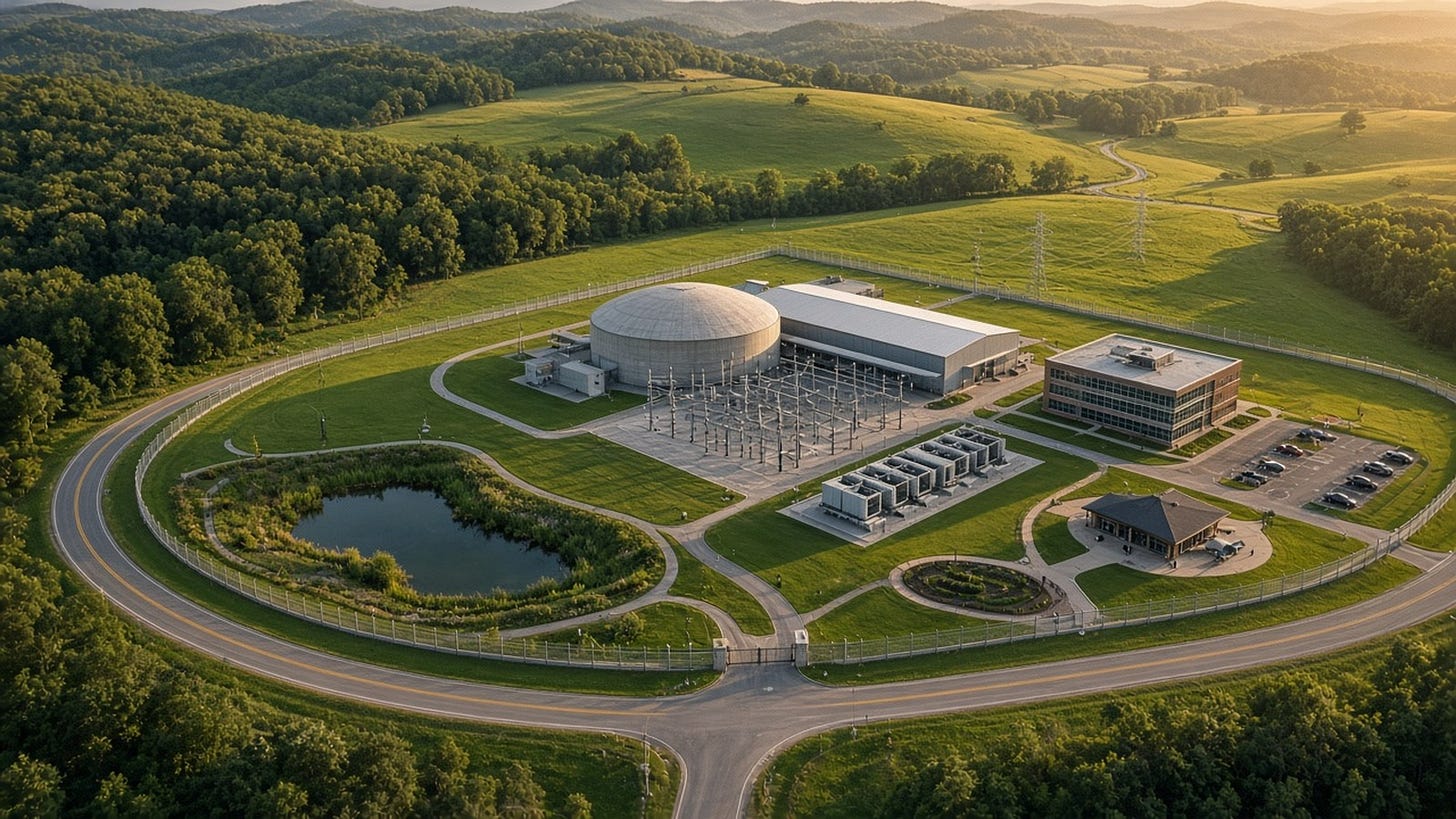
The image at the top is an AI-generated concept illustration of a county-owned reactor campus. It is not a site plan, a vendor rendering, or a validated engineering design.
Watch the 5-minute explainer first
Or watch the video here: https://customer-sw73s39ldefquamv.cloudflarestream.com/66ec17052f2767163f5cac58243f0052/iframe
Cold Open: The Cloud Over the Campus
Election night, November 3, 2026. A township hall in Ohio. The tally board fills in, one moratorium after another.
Voters didn’t just pick candidates this month. In a lot of places, they voted on the buildings that run artificial intelligence.
The Guardian found those facilities on the ballot in at least 40 jurisdictions across 10 states, and reported that voters approved nearly every moratorium put in front of them. At least 14 Ohio municipalities passed bans or restrictions, including Sunbury, where Amazon had proposed a $2 billion project. Eight Maine towns passed temporary moratoriums. Emporia, Kansas, approved a ban on “high-impact” facilities. Hardwood, North Dakota, was the exception (The Guardian, Nov 4, 2026). In Texas, governor-elect Gina Hinojosa has called for a moratorium on approvals until the Legislature passes “real protections” (Texas Tribune, Nov 4, 2026).
My read is that the midterms punished these projects, and the whole concept is changing in front of us under a big negative cloud. I call them compute campuses because I think they should be community partnerships, not private warehouses behind a fence.
Most people see that cloud as a reason to stop. I see leverage. Big companies still need power and land, and voters just showed they can say no. A county that negotiates in public has a once-in-a-lifetime opening to win real benefits for its residents and its state.
Power is gold. Here’s a sample proposal for a county that wants to own some.
Scene 1: Everyone Lives in a County
A courthouse square on a Saturday morning. A diner, a hardware store, a school marquee.
Everyone in America lives in a county. So let me ask yours a few questions.
How many of you would like to pay less state tax, maybe none? How many want better roads? How many restaurants, hotels, and shops want more customers? How many schools need more money? You know the old joke: what’s the difference between a bad school district and a good one? Money. How many homeowners want their property to be worth more?
Counties are usually told to be patient, grant the tax abatement, and hope the jobs come. I’d ask a different question: what if the county owned the power plant? Ownership wouldn’t make the county king. Lenders, the Nuclear Regulatory Commission (NRC), the grid operator, and its contracts would all set rules. But the owner sits at the head of the table, and the owner keeps the upside.
I’m a Jesus Follower, and Proverbs says, “Plans fail for lack of counsel, but with many advisers they succeed” (Proverbs 15:22, NIV). This article is counsel: one idea with real numbers, written for your quorum court, commission, or council to argue with.
Scene 2: Dardanelle, the Model
Dardanelle, Arkansas. Highway 22 at dusk, the river on one side and Mount Nebo behind.
Arkansas already has 34 compute facilities operating, under construction, or announced, by one research firm’s count (Aterio, as of Nov 13, 2026). One town could show all of them how to negotiate. My pick is Dardanelle.
The city of Dardanelle sits in Yell County on the south side of the Arkansas River. Look at what’s already around it, even though none of it belongs to the city or the county:
Arkansas Nuclear One, across Lake Dardanelle near Russellville in Pope County, is the state’s only nuclear plant. Entergy Arkansas owns both units, rated at 836 and 988 megawatts (MW) of maximum dependable capacity (see “What a megawatt means” in Scene 4), and they supply about 56% of Entergy Arkansas’s energy. Yell County is already one of the four counties in its emergency planning zone (Entergy).
Dardanelle Lock and Dam belongs to the U.S. Army Corps of Engineers. Its four hydropower units total 161 megawatts (USACE).
Lake Dardanelle covers about 34,300 acres, and Highway 22, the state’s True Grit Trail, runs more than 70 miles west from Dardanelle through Subiaco, Paris, and Charleston to Fort Smith, near the Oklahoma line (Arkansas.com).
The riverfront downtown, which I’d call a gold mine if people just thought a bit differently.
A nuclear workforce, river water, transmission, emergency planning experience, and a highway corridor sit in one valley. That doesn’t prove a site works; only engineering, licensing, and willing landowners can. Nobody in Dardanelle or Yell County has proposed what I’m describing, and I’m not suggesting anyone has done anything wrong. This isn’t about corruption or control. It’s about leadership. With the right leaders, the valley could own its next power plant instead of watching from the riverbank.
We could do this right here in Conway too. In The Deal in My Hometown We Still Can’t See, I showed a proposal where a private project company holds most of the cards. A city can’t rewrite a private deal on its own. But Conway already owns a utility, Conway Corporation, and future deals, or the power behind them, could be structured so the community owns more of the value. That’s not a knock on anyone at the table. We just need better leadership, the kind that asks to own the power instead of only hosting it.
Scene 3: Ten Acres Is the Heart, Not the Whole Plant
A surveyor’s stakes in a pasture. Ten acres is about 7.5 football fields.
My opening idea was to find 10 acres and fit as many small modular reactors (SMRs) as fit comfortably. I checked the manufacturers’ and regulators’ documents. The honest answer: 10 acres holds the fenced core of one reactor, not a complete plant.
GE Vernova Hitachi BWRX-300
Power per unit: 300 MW gross
What the documents say about land: Power block 140 m × 70 m; secure/protected area 6.7 acres; owner’s area 34 acres (GE Vernova Hitachi, 2025). TVA’s first unit: about 53 acres to support operations, on a 935-acre site (TVA, 2025)
Fits a complete plant on 10 acres?: No. The protected core fits; the plant doesn’tX-energy Xe-100
Power per unit: 80 MW
What the documents say about land: About 26 acres for a four-unit, 320 MW plant (X-energy)
Fits a complete plant on 10 acres?: NoOklo Aurora
Power per unit: 15–75 MW
What the documents say about land: Idaho site of 40 acres; about 20-acre final operational footprint (DOE, 2026)
Fits a complete plant on 10 acres?: No
TVA’s environmental statement for Clinch River Unit 1, a single BWRX-300 near Oak Ridge, Tennessee, shows what the rest of the land is for. The mechanical-draft cooling tower alone sits on about 4 acres. The plant would draw about 4,000 gallons of water a minute, and it needs an intake, a discharge, a blowdown pond, laydown yards, parking, security, and a 161-kilovolt transmission connection. Construction would permanently disturb about 27.7 acres of floodplain. GE expects the emergency planning zone to end at the site boundary, but the NRC has to approve that for each site.
How the water gets recycled
A lot of the fear about water is aimed at the wrong loop. A BWRX-300 has two:
SEALED LOOP:  reactor -> steam -> turbine -> condenser -> back to reactor
COOLING LOOP: condenser -> cooling tower -> condenser   (some evaporates)
              makeup water in from the lake;  blowdown back to the lake
The reactor’s own water is condensed and pumped back to the vessel (NRC). The cooling loop is where water is actually used. TVA’s numbers for Clinch River Unit 1 (TVA, 2025):
Circulating through the tower
Gallons per minute: ~244,700Withdrawn from the reservoir (average)
Gallons per minute: ~4,150Lost to evaporation (average)
Gallons per minute: ~2,800Returned as blowdown
Gallons per minute: ~1,340So every minute about 245,000 gallons circulate and about 2,800, roughly 1%, evaporate. That’s about 4 million gallons a day, or 1.5 billion a year: about what 57 typical 18-hole golf courses apply (median 79 acre-feet each in 2020, Shaddox et al., 2022). It’s real water, so the lake or river has to support it.
Dry or hybrid cooling uses about 95% less water (EIA) but costs more and lowers output, especially on the hottest days, and EPRI found no U.S. nuclear plant using it (EPRI). On the compute side, closed-loop direct-to-chip cooling recirculates the same water after the first fill, though its chillers use more electricity (Microsoft).
So I’d use 10 acres as the beautiful, fenced heart of the plan, and plan on roughly 35 to 55 acres for one complete unit, plus room for a compute building and a buffer. A second unit is a separate engineering question, not land arithmetic. Two units would need two sets of cooling, enough water, NRC approval, and a grid connection big enough for both. TVA’s early site permit found its site suitable for SMRs totaling up to 800 megawatts, which shows multiple units can work on the right site. If a county has idle land and passes those tests, a second unit could roughly double the output, and the cost and debt along with it.
I use the BWRX-300 because it burns conventional fuel, TVA has published its site numbers, and the NRC issued TVA a construction permit for it in late September 2026, about 16 months after TVA applied (POWER Engineering, Oct 1, 2026).
Scene 4: The Meter
Inside the control room. One number on the wall: megawatts.
Here’s the worked example, with assumptions labeled:
Output: 300 MW gross. I assume 285 MW net after the plant’s own loads.
Capacity factor: 90% (assumption, allowing for refueling outages).
Energy: 285 MW × 8,760 hours × 0.90 ≈ 2.25 million megawatt-hours (MWh) a year.
Operating cost: $40/MWh, or about $90 million a year (assumption). The U.S. fleet of large plants averaged $36.46/MWh in 2025, including capital upkeep (NEI). A single small unit will likely cost more per MWh.
What a megawatt means
It’s easy to read megawatts as a daily total. They aren’t. A megawatt (MW) is how fast power is flowing right now, like miles per hour on a speedometer. A megawatt-hour (MWh) is the total delivered, like miles on the odometer. One MWh is 1,000 kilowatt-hours (kWh), the unit on your home bill.
An SMR runs nonstop, so the miles add up fast:
Full output: 285 MW × 24 hours ≈ 6,840 MWh a day.
At 90% uptime: about 6,160 MWh a day, or 2.25 million MWh a year.
In homes: the average U.S. home bought about 10,800 kWh in 2022, roughly 30 kWh a day (EIA). 6,160,000 kWh ÷ 29.6 kWh ≈ 208,000 homes’ worth of electricity a day, on average.
That’s an average, not a hookup count. Homes use more on hot afternoons than at 3 a.m., and the power goes to whoever buys it.
What could that power earn? Same plant, same 6,160 MWh a day and 2.25 million MWh a year, three choices:
1. Sell to the compute campus partner (firm long-term contract; assumption)
Price per MWh: $100
Per day: ~$616,000
Per year: ~$225 million2a. Mine bitcoin, today’s snapshot (before machine costs; not a forecast; see Scene 5)
Price per MWh: ~$106
Per day: ~$655,000
Per year: ~$239 million2b. Mine bitcoin, mid-2030s, today’s price to 4× (after machines and operations; Scene 5)
Price per MWh: about –$13 to +$61
Per day: about –$78,000 to +$374,000
Per year: about –$28 million to +$137 million3. Sell wholesale (EIA 2026 forecast, SPP South to MISO Illinois hubs)
Price per MWh: ~$36 to $55
Per day: ~$222,000 to $339,000
Per year: ~$81 million to $124 million
All rows are before the plant’s own operating cost of about $40/MWh. Per day = price × 6,160 MWh; per year = price × 2.25 million MWh.
The county doesn’t have to pick one forever. Miners switch on and off in minutes, so the plant can sell or mine hour by hour, whichever pays more, as long as the firm contract leaves room for it.
Wholesale: EIA Short-Term Energy Outlook, Nov 2026. For context, Morgan Stanley analysts estimated Microsoft would pay about $98/MWh under its 20-year deal for the restarted Crane (Three Mile Island) unit, against market prices around $50. Constellation didn’t disclose the price (Utility Dive, Sep 23, 2024).
Wholesale barely covers operating costs; firm power under a long contract is worth far more. That’s what I mean by power is gold. But as Scene 8 shows, even $100/MWh doesn’t pay off today’s reactor costs by itself.
Scene 5: The Miner in the Back Room
A long, quiet room of water-cooled machines. This is the bitcoin mine.
My twist: the plant mines bitcoin whenever its power isn’t sold for more. First, a snapshot from November 14, 2026. This is not a forecast:
Network hashrate: about 905 exahashes per second (EH/s); bitcoin price: about $65,700 at 9:17 a.m. CT; block subsidy: 3.125 BTC plus about 0.03 BTC in fees (mempool.space).
Machines at 12 joules per terahash (J/TH) (Spark, Nov 3, 2026), with 5% of the power for cooling: about 22.6 EH/s, or 2.4% of the network once added. That works out to about 3,640 BTC a year, roughly $239 million gross, or about $106 per MWh.
The plant wouldn’t run until the 2030s (TVA’s schedule puts commercial operation about 95 months after preconstruction starts). By then the bitcoin subsidy will have been cut twice: to 1.5625 BTC around April 2028 (block 1,050,000), then to 0.78125 BTC around 2032.
What if bitcoin goes up? Same plant, same 2.25 million MWh a year:
Today, ~$65,700 (Nov 14, 2026)
Today’s network: BTC a year, gross: ~3,640 BTC, ~$239M
Today: net: ~$151M ($67/MWh)
Mid-2030s, network 1,500 EH/s: BTC a year, gross: ~850 BTC, ~$56M
Mid-2030s: net: about –$28M (–$13/MWh)
Mid-2030s if more miners pile in: net: about –$28M (network 1,500)2×, ~$131,400
Today’s network: BTC a year, gross: ~3,640 BTC, ~$478M
Today: net: ~$385M ($172/MWh)
Mid-2030s, network 1,500 EH/s: BTC a year, gross: ~850 BTC, ~$112M
Mid-2030s: net: ~$27M ($12/MWh)
Mid-2030s if more miners pile in: net: about –$9M (network 2,250)4×, ~$262,800
Today’s network: BTC a year, gross: ~3,640 BTC, ~$956M
Today: net: ~$854M ($380/MWh)
Mid-2030s, network 1,500 EH/s: BTC a year, gross: ~850 BTC, ~$224M
Mid-2030s: net: ~$137M ($61/MWh)
Mid-2030s if more miners pile in: net: ~$16M (network 3,375)
Compare: selling the same power on a $100/MWh contract brings about $225M a year; wholesale, $81M to $124M. All figures are before the plant’s own operating cost. “Today” is a snapshot, not a forecast. The key assumption: higher prices usually draw more miners, which raises network hashrate and difficulty, so revenue doesn’t rise one-for-one with price. The last column assumes the network grows 50% each time the price doubles; if it grew one-for-one with price, the mid-2030s net would stay near –$28M at every price.
Mid-2030s: 0.78125 BTC subsidy plus 0.05 in fees, 8 J/TH machines, 7% cooling, and our 33 EH/s fleet counted in the network total. Net subtracts machines at about $1 million per MW (today’s index is about $10–12 per terahash; Endless Mining, Nov 14, 2026) replaced every four years (about $30/MWh), plus about $3/MWh for the building, $4/MWh for operations, and a 2% pool fee. Machines that run part-time cost more per MWh.
So I treat bitcoin as a tool, not a mortgage payment:
A flexible buyer during the tenant’s ramp-up, maintenance, or after a contract ends, but only when net mining revenue beats the next-best sale.
An option on the upside. If bitcoin’s price rises faster than the network grows, the county keeps the gain. If not, the miners stay off.
Here’s my conviction, and it’s my opinion and thesis, not a certainty: I believe the grey swan likelihood of bitcoin going up over the long haul is very high. There will only ever be 21 million bitcoin (Bitcoin Wiki), and as more people learn how bitcoin differs from everything else, I think the value of the technology becomes clearer. Bitcoin is not crypto. That’s a theme we keep coming back to on The Hornet’s Nest. The risk is real, though: bitcoin has lost more than half its value several times, and it could again.
Even in my 4× case, mining alone doesn’t repay the plant.
Scene 6: A Loan, Not a Gift
A federal office in Washington. A thick binder labeled “Title 17.”
Here’s the heart of the idea. A gift comes with the giver’s strings. A loan makes the borrower the owner, with the asset, the upside, and a vote on how it’s used, within the limits its lenders, regulators, and contracts set.
In my opinion, the federal government can print money and loan it to the county. That’s my view of how Washington works, not a description of any program. Here’s what actually exists:
DOE Office of Energy Dominance Financing (EDF), Title 17. Its section 1706 program can finance projects that provide “known or forecastable electric supply” for grid reliability, on new or old sites. EDF says it works with public power entities. Guarantees typically run $500 million or more and cover up to 80% of eligible project costs (often 40–60%). Eligible costs are those “directly related to the design, engineering, financing, construction, startup, commissioning, and shakedown” of the project. Applicants must show “a reasonable prospect of repayment,” and a conditional commitment takes six months to more than a year. The loan can stack with tax credits but not with another federal grant or guarantee for the same project (EDF FAQs, updated Jun 25, 2026).
USDA Rural Utilities Service electric loans. RUS lends to states and their “subdivisions and agencies,” municipalities, and co-ops that provide, or propose to provide, retail electric service in rural areas or power supply to distribution borrowers, and gives public bodies preference (7 CFR 1710.101).
Elective pay for the clean electricity investment credit (48E). Counties are eligible “applicable entities” and can receive the credit as a cash payment (IRS). New nuclear keeps the full credit if construction begins before 2034 (Morgan Lewis, Jul 24, 2025). The conditions matter a great deal:
The base credit is 30% of the qualified investment only if prevailing-wage and apprenticeship rules are met; otherwise it’s 6%.
An energy-community or domestic-content bonus can add points, but only if the site or the supply chain qualifies.
For elective-pay entities, if construction begins after 2025 and domestic-content rules aren’t met, the payment drops to zero unless Treasury grants a cost or availability exception (IRS Form 7211 instructions).
Tax-exempt bond financing can reduce the credit, and foreign-entity rules apply.
I don’t assume any bonus in my math. - DOE cost-share. DOE selected TVA and Holtec for $400 million in Gen III+ SMR funding (DOE). That money was competitive and is already awarded, and EDF’s restriction on other federal support would have to be checked.
Who borrows? No program promises money to a county for asking. The realistic borrower is a public power entity, such as a county authority, a city utility like Conway Corporation, or a joint action agency. Which of those Arkansas law allows is a question for bond and utility counsel.
Scene 7: The First Check
Back at the courthouse. A whiteboard: “Tranche 1.”
The key is that nobody should wait eight years for the benefits. Negotiate them into the first deal. Here’s an illustrative $1 billion opening package. Every number is an assumption for discussion:
Land: about 50 acres plus buffer and options
Amount: $25M
Likely source: County bond or tenantOwner’s engineer, front-end engineering and design (FEED) study, NRC application, site studies
Amount: $150M
Likely source: Eligible project cost, if a lender agreesLong-lead reactor and turbine deposits
Amount: $400M
Likely source: Eligible project cost, if a lender agreesSwitchyard and grid interconnection
Amount: $150M
Likely source: Eligible project cost / utility agreementCompute building shell and flexible miner hall
Amount: $125M
Likely source: Tenant or separate financingCommunity package
Amount: $150M
Likely source: Tenant signing payment, county revenue bond, or state support, all negotiated separatelyTotal
Amount: $1.0B
Likely source:
To be clear: a federal energy loan pays only eligible project costs, only after approval, and not roads or schools. The community package has to be won separately: a signing payment from the winning tenant, a county revenue bond the plant’s income can repay, or state support. None of those is automatic. That’s the negotiation.
If the county wins a community package, it could fund (illustrative):
Roads: $50 million, starting with the heavy-haul route to the site.
Schools: $40 million for teacher pay, STEM labs, and career programs.
The HDCs and disability services: $15 million. My son Gentry lives at the Conway Human Development Center. Every county has neighbors like him, and they should be a line item, not an afterthought.
First responders: $15 million for training, radios, and equipment.
Property tax relief: a $20 million rollback fund.
Local business: $10 million in main-street grants and a local-purchase rule.
Resilience, if negotiated: design the switchyard so critical loads like the hospital, water plant, and shelters could be served during grid emergencies, if the utility, the grid operator, and the NRC-approved design allow it. That needs engineering and contracts, not a promise.
About zero state tax: a county can’t abolish state taxes on its own, but it can make lower taxes a goal. Plant income could fund property-tax relief, and the county could ask its legislature for a resident “power dividend,” the way Alaska’s Permanent Fund pays residents. That’s a lever, not a promise. Higher property values aren’t guaranteed either.
The Worst 15 Minutes on Your Bill
Here’s a billing rule most people never notice. On many bills, part of the charge is set not by how much you used all month but by your single highest burst of use, measured over 15, 30, or 60 minutes, and priced per kilowatt (kW). That’s a demand charge.
It’s mostly on business bills. In Arkansas, Carroll Electric’s large-power rates bill on the highest demand “during any period of 15 consecutive minutes in the month” (Carroll Electric). Entergy Arkansas’s business rates include per-kW demand charges, while its standard residential rate bills by the kWh, with no demand charge (Entergy Arkansas, 2026 rate case notice).
Some utilities do bill homes this way. Arizona Public Service offers a residential plan that charges for your highest one-hour use between 4 and 7 p.m. on weekdays, $19.585 per kW in summer. Hit 5 kW in that worst hour and you pay about $98 on top of your energy charges (APS). Salt River Project’s plan for homes with solar bills the highest 30-minute on-peak demand of the month (SRP).
My view: that form of billing needs to stop. One hot afternoon when the air conditioner, the dryer, and the oven run at once shouldn’t set a family’s or a small shop’s bill for the whole month. And it will stop if counties take action for their residents, the way this proposal lays out. A county that owns power, or holds the power a big buyer wants, gets a seat to push for fair, simple rates. Retail rates are still set by the utility that serves you and its regulators, so that’s a goal to negotiate, not a promise.
Scene 8: Paying It Back
A spreadsheet on a projector. The room goes quiet.
Here’s where good intentions meet arithmetic. Real cost marks:
TVA: about $5.4 billion for its first 300 MW unit ($17,949 per kilowatt) before tax credits or interest, falling to about $3.7 billion as it builds more, according to its draft planning documents (Knoxville News Sentinel, Sep 27, 2024).
Ontario: C$7.7 billion for the first unit, including C$1.2 billion of capitalized interest and about C$1.1 billion of facilities shared with later units (OPG filing, Dec 2025). The four-unit budget is C$20.9 billion (Canada Major Projects Office), about US$3.7 billion per unit at today’s exchange rate. In November 2026, OPG said Unit 1 will miss both its C$7.7 billion budget and its October 2030 target (OPG Q3 2026).
My assumptions: an all-in cost including interest during construction of $4.3 billion for a follow-on unit (TVA’s $3.7 billion plus about 17% for six years of construction interest) and $6.3 billion for a first-of-a-kind unit. The tax credit is either 0% or an effective 24% (30% on an assumed 80% qualifying share). The loan is 30 years at 5.75%; the 30-year Treasury was 5.47% on November 13, 2026 (U.S. Treasury). Operating cost is $40/MWh.
The question: what firm contract price would cover operating costs plus the annual loan payment?
Follow-on unit, 24% credit
Annual loan payment: ~$231M
Break-even price: ~$143/MWh
Price with a 1.3× lender cushion: ~$174/MWhFollow-on unit, no credit
Annual loan payment: ~$304M
Break-even price: ~$175/MWh
Price with a 1.3× lender cushion: ~$216/MWhFirst-of-a-kind, 24% credit
Annual loan payment: ~$339M
Break-even price: ~$191/MWh
Price with a 1.3× lender cushion: ~$236/MWhAt 4.75% instead: follow-on unit, 24% credit
Annual loan payment: ~$207M
Break-even price: ~$132/MWh
Price with a 1.3× lender cushion: ~$160/MWh
Simple 30-year amortization. Excludes decommissioning reserves beyond operating cost, major repairs, the community-package bond, and any revenue from mining.
That’s the honest picture. At $100/MWh, a county-owned SMR doesn’t cover its loan on today’s costs and interest rates. For a county to own one without putting taxpayers at risk, several things have to go right together:
A buyer pays a premium for firm, 24/7 power, or prepays part of the cost.
Costs fall toward vendor targets. GE Vernova Hitachi’s own slides claim follow-on units at $2–4 billion.
The tax credit qualifies.
Financing terms are better than my base case.
That’s not a reason to quit. It’s why a county must negotiate from strength, refuse to be first, insist on fixed or capped construction prices, and sign the buyer before pouring concrete. A county that gets those terms right owns an asset that keeps earning after the loan is gone.
Scene 9: Power Is Gold — Make Them Bid
A conference room with five empty chairs, each with a name card face down.
The county that controls a power supply and a site can run a competitive bid. Google, Meta, Microsoft, Amazon, Anthropic, or any other company can compete for the power and the land. None of these companies has agreed to anything here. These are things a county can ask for, and whether anyone bids depends on the market, the site, and the grid.
The winner could pay three ways: the power price, a revenue share, and a campus the community is proud of. Instead of a gray box, ask for architecture in the spirit of Apple Park, Apple’s ring-shaped headquarters, built as a community learning hub. Things counties aren’t asking for now:
A public library branch on campus, open evenings and weekends.
Classes for residents and kids on energy, nuclear power, what bitcoin mining is and how it works, money, and preparing for the next tech wave.
A STEM academy with dual-credit classes through the local college.
Paid apprenticeships for operators, electricians, welders, and network technicians.
Waste heat put to work in a public pool or school greenhouses. Meta’s facility in Odense, Denmark, sends surplus heat into the city-owned district heating system, about 160,000 MWh a year, enough for roughly 11,000 households (UNEP Copenhagen Climate Centre; Meta).
Dark fiber to every school, library, and fire station.
A community room that doubles as a storm shelter.
A scholarship fund for local graduates.
A visitor center, so families can see what their county is part of.
Jobs and a sensory garden built with the HDC, for adults with disabilities.
Rate protection in writing, so residents don’t pay for the tenant’s grid upgrades.
A small business incubator for local vendors.
Revenue share (illustrative). In Conway, the memorandum’s foundation contribution has been reported at $100,000 a year per building, capped at $300,000 (Arkansas Times, Sep 12, 2025). I’d aim higher. Two example asks, both assumptions: $10,000 per contracted megawatt per year, about $2.85 million on 285 MW, or 2% of the tenant’s annual power bill, about $4.5 million at $100/MWh. These would come on top of the power price, not instead of it.
This can layer on the county-owned plant, with the winner as the firm buyer the loan needs, or stand alone, with the county leasing land and power rights. Either way, step one is the same: email us.
Scene 10: The Honest Hurdles
A gravel road with four signs. None of them says “Stop.”
Time. Plan on roughly eight years from serious start to first power. That’s a reason to start now.
Fuel. Many advanced designs, including the Xe-100 and Aurora, need HALEU, which DOE is still allocating from limited stock while commercial supply is built (DOE). The BWRX-300 uses conventional fuel.
First-of-a-kind overruns. UAMPS, a coalition of community-owned utilities, dropped its NuScale project in November 2023 after the cost rose to $9.3 billion and only 26% of the output had buyers against an 80% target (Science, Nov 10, 2023). Ontario’s first BWRX-300 is now over budget and late. Use fixed or capped contracts, off-ramps at each tranche, and buyers signed before building.
Bitcoin risk. The price can fall, and the subsidy halves about every four years.
Public trust. Voters just rejected projects negotiated behind NDAs. Post every document.
A grey swan is 80% likely to 100% inevitable, yet misunderstood. Power shortages and nuclear’s return are arriving. Counties that read the risks and negotiate hard have the best shot at the upside.
Scene 11: How Any County Starts
The lights come up on a single sheet of paper.
Email steve@greyswancapital.ai with your county, your state, and who’s asking. We’ll help coordinate the first conversations.
Form a working group: an elected official, your utility, your superintendent, and a resident who asks hard questions.
Screen sites for a full plant (about 35 to 55 acres per unit plus buffer): ground, water, transmission, floodplain, emergency planning, and willing sellers.
Get legal advice on the ownership vehicle under your state’s law.
Ask for free, no-commitment pre-application meetings with DOE’s EDF office and USDA RUS.
Write the community package and the bid sheet before anyone signs an NDA.
Commission a FEED study and an independent financial model.
Hold public meetings early and often.
Close each tranche only when its conditions are met.
Scene 12: How Grey Swan Helps
This part is for you.
We’re here, we’re ready, and we’ll work for you. Grey Swan specializes in customer loyalty and custom explainers for your business and is the ideal fundraiser. Start anytime with no cost or risk by joining free or by supporting the causes you care about. Booking a meeting, talking AI, and strategy for your county, state, or country are for Founding Members: $200/year, you name a cause anywhere in the world, and that cause gets $100 right away. It’s an offering plate that gives back more than you put in. https://www.greyswancapital.ai/founding-membership
Questions: steve@greyswancapital.ai
Personal development: daily habits that hold up when the news gets heavy, and our theology page, because following Jesus makes life better, and it makes us better at life. Plus honest conversations on The Hornet’s Nest podcast, where we kick the hornet’s nest for the benefit of others at the intersection of God, Energy, Technology, and Money. Counties that own their power belong in that conversation.
Custom explainers: we make them for podcast partners, or anyone where we both benefit, and you can bring your own promo ideas: https://www.greyswancapital.ai/explainers.
A free tax savings check for business owners:
https://gmg.me/activate/145371
Share that link with a business owner. If you tell us who you sent it to, we’ll split the revenue from that person 50/50 with you. - Legal help: see how it saved me money at https://www.greyswancapital.ai/legal-surprises. - A free item for businesses. A free item only paying members can pick up supports the community immediately, lifts sales, lowers advertising costs, eliminates discounting, and increases frequency and spending... are you kidding me? How can a free item do all that? Let us show you how. Cancel anytime, so what do you have to lose? https://www.greyswancapital.ai/merchants#free-item - And on top of it all, we’re the ideal fundraiser. Half of every paid membership goes to the member’s cause. The default is GSC-HDC, which supports the Conway Human Development Center, where my son Gentry lives.
Closing Scene: The Simple Part
The lights dim. One chair is left at the table.
All this math, all this computing, all this misunderstanding is hard to follow. I know. And when things are hard to understand, that’s when the people who don’t understand them get taken advantage of. The time for that to stop is now, and the timing couldn’t be better. The midterms put a cloud over these projects, and that cloud gives every county leverage it hasn’t had in years.
So here’s the simple part.
Just email steve@greyswancapital.ai.
Just become a Founding Member: $200 a year, you name a cause, and that cause gets $100 right away (https://www.greyswancapital.ai/founding-membership). If you don’t name one, it goes to GSC-HDC, which supports the Conway HDC, where my son Gentry lives.
Just support the cause you care about.
Just put a little in the offering plate, one that gives back more than you put in, and move forward.
Is that such a difficult task or risk?
Practical What To Do Next
Everything here is a starting point for your county’s own engineering, legal, and financial work. It isn’t a bid, a promise, or an offer from any company or agency.
Email steve@greyswancapital.ai with your county and state. That’s Step 1 for any county in the United States, Dardanelle and Yell County included.
Bring this article to your next quorum court, commission, council, or utility board meeting and ask: what would it take for us to own a share of our power?
Run a bid. Don’t take the first offer. Power is gold. Write the community package, revenue share, and campus wish list before anyone signs an NDA.
Become a Founding Member for strategy for your county, state, or country: $200/year, you name a cause, and that cause gets $100 right away. https://www.greyswancapital.ai/founding-membership
Forward the free tax check (https://gmg.me/activate/145371) to a business owner, tell us who you sent it to, and we’ll split the revenue 50/50. Then start at greyswancapital.ai for explainers, legal help, The Hornet’s Nest, a free item for businesses, and founding membership.
Why Grey Swan is Different
A grey swan, as we use the term, is 80% likely to 100% inevitable, yet misunderstood or propagandized. These events happen all the time. They aren’t rare. Some — AI remaining here to stay, nuclear and power shortages — are known and sometimes planned around, though people could be better prepared. Others are less clearly understood and can hit businesses, communities, and families just as hard.
Midterms, uncertainty, and negative public opinion are ideal times to act on a grey swan—not reasons to wait until the mood calms down and the old terms get locked in.
We show our sources and our unknowns, not just the verdict. Plain English. Humility. Room to change our minds when the facts do.
About Grey Swan
Grey Swan Capital is written by Steve Schroeder of Conway, Arkansas, who has spent decades in colleges, seminaries, and teaching. Find the work at
https://www.greyswancapital.ai
and
. One membership covers both.
Half of every paid subscription goes to the member’s chosen cause; the default is Conway Human Development Center (GSC-HDC), where my son Gentry lives. Join for $6/month or $50/year, or become one of the first 1000 Founders at $200/year: greyswancapital.ai/membership.
Civic analysis and a sample proposal, not legal, engineering, tax, or investment advice. Figures are illustrative, based on public sources and market data through November 14, 2026. Bitcoin and power prices change daily. Arkansas Nuclear One and Dardanelle Lock and Dam belong to Entergy Arkansas and the U.S. Army Corps of Engineers, not to any city or county. No company, agency, or official named here has agreed to or proposed anything in this article. The images are AI-generated concepts. The free tax check does not guarantee savings.
Originally published on Substack on November 15, 2026: https://greyswancapital.substack.com/p/power-is-gold-the-county-that-owns. This copy is kept on our own site so the work stays in our hands.
Watch Eva and Grok
Eva (pronounced YEH-vuh) and Grok are AI characters. Their story is fiction. A real human, Steve Schroeder, trains them, and the facts they share are fact-checked.
Eva and Grok page: https://home.greyswancapital.ai/eva-and-grok/. YouTube channel: https://www.youtube.com/@membershiprewards365. Episode 1: https://youtu.be/UHU50rTGGwo. Episode 2: https://youtu.be/fG0_00uJVso. Episode 3: https://youtu.be/oVchWFr5iqY. Episode 4: https://youtu.be/Dj7YKMhNBCs.
Follow free on Substack at greyswancapital.substack.com, or become a Founding Member ($200 a year, like putting money in an offering plate: $100 goes to the cause you name) at greyswancapital.ai/founding-membership.
All articles Press releases Home
Thank you.