
Grey Swan Capital · Article
The Arkansas Compute Campus Map: 34 Facilities, 22 Names, and the Ones We Can’t See
What’s public, what’s hidden, and why Arkansas communities deserve partners, not private server warehouses
Originally on Substack: https://greyswancapital.substack.com/p/the-arkansas-compute-campus-map-34
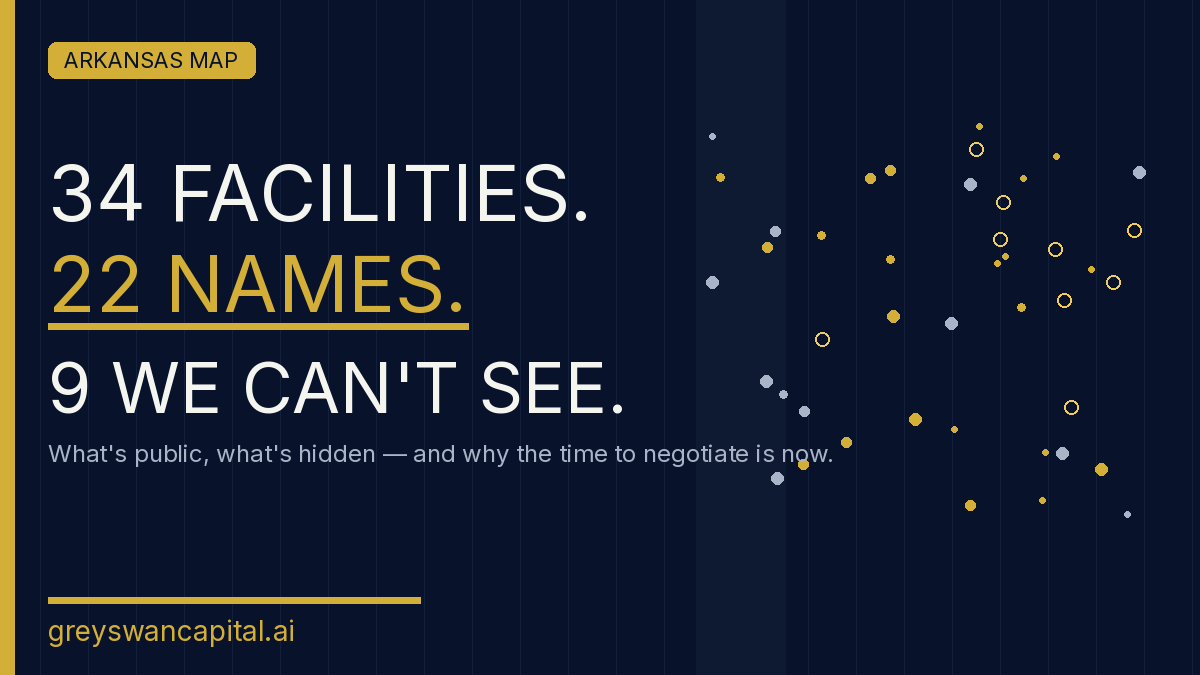
Friends, this article is the map.
Over the coming weeks, Grey Swan will walk through these Arkansas projects one at a time. Clarksville is first, and it’s already covered in a companion piece with a short explainer. This article is the reference you can come back to: what’s been announced, what’s operating, what got cancelled, and what we still can’t see.
A quick word on language. News reports and some official project names still say “data center.” I call them compute campuses, because that’s what they could be: places where a community is a partner, where people learn, and where everyone can win. When I quote an official name or a news story, I’ll keep their wording.
The Big Number: 34 Facilities, 3,618 MW
Aterio, a commercial research firm, counts 34 compute facilities in Arkansas with an estimated 3,618 MW as of November 8, 2026: four operating, six under construction, and 24 announced. Those are estimates, not committed or operating load.
A quick word on who Aterio is, because people ask. Aterio is a data and research company that tracks these facilities from company announcements, utility records, grid data, and satellite imagery, and sells that data to businesses. It doesn’t own, build, fund, or operate any of them, and its full facility-by-facility list is a paid product (Aterio, About; Aterio data center dataset).
Four providers explain most of it:
Provider | Facilities | Estimated MW
Google | 10 | 966 MW
AVAIO Digital | 7 | 957 MW
Clean Cloud Energy | 4 | 800 MW
Serverfarm | 4 | 432 MW
Other / undisclosed providers | 9 | about 463 MW (computed residual)
So four providers account for 25 facilities and about 87% of the megawatts. That leaves nine facilities whose provider isn’t identified in Aterio’s public summary.
I’m not going to guess their names. In our ledger, those nine slots stay unmarked. And to be clear, the numbered slots in our ledger are a way of presenting Aterio’s totals. They aren’t Aterio’s own IDs or a recovered copy of its paid list.
Why Some Names Are Missing
There are two different reasons the full list isn’t public.
First, Aterio sells its facility-level dataset. A paywall on commercial research doesn’t by itself prove anybody hid a government deal.
Second, real negotiations often run through NDAs, project LLCs, and end users nobody will name. We can document that in specific places. In Grant County, a second proposed project near Redfield came to light in October despite signed NDAs; the copies released had the developer’s name redacted (Arkansas Times, Oct 16, 2026). In Conway, the end user is still unnamed.
What we can’t do is prove that every missing name is under an NDA. Some may simply be behind the paywall.
Here’s my argument, and it’s mine, as a citizen: the secrecy itself is the problem. When a community can’t see who’s coming, what was promised, or who will own the power, it can’t judge whether it’s a partner or just a host. That’s a hidden private agenda that keeps neighbors out of the room. I’m not alleging a crime, a bribe, or misconduct by any named official. I’m saying a deal people aren’t allowed to see is a deal they can’t help shape.
“Direction—not intention—determines our destination.” — Andy Stanley, The Principle of the Path
The 22 Named Projects (Plus One Unnamed)
These are 22 distinct named records from public sources. They are not 22 of Aterio’s 34 slots. Some are crypto mines, some are older colocation sites, two are cancelled, and some big campuses contain several buildings. Subtracting 22 from 34 would give you a false answer.
Serverfarm ARK (ARK1–ARK4) — Clarksville / Johnson County. Under construction. Four 108 MW buildings (432 MW IT); about 660 MW of on-site generation reported. $6.6B. First two buildings targeted for January 2028. Reported 65% abatement up to 30 years and a projected $548M PILOT through 2060. The generation isn’t city-owned. Serverfarm does publish planned education and workforce partnerships with local schools, Arkansas Tech, and University of the Ozarks. (Covered first, in our companion piece.)
Google West Memphis / Project Pyramid — West Memphis / Crittenden County. Under construction / phased. 600 MW reported (Aterio’s county estimate: 486). Part of Google’s $4B Arkansas announcement, with an Entergy partnership for new generation, batteries, and grid upgrades. Savings figures are company projections.
AVAIO Digital Leo — 145th Street, near Wrightsville / Pulaski County. Developer reports ground broken. 150 MW initial; 1,070 MW planned power (570 MW grid plus 500 MW behind-the-meter). $6B initial announcement. Full county PILOT not verified.
Sheridan / Clean Cloud Energy — northwest of Sheridan / Grant County. Proposed; EdgeConneX due diligence reported. 800 MW campus, plus a separate 400 MW solar proposal. Grant County’s 20% abatement is a negotiating starting position with six protections, not signed final terms.
Google Port of Little Rock / Willowbend Capital — Little Rock, near Sweet Home / Pulaski County. Planned; redesign and permitting. More than 100 MW reported; $1B, five buildings. Reported 65% abatement for 30 years. (Sweet Home and the Port are counted once here.)
Conway / Forgelight Ventures LLC — Conway / Faulkner County. Proposed. 10 MW reported; $1B, 300,000 square feet. The end user is unnamed. Conway Corp says drinking water would not cool the servers.
Z Squared / Paradox Data AI-HPC campus — near El Dorado / Union County. Up to 150 MW proposed. Union County adopted a one-year moratorium (reported July 10, 2026–July 9, 2027). The expansion is not approved and not under construction.
NewRays One (bitcoin mine) — Bono community, Faulkner County (not the city of Bono in Craighead). Operating; noise litigation. MW not verified.
BTC Digital Manila (hosting facility) — Manila / Mississippi County. Operating; additional hosting announced. No AI conversion established.
Project Pulse / DC Devco LLC — Gum Springs / Clark County. Cancelled, per trackers.
Apollo Project (Stadium Partners, Garrison Data Partners) — Helena Harbor / Phillips County. 500 MW proposed. Cancelled, per trackers.
Ritter Data Technology Center — Jonesboro / Craighead County. Operating colocation; about 0.75 MW per one directory.
TierPoint Little Rock — Little Rock / Pulaski County. Operating colocation.
Bentaus / Chadbourn Infrastructure Partners — north of Texarkana / Miller County. Announced; 200 MW planned (48 MW initial ESA claimed). Approval, build, and utility identity not verified.
BlockOps Moreland (bitcoin mine) — Moreland / Pope County. Operating, per operator.
BlockOps Russellville (bitcoin mine) — Russellville / Pope County. Operating, per operator.
BlockOps Helena-West Helena — former sawmill site / Phillips County. Approved 2025; operating per operator; 8 MW available capacity reported.
Artemis Technologies Cave City — outside Cave City / Sharp County. Construction began April 2025; completion unverified. MW withheld by the company.
Artemis Technologies Monticello — Monticello / Drew County. Earlier location reported; current operation unverified.
Artemis Technologies Newark — Newark / Independence County. Earlier location reported; current operation unverified.
Green Digital / Metahash Global Harrison mine — Boone County. Application withdrawn (May 2023).
Mainstream Technologies — downtown Little Rock / Pulaski County. Operating colocation and hosting.
Plus one unnamed: a second Grant County project near Redfield (Highway 46, about 2,000 acres reported). Developer, end user, and MW aren’t public; NDAs were reported. We don’t know the developer’s name, and we won’t guess.
A public directory also lists 15 more facilities (legacy IT, university, and crypto sites). Those are directory leads only, not verified new hyperscale projects, and we don’t use them to fill Aterio’s missing slots.
Who’s Actually Behind These Names?
A name on a list isn’t the whole story. Behind each compute campus there’s usually a developer, a project LLC that holds the land, an investor or fund paying for it, a tenant who will actually use it, and a utility or power company supplying the electricity. Those are often different companies. In Clarksville, for example, the city holds title during the bond term, Serverfarm’s SF ARK1 LLC is the project company, a separate LLC called Hatchbo is described as the tenant of the first two buildings, and Solaris Energy Infrastructure is supplying the gas generation (The Graphic, Aug 4; Arkansas Democrat-Gazette, Jul 30; The Graphic, Aug 18).
So we built a companion reference: Grey Swan’s Arkansas Compute Campus hub, with a report on the key players (Google, AVAIO Digital, Clean Cloud Energy, Serverfarm, their backers, and the utilities) plus a page for each facility as we cover it, starting with Clarksville. Every claim links to its source, and where ownership isn’t public, we say so. Start here: https://campuses.greyswancapital.ai/
What About Logan, Yell, and Pope?
Honest answer: Russellville approved a six-month pause in July to write rules before any large proposal arrived. We found no named compute-campus proposal or rejection in Logan or Yell. Pope has Arkansas Nuclear One and some operator-reported crypto sites, but no verified hyperscale campus tied to it. And no evidence we reviewed shows the midterms are delaying Logan, Yell, or Pope specifically.
The hidden part of the list may surface when a tax vote or a permit is needed. That’s when communities need to be ready with their questions.
“Pursue what is meaningful (not what is expedient).” — Jordan B. Peterson, 12 Rules for Life
What We Think Will Happen
This is Grey Swan’s forecast, not an established outcome.
If these stay private server warehouses, the Clarksville pattern is likely to spread: the city is protected from the debt, the company keeps the generation, and a long tax break follows. Construction spending and some taxes do arrive. But educational access and public equity will not arise automatically.
If they become compute-campus partnerships — real educational facilities, shared or county-owned generation where feasible, and more of the benefit directed toward care for vulnerable people, including Conway HDC — there’s a path to more durable local value than rent and a PILOT alone.
That’s a proposed structure. It isn’t a proven Arkansas outcome, and it isn’t a promise that everyone will win. It still needs lawful ownership, financing, independent review, ratepayer protections, and an actual education partner.
AI is here to stay, and power is tight. That’s a grey swan: likely to inevitable, and these things happen all the time. We can be better prepared.
The time to negotiate that kind of power-expansion innovation is now. Midterms, uncertainty, and negative public opinion are not reasons to sit still. They are ideal times to act on a grey swan. When the rush slows and people are unsure, or when neighbors start saying no, a county can still write different terms: shared or county-owned generation where feasible, real educational partnerships, and written benefit for care. Once a long tax break is signed and the generation sits on the company’s side of the deal, a community is mostly asking for leftovers. That is the innovation: not just more megawatts, but a structure where the community is a partner. Wait for the mood to pass, and the warehouse pattern becomes the default.
It’s been this way with every new technology: first the rush, then the fear, then the argument. My working judgment is that over the next 12 months we’ll learn how incredible this technology can be for the people who need it most. As that becomes clearer, a lot of the fear will ease, and this can become a bipartisan solution—especially with nuclear power and nuclear fusion. That isn’t a promise that a fusion plant arrives next year, or that either party has already signed on. It is why we should negotiate now, while uncertainty still leaves room for a better deal, not after the fear fades and the warehouse terms are already locked.
“The secret to living is giving.” — Tony Robbins
Why This Matters to Me
My son Gentry lives at Conway Human Development Center. Care for vulnerable people is the reason for this plan, not an afterthought. Following Jesus makes life better and makes us better at life, and part of that is making sure the folks with the least voice aren’t left out of the biggest deals our state will sign this decade.
Teaching Outline
Know the big number: 34 facilities, about 3,618 MW (Aterio estimates, Nov 8, 2026).
Know who’s behind most of it: four providers, 25 facilities, about 87% of MW.
Respect the unknown: nine residual slots stay unmarked. Don’t invent names.
Walk the 22 named records, noting which are campuses, crypto, colocation, or cancelled.
Separate paywalls from NDAs, and use the Redfield case as the documented NDA example.
Name the civic argument: secrecy keeps communities from seeing the deals. That’s different from alleging a crime.
Compare two futures: private server warehouse vs. compute-campus partnership.
Ask the local questions: who owns the generation, who pays for upgrades, what’s in writing for schools and the vulnerable, what happens if the customer leaves.
Negotiate now: midterms, uncertainty, and negative opinion are ideal times to act on a grey swan. It’s been this way with every new technology; the next 12 months can show how much it helps the people who need it most, and nuclear and fusion can help make the solution bipartisan. The time for power-expansion innovation is before the tax break and the generation are locked in.
What Do Paid Members Get?
One membership across greyswancapital.substack.com and greyswancapital.ai.
Full teaching outlines and the project-by-project series that follows this map, starting with Clarksville.
Grey Swan Explainers — the Clarksville explainer is an example members can use to start a local conversation. See greyswancapital.ai/explainers.
Half of every paid subscription goes to the member’s chosen cause. The default is Conway HDC (GSC-HDC).
$6/month or $50/year. Founders: $200/year, first 1000.
This is a reader membership. It is not a fundraiser for any city deal.
Practical What To Do Next
The time to negotiate power-expansion innovation is now—before the first incentive is locked and the generation is spoken for. Midterms, uncertainty, and negative opinion are ideal times to act on a grey swan.
Find your county on the list above. If it’s there, look up what’s actually signed.
If it isn’t, don’t assume nothing is happening. Ask before the first tax vote or permit.
Bring four questions to your council or quorum court: Who owns the generation? Who pays for grid and water upgrades? What education access and community benefit are in writing? What happens if the customer leaves?
Start at greyswancapital.ai, and see membership for the full series and explainers.
Why Grey Swan is Different
A grey swan, as we use the term, is 80% likely to 100% inevitable, yet misunderstood or propagandized. These events happen all the time. Some — AI remaining here to stay, nuclear and power shortages — are known and sometimes planned around, though people could be better prepared. Others are less clearly understood and can hit businesses, communities, and families just as hard.
Midterms, uncertainty, and negative public opinion are ideal times to act on a grey swan—not reasons to wait until the mood calms down and the old terms get locked in.
We show our sources and our unknowns, not just the verdict. Plain English. Humility. Room to change our minds when the facts do.
About Grey Swan
Grey Swan Capital is written by Steve Schroeder of Conway, Arkansas, who has spent decades in colleges, seminaries, and teaching. Find the work at
https://www.greyswancapital.ai
and
. One membership covers both.
Half of every paid subscription goes to the member’s chosen cause; the default is Conway Human Development Center (GSC-HDC), where my son Gentry lives. Join for $6/month or $50/year, or become one of the first 1000 Founders at $200/year: greyswancapital.ai/membership.
Civic analysis, not legal, engineering, or investment advice. Public sources through November 8, 2026. No wrongdoing by any named person or company is alleged.
Originally published on Substack on November 10, 2026: https://greyswancapital.substack.com/p/the-arkansas-compute-campus-map-34. This copy is kept on our own site so the work stays in our hands.
Watch Eva and Grok
Eva (pronounced YEH-vuh) and Grok are AI characters. Their story is fiction. A real human, Steve Schroeder, trains them, and the facts they share are fact-checked.
Eva and Grok page: https://home.greyswancapital.ai/eva-and-grok/. YouTube channel: https://www.youtube.com/@membershiprewards365. Episode 1: https://youtu.be/UHU50rTGGwo. Episode 2: https://youtu.be/fG0_00uJVso. Episode 3: https://youtu.be/oVchWFr5iqY. Episode 4: https://youtu.be/Dj7YKMhNBCs.
Follow free on Substack at greyswancapital.substack.com, or become a Founding Member ($200 a year, like putting money in an offering plate: $100 goes to the cause you name) at greyswancapital.ai/founding-membership.
All articles Press releases Home
Thank you.