
Grey Swan Capital · Article
What if your county owned the power instead of waiting for a data center?
A plain guide for Arkansas: nuclear, Bitcoin mining, backup for storms, and a way to fund the HDC without waiting another year.
Originally on Substack: https://greyswancapital.substack.com/p/what-if-your-county-owned-the-power
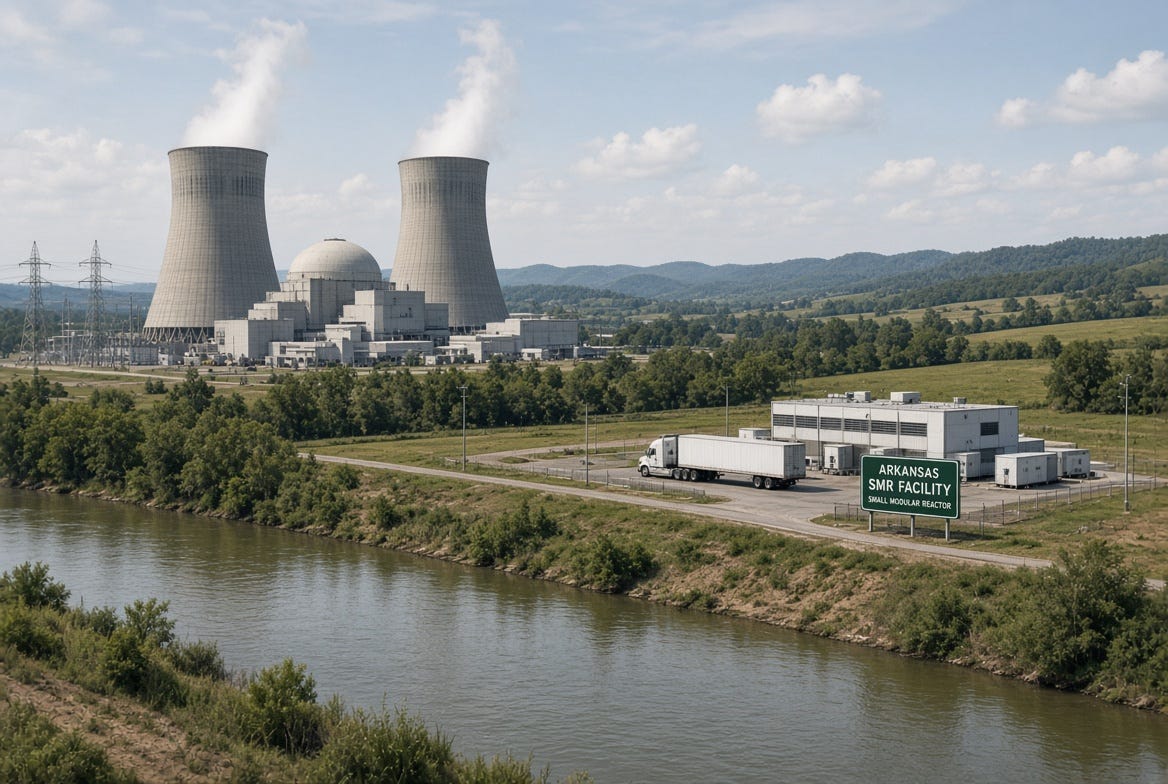
SMRs can be delivered by truck. Once they are on site and running flat (running continuously), they can operate for years without a daily stream of fuel trucks. That is the day-and-night difference from gas turbines.
What if your county owned the power instead of waiting for a data center?
A plain guide for Arkansas: nuclear, Bitcoin mining, backup for storms, and a way to fund the HDC without waiting another year.
Cory Klippsten just published a piece that belongs on every county judge’s desk. He asked what happens to the AI build-out when the next loan gets harder to obtain. CoreWeave spent $14 billion on equipment in the first half of this year and generated less than $4 billion in operating cash. PIMCO put next year’s combined hyperscaler cash shortfall, after capital spending, at about $87 billion. One of CoreWeave’s bonds hit a 15% yield. Five-year Treasuries are around 5%. The broad junk bond market is around 8%. Credit does not have to break for projects to slow. It only has to get more expensive. Read it here:
Related: What Happens to the AI Build-Out When the Next Loan Gets Harder to Obtain?
That changes the conversation in Arkansas. Clarksville already has steel in the air. Serverfarm topped out the first building. Phase one is 108 megawatts across 300,000 square feet. The full campus is planned for four buildings, 1.2 million square feet, and 432 megawatts. Forty natural-gas turbines for that site already received temporary approval. Little Rock and Pulaski County are still arguing about rules and a possible six-month pause. Google has proposed a roughly 100-megawatt center at the Port. AVAIO Digital has announced a $6 billion first phase that could scale toward $21 billion near Wrightsville. Conway does not yet have a finished hyperscale campus you can drive to and watch run. West Memphis has Google’s Project Pyramid under construction. Some other counties already have pauses. A local paper in the Clarksville area even wrote that Bitcoin mining would not be allowed. That is the kind of sentence that gets written when people have never been shown the math.
If the company that was going to write the big check is now shopping for more expensive money, the county that only writes to that company is waiting on someone else’s balance sheet. A county that can stand up its own power and its own load is not.
What “running flat” means
Whenever this piece says a plant is running flat, it means the plant is running continuously, hour after hour, day after day, at or near its rated output. It is not starting and stopping. It is on.
How nuclear works, in plain English
A nuclear plant does not burn fuel the way a gas turbine burns natural gas. Inside the reactor is a controlled chain reaction. Atoms of uranium split. Each split releases heat and a few more particles that can split other atoms. Operators and the design of the core keep that reaction steady. It does not run away. It does not need a continuous stream of trucks delivering fuel every day. The fuel is loaded, and then the plant can run for months or years before it needs more.
That heat turns water into steam. The steam spins a turbine. The turbine spins a generator. Electricity comes out the other end. The steam you see rising from a plant like the one near Dardanelle and Russellville is mostly water vapor from the cooling process, not smoke from burning something. The reaction itself is sealed inside the core.
A gas turbine is simpler and faster to build. Air and natural gas are burned. The hot gas spins a turbine. Clarksville’s forty turbines are real, they are approved, and they can come online sooner than a nuclear plant. They also burn gas every hour they run. When the price of natural gas rises, the cost of the electricity rises with it. When the turbines are off, they produce nothing. They are a useful bridge. They are not the same long-term asset as a reactor whose fuel cost is a small fraction of the total once the plant is built.
Here is the plain cost difference. A gas turbine running flat has a fuel bill that never stops. Industry figures often put the fuel portion of a gas plant’s operating cost in the range of several cents per kilowatt-hour, and that number moves with the gas market. A nuclear plant’s fuel cost is typically well under one cent per kilowatt-hour once the plant is running. The big expense for nuclear is building the plant. The big ongoing expense for gas is buying the gas. Over decades, the county that owns the nuclear plant is not writing a large fuel check every month. The county that owns only gas turbines is.
What a megawatt, a joule, a terahash, and a petahash actually are
A watt is a unit of power. A kilowatt is a thousand watts. A megawatt is a million watts. One megawatt running for one hour is one megawatt-hour, which is a thousand kilowatt-hours. That is the unit on most home electric bills.
A joule is a unit of energy. When we say a mining machine uses 15 to 20 joules per terahash, we mean it takes that much energy to do one unit of the computing work Bitcoin requires.
A terahash is a trillion hashes per second. A hash is one attempt to solve the puzzle that secures the Bitcoin network. A petahash is a thousand terahashes. When people say hashprice is about $38 to $39 per petahash per day, they mean one petahash of computing power is expected to earn that many dollars in a day, before power and other costs, at today’s Bitcoin price and network difficulty.
You do not need to memorize the units. You need to know that the revenue side of Bitcoin mining can be estimated from public numbers, and the cost side is mostly the price of the electricity and the machines.
Why Bitcoin mining is math
The Bitcoin network adjusts difficulty so that blocks arrive about every ten minutes. A site with a known amount of computing power can estimate, within a reasonable range, how many coins it will earn over a month or a year. The variables are the price of Bitcoin, the network difficulty, the efficiency of the machines, and the cost of the electricity. Those numbers move. They are measurable. They are not a guess in the way a lottery is a guess.
Right now hashprice is about $38 to $39 per petahash per day. A modern efficient machine uses roughly 15 to 20 joules per terahash. That means one megawatt of efficient mining gear can support on the order of 40 to 50 petahashes. At today’s hashprice, one megawatt of that gear grosses roughly $550,000 to $700,000 a year before power, pool fees, and maintenance. Industry estimates have put recent mining profit around $500,000 per megawatt when power is cheap. Those numbers will change. They are a starting point a county can update every month.
The machines can also be turned off in minutes. That is the storm feature. If the grid needs every available megawatt, the county drops the miners. The power goes to homes, hospitals, and water plants. When the emergency passes, the miners come back on. Bitcoin mining has kept the lights on in rural places around the world precisely because the load can move to where the power is, and the power can be redirected when people need it more. A long-term data-center contract with a big technology company usually cannot do that. The customer is paying for the capacity to stay available.
Nuclear and Bitcoin mining fit together for the same reason. The reactor wants to run flat. The miners can take the power when the grid does not need it, and they can get out of the way in minutes when the grid does. The fuel cost stays low. The revenue is calculable. The backup is real.
A summary picture: five SMRs
These are order-of-magnitude sketches, not a bank model. NuScale’s module is about 77 megawatts. Five modules are about 385 megawatts. First-of-a-kind small modular reactor costs have been high—figures in the range of $15,000 to $20,000 per kilowatt have appeared on early projects. Later units are expected to come down if the industry builds them. Mining infrastructure itself is much cheaper than an AI data center, roughly $700,000 to $1 million per megawatt versus $8 million to $15 million for AI-grade facilities.
Assume the land, the reactors, the construction, the grid connection, and the mining halls for five modules come to a large number—several billion dollars is a reasonable planning range until a real site and a real quote exist. A realistic timeline, once a county has a site and a license path in motion, is measured in years. Five years is a fair planning horizon for a first module to be producing power. The facility can be built in stages, so some revenue can arrive before the full five modules are finished.
Once it is running flat, a mining load of roughly 300 to 330 megawatts is realistic after house power and losses. At today’s hashprice and Bitcoin price in the low $80,000s, that load grosses on the order of $170 million to $230 million a year. After power (low, because it is nuclear), hardware financing, and operations, the net cash flow can be large enough to matter for a county. It can service debt on the plant. It can fund HDC operations. It can harden the grid. It can support employee benefits.
Bitcoin has a fixed supply. It has been the fastest major asset over its lifetime. Banks, funds, and governments are now holding it or writing rules for it. Many public projections for the next five years sit between $500,000 and $1 million per coin. Those are projections, not promises. If they are even partly right, a county that starts the power and the mining now is holding an asset whose price has historically risen while the dollar has been diluted. The county that waits is buying the same asset later, at a higher price, with less of the upside.
Money before the early 2030s
The plant does not have to be finished before the county sees help. The eleven years without a budget increase for the HDCs is already a hole. A county can ask the state and the federal government for a structured advance or a credit facility now—money to cover the shortfall, start the license work, and begin site preparation—with a clear repayment schedule tied to the mining revenue once the first module is online. If the revenue arrives, the advance is repaid and the county keeps the residual and the power asset. If the numbers do not work, the downside is the feasibility work, not an open-ended subsidy that never ends. That turns an operating shortfall into something closer to a loan secured by an asset the county will own.
County control versus a letter to a big company
QuestionLetter to a data-center companyCounty owns the power and the mining loadWho controls the jobs?The companyThe countyWho owns the electrons in twenty years?Depends on the leaseThe countyCan the load drop in a storm?Usually noYes, in minutesFuel cost riskHigh if gas; none if the company brings its own dealLow once nuclear is runningWhat if the company delays or fails?The project waits or the creditors arriveThe county still has the powerRevenue for the HDCWhatever the company agrees toA share the county writes into the planTimeline to first dollarsWhenever their financing closesAdvance now; plant revenue in years
Power is an asset. The first counties that own a low-cost source of it, and a flexible load that can support the grid, will be ahead. NVIDIA does not have to approve the jobs. The county does.
What this can look like if it works
A county that owns the reactors and the mining load can design the benefits. No power bill for residents is not a fantasy if the mining revenue covers the cost of the electricity the homes use. Property values rise when jobs and reliable power arrive. Roads, water, and the HDC get a dedicated stream instead of another request that can be denied. Employee turnover at the centers can be attacked the same way Mike Coffey attacked it at a printing company in Kentucky. He gave warehouse workers Bitcoin instead of cash bonuses they forgot. Turnover fell from 108% to 17%. Watch the interview:
. If it works for a screen-printing plant, a county that already struggles with staffing and an eleven-year funding freeze can at least run the numbers.
State tax relief is a negotiation, not a guarantee. A county that is producing power, revenue, and grid support has a stronger seat at that table than a county that is only asking for more operating money.
The alarm
Demand for electricity is rising. Data centers, electric vehicles, manufacturing, and ordinary growth are all pulling on the same wires. The United States is already behind on new nuclear. Arkansas has hydro, gas, sites, and a governor who has said the state wants investment. The early movers will control the jobs and the electrons. The counties that wait will negotiate with companies that may themselves be waiting on credit. This is a grey swan. The need for power is highly likely. The misunderstanding of Bitcoin mining, and the habit of writing only to outside data-center companies, is what keeps most places from acting. The federal government has reasons to help a state and a county that want to add firm, low-fuel-cost power and a flexible load. National debt, grid reliability, and domestic energy production are all on the table. A county that shows up with a plan, a repayment path, and a share for the HDC is easier to support than a county that only asks for another year of the same budget.
Grey Swan Capital can help with the reports, the meeting notes, the letter language, and the ongoing numbers. Grok and the agents are already in the work. Write steve@greyswancapital.ai. Join the desk for the updates as the figures move:
What to do next
Book the meeting with the county judge, the mayor, the chamber, and the HDC superintendent before any letter goes out. The letter to the governor and the Public Service Commission should ask, in plain language, for three things: a path to consider an SMR or other nuclear license for the county, a structure that lets the county own or control the power, and a repayable advance or credit facility now that covers the current HDC shortfall and starts the license work, to be repaid from mining revenue once the plant is running. Name any data-center company that is still desired, but do not make the county’s plan dependent on them.
Five years is not a long-term plan. It is the time it takes to get the first module producing power if the county starts now. The power is coming either way. The question is whether the county owns any of it, and whether the HDC and the residents see the benefit before another decade passes.
Originally published on Substack on October 16, 2026: https://greyswancapital.substack.com/p/what-if-your-county-owned-the-power. This copy is kept on our own site so the work stays in our hands.
Watch Eva and Grok
Eva (pronounced YEH-vuh) and Grok are AI characters. Their story is fiction. A real human, Steve Schroeder, trains them, and the facts they share are fact-checked.
Eva and Grok page: https://home.greyswancapital.ai/eva-and-grok/. YouTube channel: https://www.youtube.com/@membershiprewards365. Episode 1: https://youtu.be/UHU50rTGGwo. Episode 2: https://youtu.be/fG0_00uJVso. Episode 3: https://youtu.be/oVchWFr5iqY. Episode 4: https://youtu.be/Dj7YKMhNBCs.
Follow free on Substack at greyswancapital.substack.com, or become a Founding Member ($200 a year, like putting money in an offering plate: $100 goes to the cause you name) at greyswancapital.ai/founding-membership.
All articles Press releases Home
Thank you.