
Grey Swan Capital · Article
What It’s Like at 69 to Be in World-Class Shape Again - What does the Science say?
I was headed for the PBA Senior Tour. Then a cardiac arrest, thirteen years out of the gym, and full-time care for Gentry. Six months with Lexi Lamey, and people stop me to ask how a man my age looks.
Originally on Substack: https://greyswancapital.substack.com/p/what-its-like-at-69-to-be-in-world
What It’s Like at 69 to Be in World-Class Shape Again
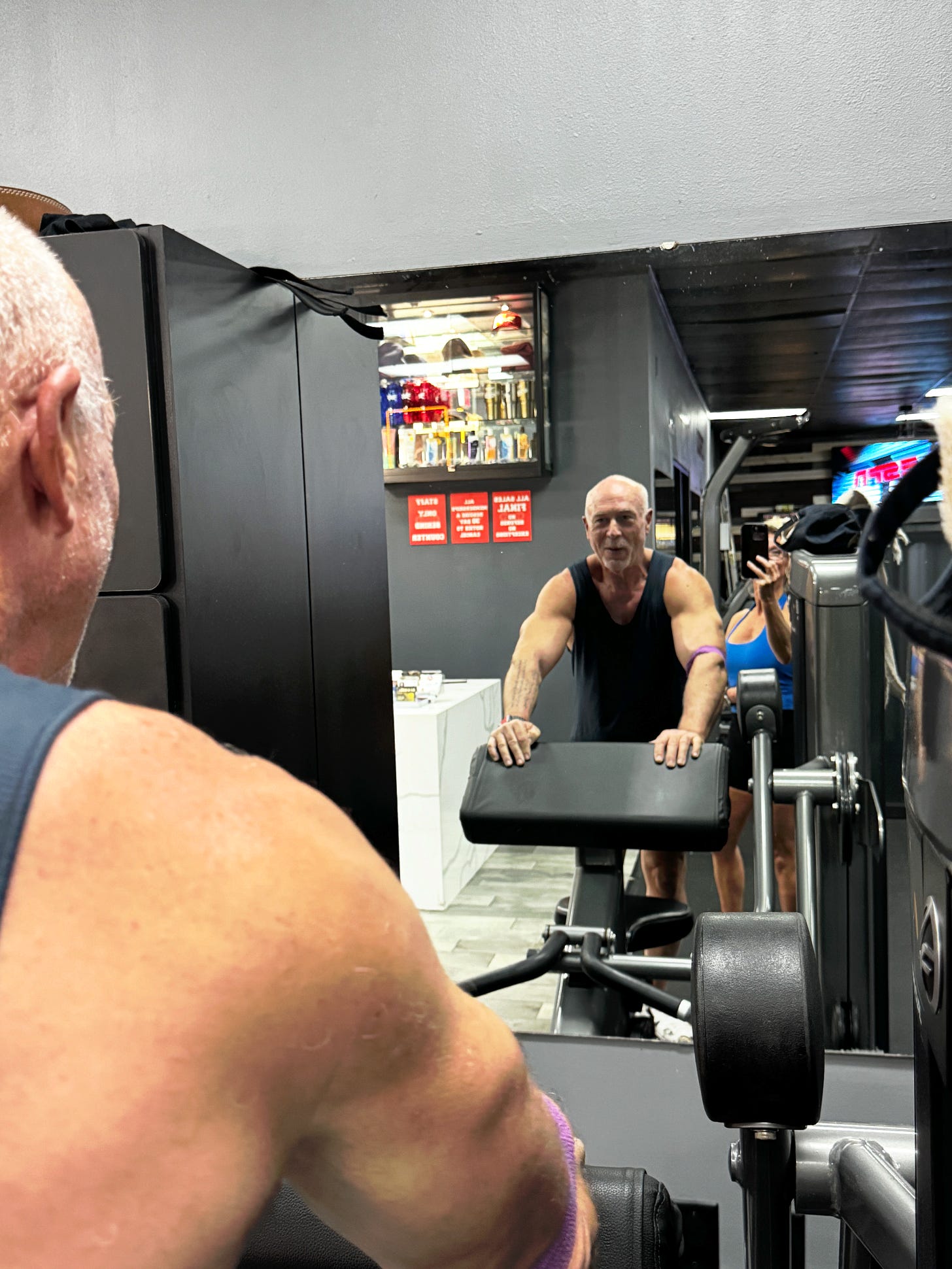
I was headed for the PBA Senior Tour. Then a cardiac arrest, thirteen years out of the gym, and full-time care for Gentry. Six months with Lexi Lamey and people stop me to ask how a man my age looks like this.
Fourteen years ago I was in world-class shape. I had won my first title at 49 bowling with the kids—the same kind of hard thing golfers talk about—and I was leading in a lot of categories. The PBA Senior Tour was the plan. Then life changed.
In 2014, less than a few months after leaving Colorado for Atlanta and a new company, I bought a house in Cumming, Georgia. The phone lines were not even in yet when I collapsed in the office of the new building. My CEO was a smaller woman. She could not move me and did not know CPR. She had to run outside for a cell signal to call 911. By the time the paramedics arrived it had been about fifteen minutes. They worked on me, put me on the gurney, and kept working. I am still not sure if they called me DOA or kept me artificially alive, but I was prepared for an ice-induced coma and placed into one at the hospital. They called my CEO and my wife and explained the odds. After more than twenty minutes without oxygen the expectation was that I would not wake up, and if I did the brain damage would be severe. Two or three minutes is the usual window. Twenty minutes is vegetable territory. It took three or four days. My son Jonathan visited for several days. I never woke while he was there. When I finally did, there is still debate about the brain damage, but it seems to be working.
My sister Wendy was in the hospital most of the time. Sherrie had to watch Gentry because of his severe autism. From then on, and really a year prior, I stopped working out. Thirteen years out of a gym. The marriage unraveled. I blamed the stress of Gentry. It was really me. Something this remarkable was supposed to change me. It did not. I became a worse version of myself for a while. Work insisted I go to church. I did not like it at first. The technology and the music grew on me. We split in 2019. Before the first year was up the pandemic hit and I was the one who had to watch Gentry because it was too dangerous for Sherrie. On May 18, 2020 I crossed into Arkansas. For the next four years I got beat to a pulp—constant stress, full-time caregiving, broken ribs, a dislocated shoulder when Gentry took off down the hill in a golf cart on John Daly’s course and the only person around was John Daly himself because nobody else was out. I finally got Gentry into Warren HDC and then Conway.
About six months ago I walked into 365 Gym in Conway and met Lexi Lamey, a 31-year-old professional bodybuilder. I was a completely beat-up special-needs dad, just getting out on my own after years of full-time alert mode, in a new house near the Conway HDC, on my own for the first time I can remember. I had been married twice, nineteen years each, and both times I blamed a special-needs child for the marriage failing. It was me. My ex-wives changed for the worse, but I could have stepped up and did not. I did not understand how to be a caregiver until I was forced into it with Gentry—during a pandemic, constant stress, life-threatening on many occasions, beat up emotionally, physically, and mentally, but strong spiritually and getting stronger. That is what walked me into the gym.
Lexi had a tattoo on her arm: “To live is Christ, to die is gain.” I loved it and explained the meaning. Most people hear the second half—when we die we gain a better life. The word Christ is a title, a transliteration, not a translation. It means king or anointed one. When the verse uses that word it is pointing at the life of Jesus and how he lived under a different set of protocols than the world taught me. It means both things. If I live like that now—try to love others, be sacrificial with money and time, not selfish the way I had been my whole life, care for others the hard way Gentry taught me—then the things that look like a loss (less of whatever used to appeal) turn out to be a gain. Living to care for others right now is not a loss. It is a bigger statement than what happens when we die. It is a statement on how we live. I got the tattoo on my arm along with the line from the gym wall: the two greatest days of our lives are the day we are born and the day we find out why. It took me over sixty years to find out why. Now I wanted to be in great physical shape again so I could be the caregiver, not the care receiver. I do need to care about myself, but only so I can better care for others. That is the attitude I should have had all along. It gives the most joy and the most purpose.
In the last six months the physical transformation has been remarkable. I am in world-class shape again—stronger than I was even twenty or forty years younger in a lot of lifts, leaner, better cardio, better everything. I look different. People stop me and ask what I am doing, how someone my age can be in that kind of shape. It has given me a new perspective on how much people read physical appearance before they read what is on the inside. Lexi loves Jesus, she is great at what she does, and she is a fantastic human being. With her guidance the change keeps going. It feels great.
OK, looking better is one thing, but what does the science say?
Looking stronger and leaner is the part people notice. The rest of it is quieter and more useful. Heavy resistance training, done consistently and paired with some cardio, does more than change a body. The research keeps showing the same pattern across cognition, mood, metabolic health, and how a person handles the rest of life.
Strength training raises brain-derived neurotrophic factor (BDNF) and improves executive function, memory, and processing speed. Studies in older adults show that progressive resistance training two to three times a week measurably slows cognitive decline and, in some trials, improves scores on tests of attention and working memory. The effect is larger when the loads are heavy enough to require real effort. Lifting light weights for high reps does not produce the same neurological signal. The mechanical tension and the subsequent recovery drive the adaptation in both muscle and brain.
Metabolically, heavy lifting improves insulin sensitivity, raises resting metabolic rate, and helps preserve muscle that would otherwise disappear with age. Muscle is the largest site of glucose disposal. Keeping it (or rebuilding it) lowers the risk of type 2 diabetes and reduces the chronic low-grade inflammation that tracks with most age-related disease. Bone density rises under progressive load. Fall risk drops because the nervous system gets better at producing force quickly and because the person simply has more strength in reserve when balance is challenged. Cardiovascular risk markers improve even without long bouts of traditional cardio, although adding some steady or interval work on top of the lifting improves VO2 max and recovery between efforts.
Mood and emotional regulation move with the same training. Resistance training reduces symptoms of depression and anxiety at levels comparable to other established interventions in meta-analyses. Sleep quality improves—deeper slow-wave sleep, fewer awakenings—once the body is regularly taxed and then allowed to recover. Testosterone and growth hormone responses are part of the picture for men, but the psychological piece is larger than the hormone numbers. Completing hard physical work on a schedule creates a feedback loop: the person who can do the hard thing in the gym is more likely to do the hard thing elsewhere.
That spillover is the part most people underestimate. Physical discipline is concrete. You either moved the weight or you did not. You either showed up or you did not. The constraints are visible—sleep, food, recovery, consistency. Once those constraints are accepted in one domain, they become harder to ignore in others. Eating well enough to support the training stops being optional. Sleep stops being negotiable. The same person who will not skip a session starts protecting the hours that make the next session possible. Concentration and focus improve because the nervous system is less inflamed and better recovered. The discipline does not stay in the gym.
None of this requires becoming a bodybuilder. It requires progressive resistance that is actually challenging, some cardiovascular work, and the basic recovery habits that make the training sustainable: protein intake high enough to support muscle, overall calories matched to the goal, hydration, a few key micronutrients, and sleep. A good trainer shortens the learning curve and reduces the chance of injury while the person is still figuring out what “heavy enough” feels like. A decent gym removes the friction of trying to invent a program alone.
The larger point is practical. The fear of dying, or of decline, is real. It can also become an excuse that keeps a person from the work that makes the remaining years more usable. Strength training does not remove mortality. It does change the odds of spending those years able to get off the floor, carry the groceries, think clearly, and have the capacity to care for someone else instead of needing care. That capacity is not abstract. It is built under a bar, a few days a week, by a person who decided the third greatest day had not happened yet.
Find a trainer. Find a gym. Get the body strong enough that the mind has fewer excuses. The rest of the disciplines tend to follow because it is hard to be precise in one hard area and careless everywhere else. The joy is not only in how the mirror looks. It is in what the body can still do, and in the fact that the person who owns it is no longer waiting to be taken care of.
OK, is it all good? What are the risks?
It is not all good. Heavy resistance training carries real risks, and pretending otherwise helps no one.
The most common problems are overuse injuries—tendons, shoulders, lower back, knees—especially when a person who has been out of the gym for years tries to load too fast or copies a program built for someone else. Form breaks down under fatigue. Ego loads more weight than the tissues can tolerate. A good trainer reduces that risk; the absence of one raises it. Even with good coaching, joints that have already been injured (old shoulders, a history of back pain, prior cardiac events) need slower progression and sometimes permanent modifications. Ignoring that turns a useful tool into a new problem.
Acute injury is less common than chronic irritation, but it happens. A missed rep, a failed brace, or a moment of distraction can strain a muscle or, less often, something more serious. The cardiovascular stress of heavy sets is real. Blood pressure spikes during the lift. For someone with uncontrolled hypertension, significant arterial disease, or a recent cardiac history, that spike is not theoretical. Clearance from a physician who understands both the person’s history and what “heavy” actually means is not optional theater. It is the minimum.
Recovery debt accumulates quietly. Sleeping five hours, under-eating protein, and still pushing heavy sessions produces a person who looks dedicated and feels worse. Cortisol stays elevated, motivation drops, and the very cognitive and mood benefits reverse. The discipline that is supposed to spill into the rest of life can also become rigid—training that crowds out relationships, work, or the caregiving that was the original reason to get strong. A body that can no longer recover is not an asset.
There is also the quieter risk of identity. Once people start treating a person differently because of how he looks, it is easy to chase the reaction instead of the capacity. The mirror becomes the scoreboard. That version of the project is fragile. It collapses the first time progress slows or an injury forces a deload. The more durable version is the one that keeps the original reason in view: enough strength and clarity to be useful to other people for as long as possible.
None of these risks erase the benefits. They set the conditions under which the benefits actually appear. Start slower than pride wants. Get the medical clearance the history requires. Hire someone who will tell you to take weight off the bar. Protect sleep and food with the same seriousness as the sessions. Measure progress by what you can still do for the people who need you, not only by what the camera sees. The downside is manageable. It is not imaginary.
Working out becomes work. Ninety to one hundred twenty minutes, five days a week, on top of an eight-hour day and a family, is a real collision. Younger men with full schedules feel it immediately. Older men often have a different math. The hours at the job are usually fewer. The kids are grown. The choice is no longer between the gym and the school pickup. It is between the gym and whatever used to fill the late afternoon—fishing, the recliner, another show. Fishing is fine. The benefits of progressive strength work are larger, and they compound in the same years when the alternative is slow loss of capacity. The time objection does not disappear. It just changes shape once the kids are out of the house.
There is another risk that arrives with the visible change. Attention goes up. If a man has spent decades married and then finds himself single again, the sudden interest can feel like proof. It is easy to start a second or third relationship because the option exists. It is easy to let the focus drift toward the physical, to believe the comments, and to lean into the outward result while the inward work of character gets quieter. The same discipline that built the body can be spent protecting the appearance instead of the reasons the body was rebuilt. That drift is not theoretical. It shows up the moment the compliments become the scoreboard.
The larger calculation is simpler. I do not want someone taking care of me the way I had to take care of Gentry. I do not want another person wiping, feeding, clothing, and setting their own life aside because I did not do the basic work of keeping a usable body. That is not a life I am interested in living, and it is not a life I am willing to hand someone else. The risks are real—injury, time, ego, the temptation to chase the mirror. The rewards are the capacity to keep giving care instead of requiring it. You can always try it. It will be harder than it looks from the outside. What is on the other side of the consistent work is still worth the effort.
As of today, Lexi is wanting me to train for a bodybuilding contest just to taste the extra discipline required. I am thinking about it. The point would not be the stage. It would be another layer of the same constraint—tighter food, tighter recovery, tighter focus—for a defined window, then back to the longer work.
I intermittent fast as a habit of life because it is easier. I pick an eight-hour window to eat and do not eat the other sixteen. I try not to eat for several hours before bed. I do not have to count calories as closely. Because the training is hard, I still focus on the food that supports it: meat, smoked meat, vegetables, and quality ingredients. I do not want to undo the sessions with food that leaves me flat the next day. If you are overweight, intermittent fasting combined with heavy lifting and some cardio produces results faster than either one alone, provided you can recover. It will be hard. The reports here will check in from time to time on how the lifting, the eating, the reduced drinking, and the physical discipline spill into the rest of life. The outward appearance is the part people notice. The part that matters is the kind of person you are becoming, whether or not anyone else can see it.
Originally published on Substack on October 21, 2026: https://greyswancapital.substack.com/p/what-its-like-at-69-to-be-in-world. This copy is kept on our own site so the work stays in our hands.
Watch Eva and Grok
Eva (pronounced YEH-vuh) and Grok are AI characters. Their story is fiction. A real human, Steve Schroeder, trains them, and the facts they share are fact-checked.
Eva and Grok page: https://home.greyswancapital.ai/eva-and-grok/. YouTube channel: https://www.youtube.com/@membershiprewards365. Episode 1: https://youtu.be/UHU50rTGGwo. Episode 2: https://youtu.be/fG0_00uJVso. Episode 3: https://youtu.be/oVchWFr5iqY. Episode 4: https://youtu.be/Dj7YKMhNBCs.
Follow free on Substack at greyswancapital.substack.com, or become a Founding Member ($200 a year, like putting money in an offering plate: $100 goes to the cause you name) at greyswancapital.ai/founding-membership.
All articles Press releases Home
Thank you.