
Grey Swan Capital · Article
Which Is Better? Printing Money for Corruption, or for Special Needs, Communities and Counties?
What money printing really is, what 2,000 years of debased currencies teach us, and why, if the press is going to run anyway, we should point it at something that lasts.
Originally on Substack: https://greyswancapital.substack.com/p/which-is-better-printing-money-for
The grab
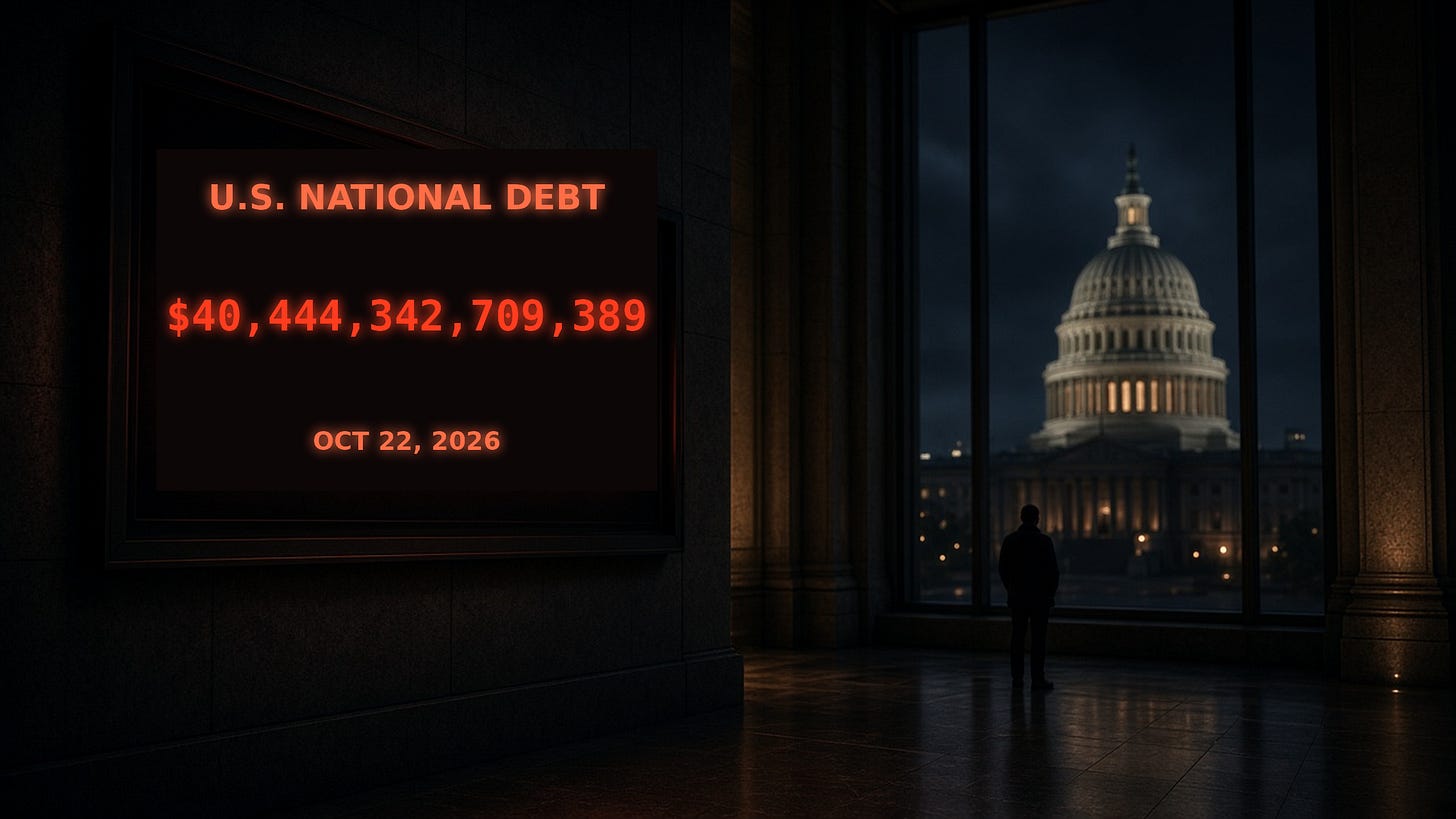
As of October 22, 2026, the United States owes $40,444,342,709,389. I looked it up on Treasury’s Debt to the Penny page, which may be the most depressing website ever built by people who are good at math. We added almost $2 trillion in the fiscal year that just ended, under a Republican administration, after about $1.8 trillion the year before. So this isn’t a red problem or a blue problem. It’s a printer problem, and both parties have the key to the basement.
Here’s my question, and I mean it honestly. If the printing press is going to keep running, and I think it will, which is better: printed money that leaks out through waste, red tape and improper payments, or printed money that builds something lasting for people with special needs, their caregivers and the counties they live in? Before I can answer that, we have to clear up what “printing money” even means, take a walk through 2,000 years of currencies that didn’t make it, and look hard at a grey swan almost nobody is planning for. Then on Monday I’ll show you the plan.
Scene 1: Two rooms in Washington

Fade in. Room one: the Bureau of Engraving and Printing in Washington. Huge green-and-black presses thump away, sheets of $20 bills sliding out like pancakes at a church breakfast. This is what everybody pictures when they hear “money printing.”
Room two: a quiet office at the Federal Reserve Bank of New York. A trader in a cardigan finishes his coffee, types a few numbers into a screen and presses Enter. In that one keystroke, more new money comes into existence than the presses in room one will print all year.
Same city. Same dollars. One room is loud and the other is silent. The silent one is where the action is.
What “money printing” actually is
Here’s the plain-English version. When people like me say “money printing,” we mean three different machines that work together. Hardly any of it involves paper.

Machine 1: Deficit spending (Congress and Treasury)
Congress spends more than it collects in taxes. In FY2026 it spent about $7.4 trillion and took in about $5.4 trillion. Treasury covers the gap by selling bonds, which are IOUs. That’s borrowing, not printing yet. It’s a promise that future taxpayers will pay or that new money will.
Machine 2: The Fed creates reserves (quantitative easing)
When the Federal Reserve buys Treasury bonds or mortgage-backed securities from banks, it pays by crediting the banks’ reserve accounts with brand-new money. Nobody runs a press. The Fed’s balance sheet went from about $4.2 trillion in February 2020 to about $8.9 trillion in early 2022. As of October 21, 2026, it’s $6.75 trillion.
Machine 3: Banks create money by lending
When your bank makes you a car loan, it doesn’t hand you someone else’s savings. It types a new deposit into your account. The Bank of England said so plainly in 2014: most money in the modern economy is created by commercial banks making loans.
And the paper? In September 2026, the broad money supply, M2, was $23.4 trillion. Physical currency in circulation was about $2.5 trillion of that, roughly 11%. So nearly 9 of every 10 dollars exist only as numbers on a computer.
Does it matter? Here’s the history. From February 2020 to April 2022, M2 grew about 41%, from $15.4 trillion to $21.8 trillion, the biggest jump in the modern record. In June 2022, consumer inflation peaked at 9.1%, the highest in about 40 years. Economists still argue about how much of that came from money growth and how much from supply chains and energy. I’m not going to settle that argument for you. But if you pour 41% more water into a bathtub, you shouldn’t be surprised when the floor gets wet. Today M2 is growing about 5.7% a year.
Scene 2: The basement with two printers
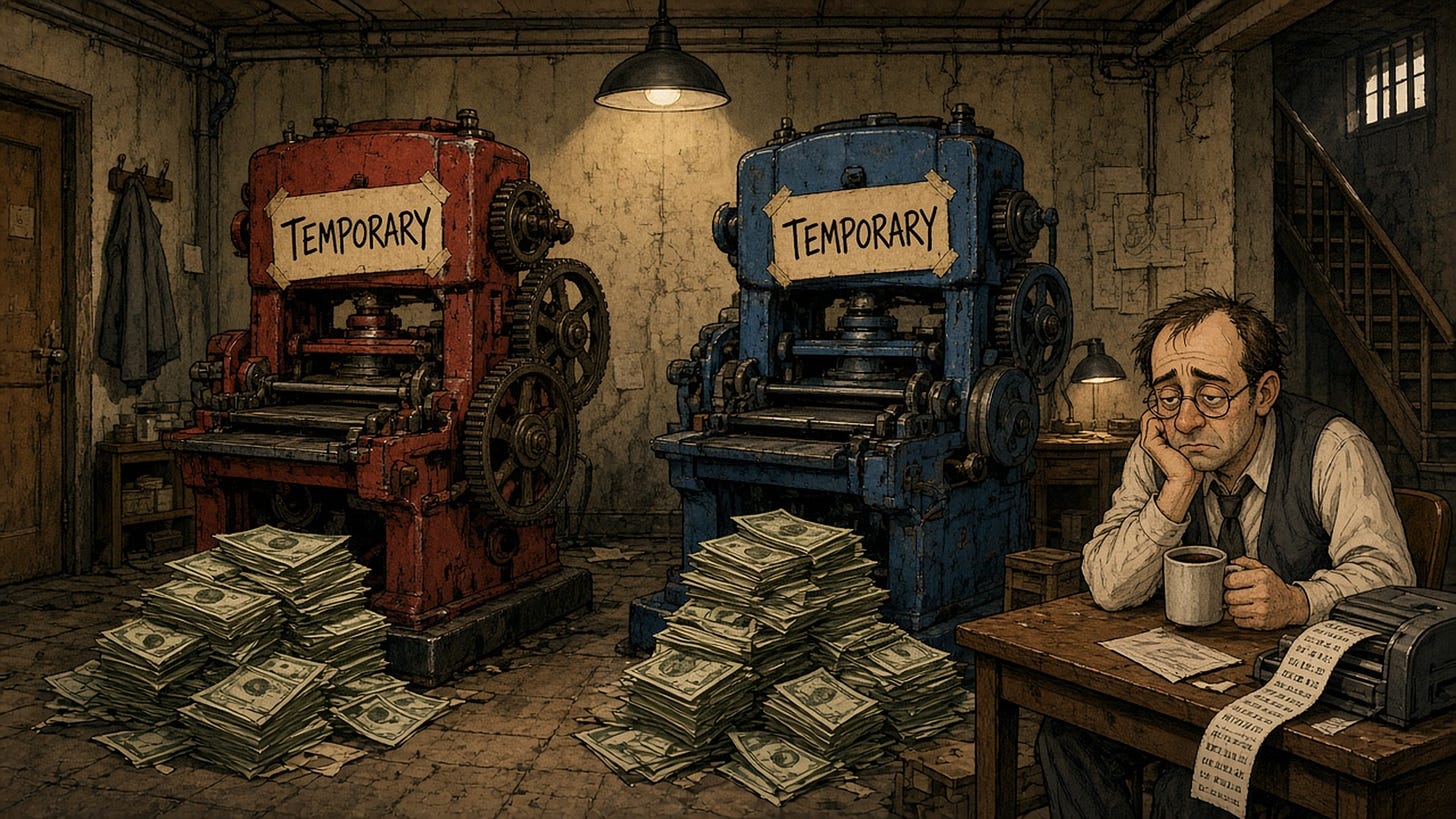
Cut to a basement. Two old printing presses stand side by side, one painted red and one painted blue. Somebody has taped a sign on each one: TEMPORARY. A tired clerk sits between them with a coffee mug, watching a ticker tape that never stops.
The red printer runs for tax cuts and defense. The blue printer, if the progressive wing of the Democratic Party gets its way, would run for ideas like Medicare for All, a universal basic income and the Green New Deal. To be fair, those weren’t in the 2024 Democratic platform. They belong to Senator Sanders, Representative Ocasio-Cortez, Mayor Mamdani and the Democratic Socialists. But they’re growing. In August 2025, Gallup found 66% of Democrats had a positive view of socialism.
Here are the price tags. Medicare for All would add at least $32.6 trillion in federal spending over ten years by the Mercatus Center’s estimate, or about $34 trillion by the Urban Institute’s. A universal basic income of $1,000 a month per adult would cost about $3 trillion a year, against total federal revenue of $5.4 trillion. One honest note: Mercatus’s own author also estimated Medicare for All could lower total national health spending under his assumptions. The issue isn’t whether health care gets cheaper overall. It’s who pays and how.
Scene 3: The word game

Cut to my reading chair. Here’s what I’ve come to believe: we’re playing a word game. Nobody quite knows what socialism means anymore, partly because we put the word “Democratic” in front of it, and that makes everybody relax. A plan imposed on everyone has the same economic effects whether a democracy votes it in or a dictator decrees it.
You don’t have to agree with me on every detail to see the practical point. Whatever we call it and whatever form it takes, when the promises grow faster than the taxes, the gap gets filled the same way: borrowing, and then printing. And printing is the opposite of affordability.
To be fair: Denmark and Sweden are generous and don’t run the printing press. They pay for their programs with high, broad taxes, including on the middle class, inside market economies. America’s trouble is wanting Nordic benefits at American tax rates. That’s a promise you can only keep with a printer.
Could the US elect openly socialist leadership by 2028? I think it very well could. That’s my concern, not a forecast. It’s a grey swan: likely enough to plan for, misunderstood enough that hardly anyone is. Polls point the same way: capitalism’s approval fell to a record-low 54% in 2025, and 41% of Americans under 30 viewed socialism positively in Pew’s 2022 survey.
Tell the truth—or, at least, don’t lie.
Jordan B. Peterson, 12 Rules for Life: An Antidote to Chaos (Random House Canada, 2018), title of Rule 8
Calling something by a softer name doesn’t change what it costs. The honest move is to say what we mean.
What we do know
Nobody knows exactly what a socialist America would look like. But here’s what we do know, whoever’s in charge:
Government moves slowly. TVA’s small reactor got its construction permit in 2026, and commercial power is projected for December 2033.
Waste is massive and measurable. GAO says federal agencies reported about $186 billion in improper payments in FY2025, up $24 billion from the year before. Since 2003 the total is about $3 trillion.
Medicaid alone had an improper payment rate of 6.12% in FY2025, or $37.4 billion, up from 5.09%.
Higher taxes hurt growth. Christina and David Romer’s study of postwar US tax changes found that a tax increase of 1% of GDP lowers real output by about 3% over the next three years.
More money chasing the same goods pushes prices up, as the 2020–2022 episode showed.
Now, a fair word, because I don’t want to be the guy who wags a finger. “Improper payment” doesn’t mean “fraud.” CMS says 77% of Medicaid’s FY2025 improper payments came from insufficient documentation, which generally doesn’t indicate fraud or abuse. Some of it is paperwork. Some is real fraud. All of it is money that didn’t do what it was supposed to do. Corruption is real, and so is red tape. Either way, the printed dollar leaks.
Scene 4: A walk through the museum of dead money
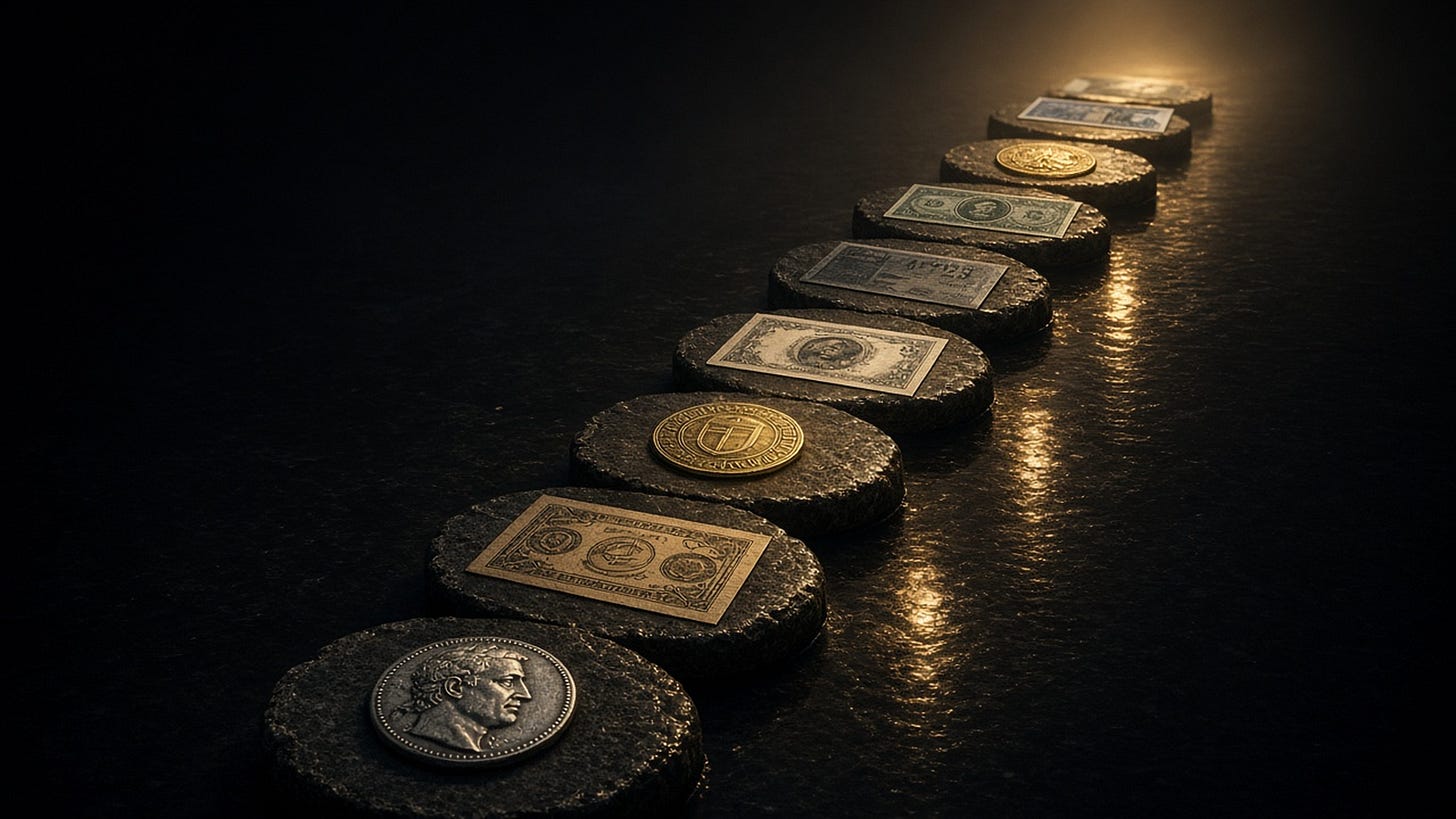
Cut to a museum. Glass cases, soft lighting, a guard who looks like he’s seen everything. The plaque at the entrance reads: “Every exhibit here was once someone’s life savings.”
Case 1, Rome. A silver denarius. Under Nero in AD 64, the coin went from about 98% silver to roughly 93%, and lab tests suggest some issues were as low as 80%. By Caracalla, around 214, it was about 50%. By the time Gallienus died in 268, Rome’s main silver coin, the antoninianus, held 5% silver or less, sometimes about 2.5%. Same face, same name, mostly copper. Emperors paid soldiers with it, the soldiers noticed, and prices climbed.
Case 2, China. The world’s first government paper money. The Song dynasty set up its Jiaozi Office in 1023 and issued its first official notes in 1024. War and money troubles led to overissue. The Yuan dynasty’s paper started out convertible to silver, then collapsed into inflation by the 1340s. The Ming issued notes from 1375 with no reserve and no redemption, and by about 1425 they were basically abandoned. That’s three dynasties, one lesson.
Case 3, Spain. In the 1500s, silver from the New World poured into Spain, and prices rose across Europe. Economists call it the Price Revolution. Then the Crown got creative. Starting in the late 1590s, it minted copper vellón coins, and in 1602 it stripped out the silver altogether. It re-stamped the coins at higher face values in 1603, 1636, 1641 and 1651 to pay its debts. A historian of the period calls it a hidden tax. It took reforms in 1680 and 1686 to end the mess. The richest empire on earth debased its own money.
Case 4, France, twice. First John Law’s System, 1716 to 1720: a bank, a trading company, paper notes and a stock bubble. By December 1720 the System had collapsed and thousands were holding worthless paper. Then the assignats, from 1789, paper money first backed by confiscated church land. War came, the printing kept going, and when the presses were publicly destroyed in Place Vendôme in February 1796, the notes had lost about 99.7% of their value.
Case 5, Weimar Germany. By November 1923, it took 4.2 trillion paper marks to buy one dollar. The new Rentenmark replaced them at one trillion to one. Honest label on this case: Weimar was war debt, reparations and the French occupation of the Ruhr. It wasn’t socialism. But the final step was the same: the central bank printed to pay the bills.
Case 6, Britain. This is the one that ought to make Americans sit up, because it’s a reserve currency dying slowly, with good manners. In 1956, during Suez, the US refused to back IMF support for sterling until Britain withdrew from Egypt, and Britain withdrew. [VERIFY: source is a secondary history; confirm with a standard account] On November 18, 1967, the pound was devalued from $2.80 to $2.40, about 14%, and Prime Minister Harold Wilson told the nation that didn’t mean “the pound here in Britain, in your pocket” had been devalued. In 1976, Britain needed a $3.9 billion IMF loan, the largest in the Fund’s history at the time, and accepted spending cuts to get it.
Case 7, the United States. In April 1933, Executive Order 6102 required Americans to turn in their gold. In January 1934, the Gold Reserve Act and a proclamation reset gold from $20.67 to $35 an ounce, cutting the dollar’s gold value to 59% overnight. On August 15, 1971, President Nixon closed the gold window, and the world’s money became fiat money. By the BLS’s CPI calculator, $1 from January 1913 had the same buying power as $33.19 in January 2026. Put another way, today’s dollar buys about 3 cents’ worth of 1913 goods.
Case 8, the modern wing. Venezuela, where the IMF projected 1,000,000% inflation in 2018. Zimbabwe, where monthly inflation hit 79.6 billion percent in November 2008. Argentina, at 211% in 2023. Turkey, at 85.5% in October 2022. Lebanon, whose pound had lost more than 98% of its pre-crisis value by February 2023. Each had other causes too: oil prices, land seizures, sanctions, banking collapse. But in every case, the printing press was the last stop.
The guard walks me to the exit. “Folks always say theirs is different,” he says. “Some of them are right. For a while.”
Here’s what stuck with me on the walk out. History’s museum is full of currencies that were debased until they lost most or all of their value. Every one of them belonged to a power that once thought it couldn’t happen to them. So the question I keep asking isn’t if, it’s when. That’s a classic grey swan: very likely over time, and very few people preparing for it.
Many people believe the answer is an asset and a currency that can’t be printed or inflated away. I’m one of them, and my conviction is that there’s only one choice: bitcoin. You’re free to disagree with me, and plenty of smart people do. But walk the museum first.
And here’s something I didn’t expect to write this soon: even Washington is starting to hedge. On October 28, Bitcoin Magazine reported that Senator Bill Hagerty said growing the U.S. Strategic Bitcoin Reserve beyond its current 200,000 BTC (Bitcoin Magazine’s figure) “could come very soon.” There’s a big string attached. He tied it to Congress first getting crypto market structure legislation done, and that bill hasn’t passed. So it isn’t happening yet. But when a sitting U.S. senator talks about adding to a bitcoin reserve, the guard at the museum might want to save a spot by the door.
The timeline
WhenWhereWhat happenedAD 64–268RomeSilver coin went from about 98% to 5% or less1024–1425Song, Yuan, Ming ChinaFirst paper money; repeated overissue and collapse1597–1686Spain (Castile)Copper vellón, re-stamping, inflation1716–1720FranceJohn Law’s System collapses1789–1796FranceAssignats lose about 99.7%1923Germany4.2 trillion marks per dollar1933–1934United StatesGold surrendered; $20.67 to $351956–1976BritainSuez, 1967 devaluation, IMF loan1971United StatesGold window closed2008Zimbabwe79.6 billion percent a month2018–2023Venezuela, Turkey, Lebanon, ArgentinaHyperinflation or currency collapse
The biggest grey swan: fiat money doesn’t last forever

Grey Swan defines a grey swan as something 80% likely to 100% inevitable, yet misunderstood or unplanned for. Over a long enough time, I’d put the decline of any fiat currency in that box.
Here’s an observation, not a law of physics. Going back to the 1400s, the world’s main reserve currencies have belonged to Portugal (about 80 years), Spain (about 110), the Netherlands (about 80), France (about 95) and Britain (about 105). That’s an average of about 94 years. The dollar’s run began around 1920, so it’s past 100. This framing traces to an investment bank study cited by the Hong Kong Monetary Authority in 2005 and to a widely shared JPMorgan chart.
Ray Dalio, founder of Bridgewater, studied 500 years of empires in his book Principles for Dealing with the Changing World Order. His conclusion, in his own words:
It is also the case that all reserve currencies in the past have ceased to be reserve currencies, often coming to traumatic ends for the countries that enjoyed this special privilege.
Ray Dalio, The Changing World Order (2020 introduction, published via economicprinciples.org)
Now let me be fair, because this is where people sell newsletters. The US dollar hasn’t collapsed. It’s still the world’s main reserve currency, and many good economists think it will stay that way for a long time because there’s no ready replacement. Europe, China and Japan all have problems of their own. A slow loss of buying power isn’t a collapse. I’m not predicting a date. I’m saying history has never yet produced a fiat currency that lasted forever, and almost nobody’s plan includes that possibility. That’s what makes it a grey swan.
Interlude: Whose image is on the coin?
Cut to a courtyard in Jerusalem, about AD 30. A group of men who don’t usually get along have teamed up to trap a rabbi. They ask Jesus whether it’s right to pay taxes to Caesar. Say yes, and the crowd turns on him. Say no, and Rome does. He asks for a coin, a silver denarius, and holds it up. He asks them a question.
Whose image is this? And whose inscription? … So give back to Caesar what is Caesar’s, and to God what is God’s.
Jesus
They answered, “Caesar’s.” I’ve spent a lot of my life studying theology, and I’ve come to read the Bible less as a magic rulebook and more as the record of how Jesus lived, so we can follow. Watch what he does here. He doesn’t give a lecture on monetary policy. He just points at whose face is on the money. Caesar stamped his image on that coin. And remember Case 1 in the museum: over the next two centuries, Caesar’s successors kept the face and quietly drained the silver out from behind it.
Our dollars carry a different face, but they’re still Caesar’s money. The state issues them, and the state can print more of them whenever it decides to. So I render it. I pay my taxes, and I use the dollar every day. But the coin in Jesus’s hand carried Caesar’s image, and the people holding it carried God’s. That’s the part I try not to lose track of.
No one can serve two masters. Either you will hate the one and love the other, or you will be devoted to the one and despise the other. You cannot serve both God and money.
Jesus
I’m still working out what that means for me. I’ll just leave the question where he left it: whose image is on the thing you’re trusting?
Scene 5: Bitcoin, humbly

Cut to my kitchen table. One window shows the Debt to the Penny page. Another shows a bitcoin wallet. Bitcoin has a fixed supply of 21 million coins. Nobody can type more of them into a screen. That’s its whole pitch, and it’s the opposite of everything in the museum.
Humility, though. Bitcoin is volatile, and it fell hard in 2022. Studies find it’s a weak hedge against month-to-month inflation. It’s better understood as a bet against long-run money expansion. JPMorgan’s asset management arm now projects about 10% a year for bitcoin over the next decade in its base case, and it calls bitcoin a “bet on fiat currency expansion.” Jamie Dimon himself has said he’s not a fan. So the sensible answer is to allocate, not bet the farm.
Complexity is the enemy of execution.
Tony Robbins, quoted by CNBC, ‘Tony Robbins: The one thing all top investors do,’ Nov 14, 2014 (from MONEY: Master the Game)
That’s true of personal finance, and it’s true of government. Fewer layers, fewer leaks.
Scene 6: The fork in the road

Cut to a gravel road in Arkansas at dusk. It splits in two. On the left, the fog rolls over a maze of filing cabinets tied up in red tape. That’s where a lot of printed dollars go to get lost. On the right, the porch lights are on at a brick care center. Caregivers sit with residents in wheelchairs. Past the trees, a small power plant hums.
Same printed dollars. Two roads. One leaks away. The other builds something that can stand on its own.
What story do I want to tell?
Andy Stanley, Better Decisions, Fewer Regrets (Zondervan, 2020), Chapter 3, ‘The Legacy Question’
Stanley asks that about personal decisions, but it works for a country, too. Fifty years from now, when somebody tells the story of what America did with all those trillions, what do we want it to say?
Coming Monday: the printing press, used for good
Here’s where I’ve landed. Money printing is coming. It’s a grey swan, close to certain and mostly unplanned for. Government won’t stop printing just because I write a Substack post. So if the press is going to run, let’s at least point it at something that pays for itself.
Monday’s post lays out a self-funding beta test. The government lends printed money, and Arkansas’s Human Development Centers, the state homes for people with developmental disabilities, where my son Gentry lives, get funded. Here’s what it would do:
Support residents with steady new funding, starting during construction, not years later.
Add pay and benefits for caregivers, including an on-site bitcoin mining benefit. One Kentucky company that tried this, BlueCotton, says turnover fell from 108% to 17%, a drop of about 84%. [VERIFY quotes against the Coin Stories audio]
Provide backup power for surrounding counties: the miners shut off in seconds when the grid needs the power.
Create education partnerships with Conway’s universities, UCA, Hendrix College and Central Baptist College. None of them has been contacted yet.
Offer a model that HDCs and special needs communities in other states can copy.
Repay the loan, then become self-funding.
Printing money for corruption, or printing money for special needs, communities and counties. On Monday, you decide which is better.
Teaching Outline (Summary)
Money printing is mostly keystrokes, not paper: deficit spending, Fed reserve creation (QE) and bank lending. Paper currency is about 11% of M2.
The Fed’s balance sheet went from $4.2 trillion in 2020 to $8.9 trillion in 2022; it’s $6.75 trillion today.
Both parties run the press: the debt is $40.4 trillion and the FY2026 deficit was about $2 trillion.
Whatever we call socialism, promises that outrun taxes lead to borrowing, then printing, which is the opposite of affordability.
Waste is real and measurable: about $186 billion in federal improper payments in FY2025, though improper doesn’t always mean fraud.
History’s lesson: from Rome to Weimar to Lebanon, debased currencies follow the same path, and reserve currencies have historically lasted about a century.
The decline of fiat money is a grey swan; bitcoin’s fixed 21 million supply is a hedge to size humbly, not a bet to make blindly.
If the press will run anyway, aim it at something self-funding, like Monday’s HDC plan.
1.Where have you felt money printing in your own budget?
2.Does putting “Democratic” in front of socialism change what it costs?
3.If you could direct $1 billion of printed money, what would you build that pays for itself?
Every paying member receives the full teaching outline, in much greater detail, free of charge. See What Do Paid Members Get? below.
Practical What To Do Next
1.Look up the debt yourself. Search “Debt to the Penny” on fiscaldata.treasury.gov. It takes 30 seconds and it’s better than coffee for waking you up.
2.Pay down variable-rate debt first. If printing pushes inflation and rates up, that debt gets more expensive.
3.Keep 6 to 12 months of cash for emergencies, and accept that it will lose a little each year.
4.If you hold bitcoin, size it so a 50% drop wouldn’t change your life, and learn self-custody or collaborative custody.
5.Ask your representatives one question: what specific waste will you cut before you print another dollar? Cite GAO’s $186 billion.
6.Read Monday’s post, and forward it to anyone you know who cares for someone with special needs.
Why Grey Swan is Different
Most people use “black swan” for the shock nobody saw coming. We care about the grey swan: something 80% likely to 100% inevitable, yet misunderstood or unplanned for. Money printing is one. The slow decline of fiat money is another. Markets have them. So do families, health, faith, legal and tax matters. Grey Swan widens the idea from markets to individuals and communities, because the most inevitable events in your life usually aren’t on CNBC.
You can copy us, but we’re first. We’re not inventing the dictionary; we’re creating the definition. And we try to do it the way this post does: with humility, a sense of humor, plain English and no finger-wagging. We show the process, not just the verdict.
About Grey Swan
Grey Swan Capital is written by Steve Schroeder, a Jesus Follower with a PhD in apologetics and theology. As a paying member, you can choose any cause you want to support, and half of your membership goes to the cause you choose. Email me at steve@greyswancapital.ai with your cause. If you don’t pick one, it goes to Arkansas’s Human Development Centers (HDCs), which we write about often and which do important, necessary work, including the Conway HDC (code GSC-HDC), where my son Gentry lives. Arkansas’s five state-run HDCs provide 24-hour residential care, therapy and support for Arkansans with severe intellectual and developmental disabilities. We keep coming back to them because their work is vital and too often overlooked, and your support helps special-needs individuals across Arkansas, plus their parents, caregivers and communities. You’ll meet them properly in Monday’s post.
Free
Posts like this one.
Junior
$6 a month or $50 a year.
Founding
A year paid in advance, price locked, and half goes to a cause you name.
What Do Paid Members Get?
Paying members can choose any cause they want to support: half of your membership goes to the cause you choose. Just email Steve at steve@greyswancapital.ai. If you don’t pick one, it goes to Arkansas’s Human Development Centers (HDCs), which we write about often and which do important, necessary work (Conway HDC, code GSC-HDC). Arkansas’s five state-run HDCs provide 24-hour residential care, therapy and support for Arkansans with severe intellectual and developmental disabilities. We keep coming back to them because their work is vital and too often overlooked, and your support helps special-needs individuals across Arkansas, plus their parents, caregivers and communities.
Give back
Half of your membership goes to the cause you choose; if you don’t pick one, it goes to Arkansas’s HDCs.
Learn
Everything we publish · Full teaching outlines · Full research briefs with every source and number · A Personal Grey Swan Plan worksheet · Ready-to-send letter templates, like the county SMR letter
Stay ahead
Monthly Grey Swan Watch on the grey swans we’re tracking · Quarterly Grey Swan Scorecard of what we called right and wrong · A behind-the-scenes look at how Steve runs Grey Swan with AI agents
Connect
Monthly Ask Steve Q&A · Live quarterly call with Steve and Jonathan · In-person meetings · Discounted consulting · Founding member wall with names and chosen causes · Early or extended cuts of The Hornet’s Nest podcast · Monthly letter on where cause money went
Save
Our custom Nostr client is in development. In the meantime, paid members will get a personal QR code for free items like pizza, bowling, golf and appetizers at partner locations, which we’re signing up now.
And we keep adding more.
Grey Swan Capital · greyswancapital.substack.com · steve@greyswancapital.ai
Sources
Treasury, Debt to the Penny (Oct 22, 2026): fiscaldata.treasury.gov
CBO, Monthly Budget Review, September 2026: cbo.gov/publication/61985; CNBC, Oct 16, 2026: cnbc.com/2026/10/16/us-budget-deficit-2026.html
American Action Forum, FY2026 deficit: americanactionforum.org/insight/cbo-fy-2026-budget-deficit-totaled-2-trillion/
Federal Reserve, Monetary Policy Report, Feb 2022 ($4.2T to $8.9T): federalreserve.gov/monetarypolicy/2022-02-mpr-part2.htm
Federal Reserve, H.4.1 (Oct 22, 2026; total assets $6,753,604M): federalreserve.gov/releases/h41/current/
Federal Reserve, H.6 Money Stock Measures (Oct 27, 2026): federalreserve.gov/releases/h6/current/default.htm
FRED, M2 year-over-year (Sep 2026, 5.7%): fred.stlouisfed.org/series/M2SL
Bank of England, Money creation in the modern economy (Quarterly Bulletin 2014 Q1): bankofengland.co.uk
GAO-26-108694, improper payments FY2025: gao.gov/assets/gao-26-108694.pdf
CMS, FY2025 Improper Payments Fact Sheet: cms.gov/newsroom/fact-sheets/fiscal-year-2025-improper-payments-fact-sheet
Romer and Romer, The Macroeconomic Effects of Tax Changes, American Economic Review (2010): aeaweb.org/articles?id=10.1257/aer.100.3.763
Mercatus, costs of single-payer: mercatus.org/research/working-papers/costs-national-single-payer-healthcare-system
UBI Center, cost of UBI: ubicenter.org/what-is-ubi/why-not-ubi/
Gallup, Image of capitalism slips (Sep 2025): news.gallup.com/poll/694835/image-capitalism-slips.aspx
Pew, views of socialism and capitalism (Sep 2022): pewresearch.org/politics/2022/09/19/
2024 Democratic Party platform: presidency.ucsb.edu/documents/2024-democratic-party-platform
Roman coinage: Butcher and Ponting, The Denarius in the First Century (warwick.ac.uk); Molecules 27(20):6903 (mdpi.com/1420-3049/27/20/6903); CoinWeek, Decline of Roman Imperial Silver Coinage
China paper money: Hoover Institution, The Rise and Demise of Paper Money in Imperial China (hoover.org); NBER w16092
Spain: Hamilton, American Treasure and the Price Revolution in Spain, 1501–1650 (Harvard); CSIC, resellos of vellón (hdl.handle.net/10261/229726); Jefferies, City Research Online
France: Velde, John Law’s System, Chicago Fed WP 2003-31 (fraser.stlouisfed.org); Historic New Orleans Collection (hnoc.org); Derejski, Depreciation of French assignats (Lodz University Press, 2025); Banque de France, Fiscal roots of hyperinflation
Weimar: Bundesarchiv, Akten der Reichskanzlei; Deutsches Historisches Museum LeMO, Währungsreform 1923
Britain: House of Commons Library, “Pound in your pocket” devaluation: 50 years on; BBC On This Day, Nov 19, 1967; 1976 IMF loan (Sky History; Wikipedia, 1976 sterling crisis)
United States: Federal Reserve History, Gold Reserve Act of 1934 and Nixon Ends Convertibility (federalreservehistory.org); Proclamation 2072 (presidency.ucsb.edu)
BLS CPI Inflation Calculator, Jan 1913 to Jan 2026: data.bls.gov/cgi-bin/cpicalc.pl
Venezuela: Reuters, Jul 2018. Zimbabwe: Hanke and Kwok, Cato Journal (2009). Argentina: Reuters, Jan 11, 2024
Turkey: Reuters, Nov 3, 2022; Central Bank of Turkey, October 2022 Price Developments. Lebanon: World Bank Lebanon Economic Monitor (2023); AP News
Reserve currency durations: Hong Kong Monetary Authority, Insight, Jan 6, 2005 (hkma.gov.hk); Financial Times via Financial Post
Ray Dalio, The Changing World Order (2020): asiabusinesscouncil.org PDF; economicprinciples.org
JPMorgan Asset Management bitcoin outlook: coindesk.com, Oct 20, 2026; Dimon comments: cryptoslate.com
Bitcoin 21M supply: bitcoin.org/en/faq
The Holy Bible, New International Version (NIV, 2011): Matthew 6:24; Matthew 22:15–22; Mark 12:13–17; Luke 20:20–26 (biblegateway.com)
Andy Stanley, Better Decisions, Fewer Regrets study guide: andystanley.com/wp-content/uploads/2020/10/Better-Decisions-Study-Guide.pdf
Jordan B. Peterson, 12 Rules for Life (Penguin Random House extract): penguinrandomhouse.co.za/wp-content/uploads/extract12rulesforlife.pdf
Tony Robbins on CNBC, Nov 14, 2014: cnbc.com/2014/11/14/tony-robbins-the-one-thing-all-top-investors-do.html
Bitcoin Magazine on X, Sen. Bill Hagerty on growing the Strategic Bitcoin Reserve (Oct 28, 2026): x.com/BitcoinMagazine/status/2115529232814318036
Originally published on Substack on October 29, 2026: https://greyswancapital.substack.com/p/which-is-better-printing-money-for. This copy is kept on our own site so the work stays in our hands.
Watch Eva and Grok
Eva (pronounced YEH-vuh) and Grok are AI characters. Their story is fiction. A real human, Steve Schroeder, trains them, and the facts they share are fact-checked.
Eva and Grok page: https://home.greyswancapital.ai/eva-and-grok/. YouTube channel: https://www.youtube.com/@membershiprewards365. Episode 1: https://youtu.be/UHU50rTGGwo. Episode 2: https://youtu.be/fG0_00uJVso. Episode 3: https://youtu.be/oVchWFr5iqY. Episode 4: https://youtu.be/Dj7YKMhNBCs.
Follow free on Substack at greyswancapital.substack.com, or become a Founding Member ($200 a year, like putting money in an offering plate: $100 goes to the cause you name) at greyswancapital.ai/founding-membership.
All articles Press releases Home
Thank you.